Puppies are born with very little of their own immune protection — colostrum in the first hours of life is what fills that gap, and the window for it to work properly is narrower than many breeders expect.
The most important first
- Dogs’ placenta type transfers minimal antibodies in the womb, so colostrum after birth is the primary source of a puppy’s early immunity.
- Antibody absorption is most efficient right after birth, drops sharply by 8–12 hours, and has largely stopped by about 24 hours — this is often called “gut closure.” Every puppy must nurse within the first 24 hours.
- Puppies should nurse as soon as possible after birth, ideally within the first couple of hours.
- Steady weight gain and settled sleep between nursing bouts are the practical signs that nursing and colostrum intake are going well.
- Orphaned litters, agalactia, or a delayed first nursing after a C-section are the main situations where colostrum supplementation needs consideration.
Why colostrum matters so much in dogs
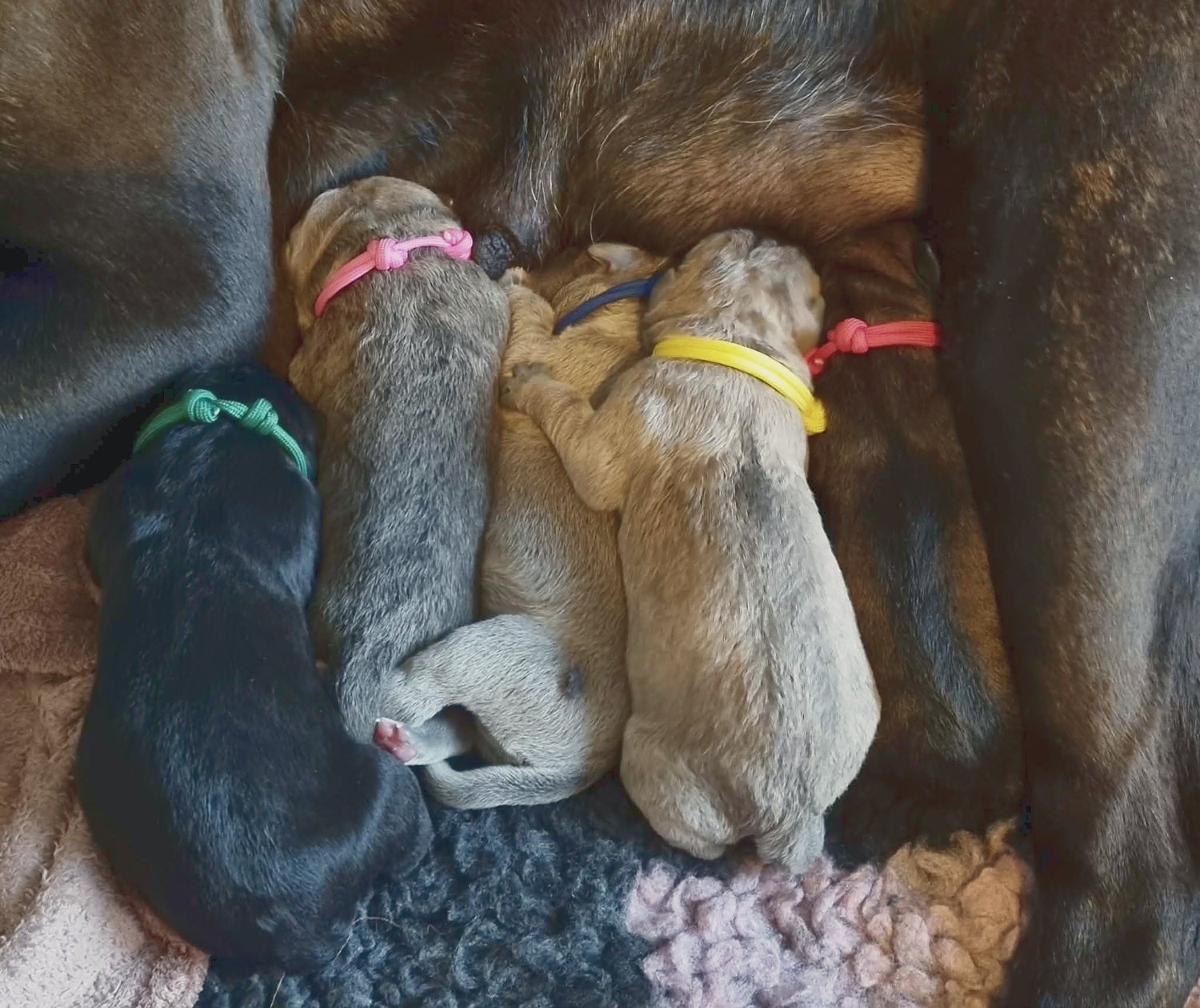
Unlike species where more antibody transfer happens across the placenta before birth, the canine placenta allows only minimal transfer of maternal antibodies in utero — puppies are born with very little circulating immune protection of their own. Colostrum, the first milk, is rich in antibodies and is effectively the main way a newborn puppy gets passive immunity in these first days, making it far more important here than it might be for a human newborn.
The absorption window: why timing matters
A newborn’s gut can absorb large antibody molecules intact for only a limited window. Absorption is best in the first hours after birth and starts to fall within 4–8 hours, is roughly halved by 8–12 hours, and has stopped by about 24 hours, a process often described as “gut closure.” Every hour counts, so the goal is for each puppy to nurse within the first couple of hours and to keep nursing often through the first day. This is why getting puppies nursing promptly matters so much: colostrum consumed after the gut has closed provides far less immune benefit than the same colostrum consumed in the first hours.
In practice
A breeder whose litter arrived by planned C-section is focused on recovery and doesn’t get puppies nursing until several hours after birth, once the dam is more alert. Understanding that the absorption window is narrowing throughout this delay is what prompts the breeder to prioritize getting puppies latched as soon as it’s safely possible, rather than waiting until everyone is fully settled.
(Illustrative, composite scenario.)
Signs nursing and colostrum intake are going well
A puppy that’s nursing effectively typically settles and sleeps quietly between feeds, and shows steady weight gain from day to day — this ties directly into the tracking covered in the neonatal assessment score sheet and weighing and tracking growth. Persistent crying, restlessness, or a puppy that isn’t gaining weight are reasons to check nursing more closely, not signs to wait out.
Even with a healthy dam, some puppies get too few antibodies. Research shows that poor weight gain over the first two days is one of the clearest signs of this, so weighing at birth and again over the first 48 hours tells you more than watching alone. Colostrum quality also varies between teats, so it helps for puppies to move around the dam rather than always feeding at the same place.
When supplementation needs considering
Situations that call for extra attention to colostrum intake include orphaned puppies with no dam available, agalactia (the dam producing no milk), and any situation — such as a difficult C-section — where the first nursing is meaningfully delayed. In these cases, a vet can advise on colostrum-replacement options; this isn’t something to improvise without guidance, given how much the timing and quality of what’s given matters.
Ordinary puppy formula provides food but no antibodies, so it can’t replace colostrum. Call your veterinarian promptly if a puppy hasn’t nursed within a few hours of birth, if the dam has little or no milk, or if puppies are orphaned or can’t be put to the dam after a cesarean. Within the first day, a vet can give antibodies from a healthy adult dog and, if needed, run a blood test to check whether a puppy received enough. These options work best early, so don’t wait to see how things go.
Protecting an immature immune system
A newborn’s own immune defenses take time to develop, and stay immature for roughly the first ten days. Keep the whelping area clean, wash your hands before handling puppies, and keep visiting and unvaccinated dogs away from the litter.
When to call your vet
- A puppy hasn’t nursed within a few hours of birth — colostrum must go in within the first 24 hours, and absorption has largely stopped by then.
- The dam has little or no milk, or won’t let the puppies nurse.
- Puppies are orphaned, or can’t be put to the dam soon after a cesarean.
- A puppy loses weight over the first two days — a common sign of too little colostrum.
- The dam has a temperature above 103 °F (39.5 °C), or hot, hard or painful mammary glands.
- Any newborn that cries constantly, feels cool or suckles weakly.
- If in doubt, call — your vet would rather hear from you early.
Work on it
A few minutes here will teach you more than re-reading the article.
Ask yourself
- Do I know how soon after birth each puppy in my last litter actually started nursing?
- Would I recognize the signs that a puppy isn’t getting enough colostrum or milk?
- Do I have a plan for what to do if nursing is delayed for any reason?
Find out & check
- Find out your vet’s recommended approach if a puppy needs colostrum supplementation, before you need it.
Do one thing
- Note the time each puppy first nurses at your next litter, and flag any delay beyond the first couple of hours.
Was this article helpful?
Anonymous. We do not store your name, email or IP address.
Sources & further reading
- Merck Veterinary Manual — Management of the Neonate in Dogs and Cats. merckvetmanual.com
- Chastant-Maillard S. et al. — Timing of the intestinal barrier closure in puppies, Reproduction in Domestic Animals 2012;47 Suppl 6:190–193. doi.org
- Mila H. et al. — Inadequate passive immune transfer in puppies: definition, risk factors and prevention in a large multi-breed kennel, Preventive Veterinary Medicine 2014;116:209–213. pubmed.ncbi.nlm.nih.gov
- Mila H. et al. — Immunoglobulin G concentration in canine colostrum: evaluation and variability, Journal of Reproductive Immunology 2015;112:24–28. doi.org
- Pereira KHNP et al. — Neonatology: Topics on Puppies and Kittens Neonatal Management to Improve Neonatal Outcome, Animals 2022;12(23):3426. mdpi.com
- Lawler DF — Neonatal and pediatric care of the puppy and kitten, Theriogenology 2008;70:384–392. confluence.cornell.edu (PDF)
- American Kennel Club — Raising Newborn Puppies. akc.org
Where evidence is limited, recommendations rest on established practice and expert judgment, and may be updated as knowledge develops.
Next steps
- Read next: Nursing and monitoring milk intake.
- Related: Warmth and the whelping-box microclimate.
- Return to the area hub: The neonatal period.