Knowing what a healthy newborn puppy actually looks like and does — reflexes, temperature, behavior — is the baseline you need before you can recognize when something’s off.
The most important first
- Healthy newborns show three key reflexes: rooting toward warmth or the dam, suckling, and a righting reflex.
- Eyes stay closed until roughly 12 to 14 days old, and ears open at around two weeks — this is normal, not a delay.
- A newborn’s body temperature runs markedly lower than an adult’s — about 95–99 °F (35–37.2 °C) in week one, gradually rising over the following weeks.
- Puppies sleep for the large majority of the day, often twitching during sleep (“activated sleep”) — this is normal, not a seizure.
- A veterinary check in the first 24 to 48 hours is recommended to screen for congenital issues like cleft palate or umbilical hernia.
Reflexes to expect
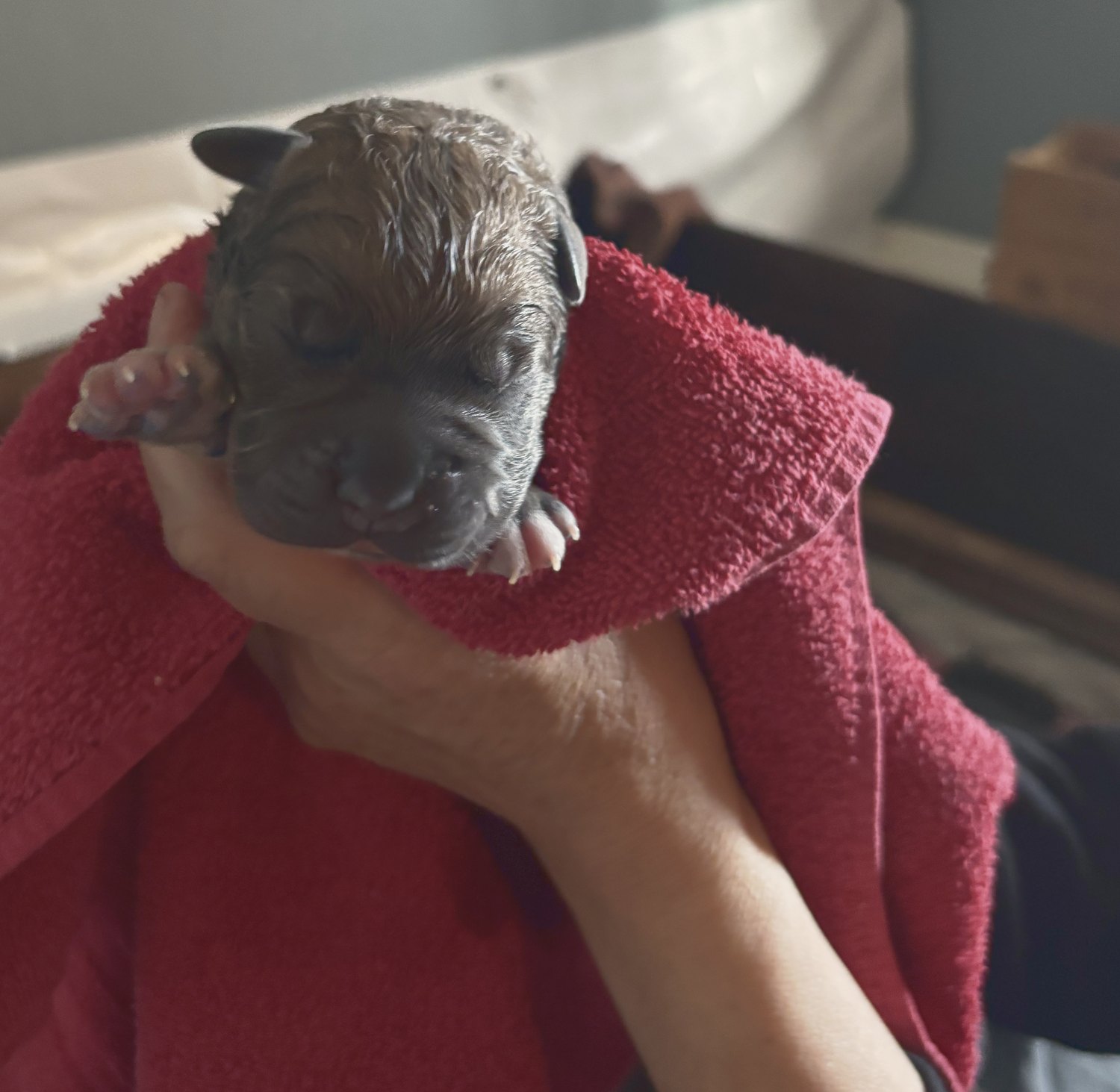
A healthy newborn shows the rooting reflex (moving toward warmth or the dam), the suckle reflex, and a righting reflex (working to turn itself upright if placed on its back or side). These reflexes are present from birth and are part of what’s checked in the first assessment right after delivery.
Eyes, ears, and early senses
Puppies are born with their eyes and ears closed, and this is entirely normal — the eyes typically open at around 12 to 14 days of age, and the ears at around two weeks (a practice-based estimate rather than a fixed figure). There’s no need to intervene or worry if eyes are still closed in the first week or so; this is simply the normal developmental timeline.
Temperature: lower than you’d expect
A newborn puppy’s normal body temperature is noticeably lower than an adult dog’s — normally around 95–99 °F (35–37.2 °C) in the first week, rising to about 97–100 °F (36–38 °C) in weeks two and three, and reaching adult levels around four weeks as the puppy’s ability to regulate its own temperature matures. This is why the ambient temperature of the whelping box matters so much in these early weeks, covered in detail in warmth and the whelping-box microclimate.
In practice
A new breeder takes a puppy’s temperature and is alarmed to see a reading that would be a fever-level concern in an adult dog. Recognizing that newborn puppies run substantially cooler than adults as a normal baseline — not a sign of illness — reframes the same number as reassuring rather than alarming.
(Illustrative, composite scenario.)
Normal behavior and breathing
Expect a healthy newborn to spend the vast majority of its time asleep, waking mainly to nurse, with muscle twitching during sleep (sometimes called “activated sleep”) that’s a normal part of neonatal development rather than a seizure. Normal heart rate is around 180–200 beats per minute, sometimes a little higher; a rate well below this is a warning sign, often from chilling. A normal respiratory rate falls roughly between 15 and 35 breaths per minute.
Hydration is hard to judge from the skin in newborns. A more useful clue is urine: it should be pale and almost colorless when you stimulate the puppy to urinate. Dark yellow urine suggests the puppy isn’t getting enough fluid.
The umbilical cord
If the dam hasn’t dealt with the cord, it can be tied off and trimmed to about 1 cm (under half an inch) from the belly, then dabbed with an iodine solution your veterinarian recommends. The stump should be dry within about a day. Have it checked if it stays moist, becomes red or swollen, smells, or hasn’t dropped off within about a week, as umbilical infections can spread quickly in newborns.
Weighing in the first days
Tracking weight at birth, then again around 12 and 24 hours, and daily after that, is the most useful early check that a puppy is doing well — covered in more detail in weighing and tracking growth.
What is not normal
Call your veterinarian if a puppy feels cool to the touch, cries for long stretches, won’t latch or suckles weakly, lies away from the dam and litter, has pale, gray or bluish gums, or has milk bubbling from its nose during or after nursing (a possible sign of cleft palate). Any one of these is enough reason to call.
By contrast, a healthy newborn feels plump and firm, has pink, moist gums, squirms and complains when handled, and settles quietly after a feed with a round, full belly.
When to call your vet
- A puppy feels cool, or its rectal temperature is below about 95 °F (35 °C) in week one.
- Milk bubbling from the nose during or after nursing — a possible cleft palate.
- Pale, gray or bluish gums, or a puppy that won’t latch or suckles weakly.
- Long stretches of crying, or a puppy lying apart from the dam and litter.
- An umbilical stump that is red, swollen, wet or smelly, or hasn’t dropped off within about a week.
- Dark yellow urine, or weight below 1.5 × birth weight by day 7.
- If in doubt, call — your vet would rather hear from you early.
Work on it
A few minutes here will teach you more than re-reading the article.
Ask yourself
- Would I recognize a newborn’s normal (lower) temperature range, rather than judging it against adult norms?
- Do I know roughly when eyes and ears should open, so I don’t worry unnecessarily or miss a genuine delay?
- Am I weighing each puppy in the first 24 hours and daily after that?
Find out & check
- Find out whether your vet wants to see the litter within the first 24–48 hours or has a different preferred timeline.
Do one thing
- Book the first litter vet check now, if you haven’t already, rather than waiting until after the puppies arrive.
Was this article helpful?
Anonymous. We do not store your name, email or IP address.
Sources & further reading
- Merck Veterinary Manual — Management of the Neonate in Dogs and Cats. merckvetmanual.com
- Lee JA, Society for Theriogenology — Critical Care of the Neonate, 2004. therio.org (PDF)
- Royal Canin Veterinary Academy (Vannucchi C.) — A quick guide to intensive care of newborn puppies. academy.royalcanin.com
- Royal Canin Veterinary Academy (Chastant S., ENV Toulouse) — Dealing with the sick newborn puppy. academy.royalcanin.com
- University of Illinois, ANSC 207 — Puppy Development (lecture notes). illinois.edu
- Bowles D, dvm360 — Care of the canine and feline neonate, part 2 (Proceedings), 2010. dvm360.com
- The Royal Kennel Club — Whelping your first litter. royalkennelclub.com
- American Kennel Club — Raising Newborn Puppies. akc.org
Where evidence is limited, recommendations rest on established practice and expert judgment, and may be updated as knowledge develops.
Next steps
- Read next: The first assessment: Apgar-style scoring.
- Related: Newborn resuscitation at birth.
- Return to the area hub: The neonatal period.