Evidence summary
The question: How do the recognized animal-welfare frameworks — the Five Freedoms and the newer Five Domains model — actually apply to breeding dogs and the puppies they produce, and what does the evidence say about where breeding puts welfare at risk?
The most important first
- The Five Freedoms (1979) reframed welfare as more than the absence of cruelty; the Five Domains model (updated 2020) went further, asking not just how to avoid suffering but how to give animals positive experiences.
- Applied to breeding, the domains turn “is this dog okay?” into five concrete questions covering nutrition, environment, health, behavior, and the mental state those four produce.
- The strongest evidence of welfare risk in breeding concerns conformation-related inherited disorders — where selecting for appearance is linked to disease.
- A known constraint: owners often perceive the clinical signs of these disorders as “normal for the breed”, which lets problems persist.
- Use the frameworks as a structured checklist for reflection, not as a score.
From the Five Freedoms to the Five Domains
Modern animal-welfare thinking has a lineage worth knowing, because it explains why “the dog isn’t suffering” is no longer considered a high enough bar.
Rooted in a 1965 UK government inquiry (the Brambell report), the Five Freedoms were formalized by the UK Farm Animal Welfare Council in 1979 and revised in the 1990s. They defined welfare as freedom from hunger and thirst, discomfort, pain and disease, fear and distress, and freedom to express normal behavior. It was a landmark: welfare became about positive provision, not just the absence of cruelty.
The Five Domains model, first set out in 1994 by David Mellor and Cam Reid to grade how much research procedures affected animals, then refined by Mellor and colleagues and substantially updated in 2020, took the next step. It keeps four physical/functional domains — nutrition, physical environment, health, and behavioral interactions — and treats them as inputs to a fifth, the animal’s mental state. The shift matters: the goal is no longer only to minimize negative experiences but to promote positive ones — comfort, curiosity, the chance to do what dogs enjoy. For a breeder, that is the difference between puppies that are merely unharmed and puppies that are actively thriving.
The 2020 version made one change that matters directly to breeders. The behavior domain now includes interactions with people. How you and your helpers handle, talk to and spend time with your dogs counts as a welfare input in its own right, alongside food, housing and health.
The five domains, applied to breeding
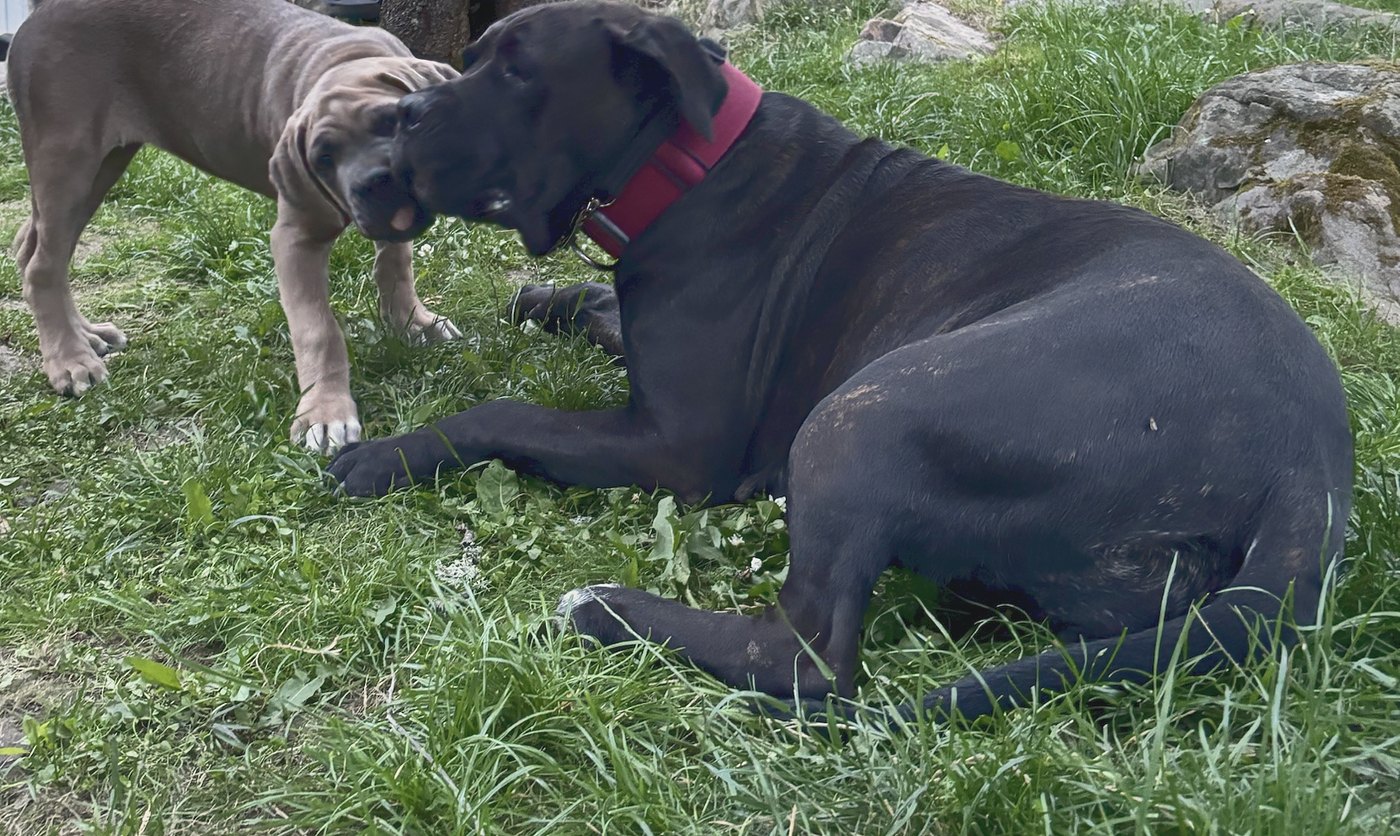
The value of the model for a breeder is that it turns a vague question — are these dogs and puppies doing well? — into five specific ones.
Nutrition. Is the pregnant and lactating bitch fed for her changing needs, and are puppies weaned onto appropriate food and growing well?
Physical environment. Is the whelping and rearing space warm, clean, safe and appropriately stimulating, rather than merely adequate?
Health. Are the breeding dogs screened and sound, and are puppies free of preventable disease and parasites — and are you breeding away from heritable health problems, not toward them?
Behavioral interactions. Can the dogs behave normally — bitch with pups, pups with littermates, all with people and a widening world — and are puppies getting the socialization and enrichment their development needs?
Mental state. Taken together, do the first four add up to animals that experience comfort, security and positive engagement — not just the absence of distress?
The fifth domain is the point of the whole model. Four boxes can look ticked while the mental picture still has a gap — which is exactly what the scenario below shows.
In practice
A breeder reviews their setup against the five domains and finds everything scores well except one thread: the puppies meet plenty of people, but almost no new surfaces, sounds or mild challenges. The four physical domains looked fine; the mental domain flagged what they hid. Two weeks of simple, varied exposure closes the gap — and the litter leaves more resilient for it.
(Illustrative, composite scenario.)
What the evidence says about welfare risk in breeding
Where the frameworks are principles, the sharpest evidence attaches to one issue in particular: conformation-related inherited disorders — health problems linked to breeding for particular physical features.
A widely cited review by Asher and colleagues (2009) documented 84 disorders in pedigree dogs associated with breed-standard-driven conformation, and found that every one of the 50 most-registered UK breeds had at least one — that is, selection for appearance carrying health costs. This is the empirical backbone of the ethical line drawn in Animal welfare and breeding ethics: the concern about exaggeration is not aesthetic preference, it is a welfare finding.
A second, subtler finding matters just as much for breeders. Research by Packer and colleagues (2012) found that owners frequently perceive the clinical signs of conformation-related disorders — labored breathing, for instance — as normal for the breed. That normalization is a constraint on welfare: a problem that looks normal does not get bred away from. It is the population-level cousin of the “kennel blindness” described in the foundation guide.
The normalization problem is well measured. In one UK hospital study, more than half of the owners whose dogs showed signs of obstructed breathing said their dog had no breathing problem. A 2019 survey of more than 2,000 Pug, French Bulldog and Bulldog owners found the same gap: fewer than one in five reported a breathing problem, although about two in five dogs had clinically relevant signs. For these breeds, the Respiratory Function Grading Scheme developed at the University of Cambridge gives breeders an objective test. Dogs are graded 0–3 after a short exercise test, and dogs graded 3 should not be bred.
How to use these frameworks — and their limits
Frameworks are lenses, not verdicts. Used well, the Five Domains give you a repeatable way to audit your own dogs and litters and to catch the gap the eye slides past. Used badly, they become a checklist ticked once and forgotten, or a false precision — a “welfare score” that implies more measurement than exists.
Two honest limits are worth stating. First, welfare science is still developing, and much of it comes from farm and companion-animal contexts that do not map perfectly onto a breeding kennel. Second, the models describe what to consider, not how much is enough — that judgment stays with the breeder, informed by evidence and expertise. Treat the domains as the questions you commit to asking every litter, not as a number that lets you stop thinking.
The model’s own authors warn against overstating it. The domains cannot be added up into a single welfare score, and some feelings are easier to judge from the outside than others. Use it as a structured checklist, not as a number.
Work on it
A few minutes here will teach you more than re-reading the article.
Ask yourself
- If I ran my current litter through the five domains, which domain is strongest — and which would flag a gap?
- Am I confident I can tell the difference between “normal for the breed” and “a sign of a problem the breed has normalized”?
- Do I audit welfare on a positive standard (are they thriving?) or only a negative one (are they suffering?)?
Find out & check
- Find out which conformation-related disorders are recognized in your breed, and how they present.
- Check your setup against each of the five domains in turn — write one line per domain for your current or next litter.
- Verify your health-screening choices against what the evidence recommends for your breed, not just what is required.
Do one thing
- Build a simple five-domain checklist for your own whelping and rearing, and use it once per litter.
Was this article helpful?
Anonymous. We do not store your name, email or IP address.
Sources & further reading
- Farm Animal Welfare Council (1979) — The Five Freedoms. Accessible summary: RSPCA Australia Knowledgebase, What are the Five Freedoms of animal welfare? https://kb.rspca.org.au/knowledge-base/what-are-the-five-freedoms-of-animal-welfare/
- Mellor DJ, Beausoleil NJ, Littlewood KE, McLean AN, McGreevy PD, Jones B, Wilkins C (2020) — The 2020 Five Domains Model: Including Human–Animal Interactions in Assessments of Animal Welfare. Animals 10(10):1870. https://doi.org/10.3390/ani10101870
- Mellor DJ (2016) — Updating Animal Welfare Thinking: Moving beyond the “Five Freedoms” towards “A Life Worth Living”. Animals 6(3):21. https://www.mdpi.com/2076-2615/6/3/21
- Asher L, Diesel G, Summers JF, McGreevy PD, Collins LM (2009) — Inherited defects in pedigree dogs. Part 1: Disorders related to breed standards. The Veterinary Journal 182(3):402–411. https://doi.org/10.1016/j.tvjl.2009.08.033
- Packer RMA, et al. (2012) — Do dog owners perceive the clinical signs related to conformational inherited disorders as ‘normal’ for the breed? A potential constraint to improving canine welfare. Animal Welfare 21(S1):81–93. https://doi.org/10.7120/096272812X13345905673809
- Packer RMA, O’Neill DG, Fletcher F, Farnworth MJ (2019) — Great expectations, inconvenient truths, and the paradoxes of the dog-owner relationship for owners of brachycephalic dogs. PLOS ONE 14(7):e0219918. https://journals.plos.org/plosone/article?id=10.1371/journal.pone.0219918
- University of Cambridge — Scheme launched to improve health of French bulldogs, pugs and bulldogs (Respiratory Function Grading Scheme). https://www.cam.ac.uk/research/news/scheme-launched-to-improve-health-of-french-bulldogs-pugs-and-bulldogs
- WSAVA Global Nutrition Committee — Body Condition Score chart, dog. https://wsava.org/wp-content/uploads/2025/06/WSAVA_BCSCat_BCSDog_Nutrition_250612.pdf
Method & limitations: This is an evidence summary of established welfare frameworks and selected peer-reviewed studies, written for breeders. It is not a systematic review. Welfare science continues to develop, and evidence specific to breeding kennels is more limited than for companion or farm animals; recommendations may be updated as knowledge grows.
Next steps
- Read next: Housing, husbandry and quality of life for breeding dogs — the domains applied to daily life.
- Related: Animal welfare and breeding ethics · Health screening and health schemes.
- Return to the area hub: Becoming a responsible breeder: the complete foundation.