Almost every confident number in a kennel catalog — square meters, decibels, lux — rests on a research base far thinner than the confidence suggests, and knowing which parts are solid changes what is worth spending money on.
The most important first
- The strongest finding in this literature is not about buildings. Positive contact with people, and compatible company with other dogs, have more support than any structural feature of a kennel.
- Evidence on kennel size is weak. A critical review of experimental studies found that most work lacks within-dog, single-variable designs, so firm conclusions about space, grouping and kennel location cannot be drawn.
- Measured noise in working kennels is high: peak levels regularly exceeded 100 dB and sometimes reached 125 dB, with equivalent continuous levels of 65 to 100 dB. The welfare consequences are plausible but not established.
- Flooring has the clearest practical consensus: solid, non-slip, non-porous, well drained and quick to dry. Open grid or mesh flooring is advised against in published codes.
- This article deliberately covers adult dogs and the kennel building. The whelping box and the puppies’ own space are treated separately in puppy environment setup.
What the evidence base actually looks like
The honest starting point is that kenneling research is small in volume and awkward in design. Taylor and Mills’s critical review of experimental studies on the kennel environment concluded that the literature relies heavily on between-group comparisons and quantitative behavioral measures, and that it lacks the within-dog, single-manipulation studies needed to attribute an effect to one variable. Their explicit verdict is that valid conclusions about social housing, kennel size and kennel location are difficult to reach on current evidence.
Two problems follow. Most studies are run in shelters or laboratories, on populations whose baseline stress and history differ from a breeder’s own dogs living in a familiar place; and most compare two conditions at once — more space and a different pen, say — so a difference cannot be assigned cleanly. The result is a field in which some claims are well supported, some plausible but untested, and a surprising number are convention repeated until it sounded like a standard. Where a claim below needs qualifying, the strength of the evidence is noted.
Space

Minimum space figures appear in legislation in many jurisdictions, and Purdue’s Center for Animal Welfare Science notes there is little research supporting those minimums. The functional requirements are better established than the numbers: room to sit, stand, lie fully extended and move comfortably, separate areas for resting and elimination, and the option to move away from other dogs or from the pen front.
The one well-reported experimental comparison is small. Normando and colleagues observed twelve neutered shelter dogs housed in pairs at 4.5 m² and 9 m² per dog, and found more activity, more standing, more positive social interaction and more visual exploration at the larger allowance — along with more vocalization. They read this as tentative support for the larger allowance (limited evidence: twelve dogs, two conditions, paired housing only). The practical conclusion is unsatisfying but defensible: more space, with somewhere to retreat to and something to look at, is better supported than any particular figure.
Flooring and resting surfaces
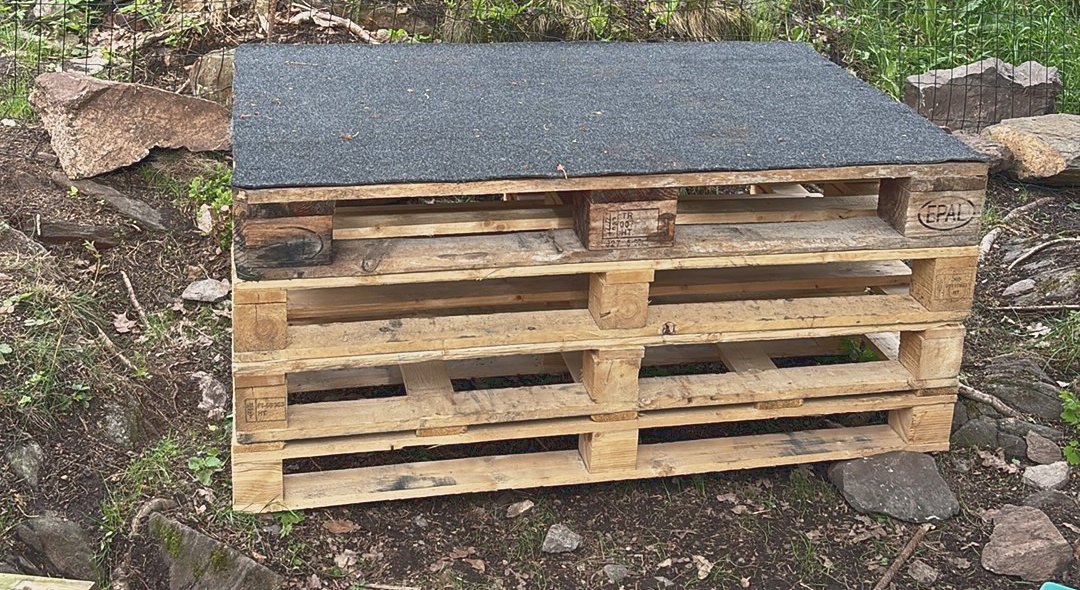
Flooring is where practice and evidence align most comfortably. Codes for licensed establishments state a preference for solid, non-slip floors, advise that open flooring systems such as grids or mesh should not be used for dogs. Puppies before weaning and bitches around whelping are the most vulnerable on open flooring, so keep them on solid surfaces.
The reasoning is mechanical rather than contested. Slippery surfaces raise injury and orthopedic risk; porous surfaces absorb urine and feces and cannot be reliably disinfected; standing damp is associated with pododermatitis. One overlooked side effect is acoustic — smooth hard surfaces reflect sound and make a kennel louder.
Resting surfaces come with a clearer preference attached. In the Normando study, dogs used a fabric bed in 53 percent of observations and a plastic basket in 15 percent. Access to more than one substrate gives dogs a choice, which is the recurring theme in this literature.
Noise
Noise is the element most often underestimated by the person who works in the building. Sales and colleagues monitored sound in shelters, training establishments and laboratories over 24 and 48 hours and found daytime peak levels regularly above 100 dB and sometimes reaching 125 dB, with equivalent continuous levels between 65 and 100 dB. Barking was the main source; husbandry tasks such as cleaning contributed.
What this does to dogs is less settled. The authors stated that the levels recorded may have welfare implications and noted the absence of adequate guidelines for noise in dog kennels (plausible, not established); Taylor and Mills likewise identified sensory overstimulation as an under-researched priority rather than a demonstrated harm. That still makes noise an area where cheap structural decisions are worth making: siting, sound-absorbent surfaces, avoiding long rows of dogs facing each other, and removing the triggers that start a bark chain. Published codes recommend exactly this, alongside habituation to people, which reduces barking in the first place.
Light, temperature and ventilation
Here the published figures come from codes rather than from studies of breeding kennels. One UK code of practice accepts a natural 24-hour light–dark cycle, suggests 10 to 12 hours of artificial light daily where it is used, and specifies night lighting of 5 to 10 lux if natural light is entirely excluded. For dogs requiring precise environmental control it gives a room temperature range of 15 to 21 °C (59–70 °F), while otherwise accepting a wide range provided welfare is not compromised and abrupt changes are avoided.
The same code considers control of relative humidity unnecessary for dogs, and notes that newborn puppies need supplementary local heat for roughly their first ten days — a different requirement from the adult kennel. These are regulatory consensus figures rather than experimental findings (convention, with limited direct evidence in dogs), but they remain the most defensible numbers available, which is worth knowing when a supplier quotes something different.
Legal limits give a floor, not a target. In the United States, USDA standards for licensed facilities say indoor and sheltered housing should not fall below 45 °F (7 °C) or rise above 85 °F (29 °C) for more than four hours in a row. The floor rises to 50 °F (10 °C) for puppies, older, sick or short-coated dogs and dogs not used to the cold. In England, breeding license guidance asks for sleeping areas between 10 °C and 26 °C (50–79 °F), and whelping areas between 26 °C and 28 °C (79–82 °F). Newborn puppies cannot regulate their own temperature for roughly the first week or two. A healthy newborn’s body temperature is about 95–99 °F (35–37.2 °C) in week one, so the whelping box needs a warm zone and a cooler area the puppies can crawl to.

Grouping, contact and enrichment
Social housing has the best-supported welfare case in the review literature, with the caveat that the same review flags aggression in groups as an unresolved problem requiring study, so compatibility has to be monitored continuously rather than established once. Where a dog must be housed alone, visual, auditory and where possible tactile contact with other dogs is preferred to isolation, and one UK code advises that single housing should not exceed four hours without welfare or veterinary justification.
Positive human contact is described as having considerable supporting evidence, particularly for sociability and stress responses. It is the one intervention that is both well supported and free, and the one most often displaced by building work undertaken to improve welfare. Inanimate enrichment is weaker: raised platforms, barriers and places to hide give dogs control over their exposure to stimuli, which is well reasoned if lightly tested, while toys, music and scent have been studied surprisingly little in dogs.
Wells’s review of enrichment for kenneled dogs comes to the same conclusion as the housing studies: contact with people matters most, and dogs in kennels often get very little of it. Where a dog must be housed alone, being able to see other dogs helps, although it can increase barking. Adult dogs lose interest in a toy within days, so rotating toys works better than adding more. Raised platforms were well used in the studies that tested them.
In practice
A breeder planning a two-run extension has a budget covering either underfloor heating or a larger footprint with sound-absorbent ceiling panels and solid dividers between runs. Reading the evidence, she chooses the second: the temperature range her climate already provides falls inside the published figures, while she can hear a bark chain start from the house. What is left goes on rubber matting over sealed concrete, two fabric beds per run and a raised platform at the back of each. The underfloor heating goes into the whelping room instead, where the requirement is documented rather than inferred.
(Illustrative, composite scenario.)
When to call your vet
- A dog or puppy is panting heavily, drooling, weak or collapses in a warm kennel. Move it somewhere cool and call immediately.
- Newborn puppies feel cold, are limp, cry constantly or stop nursing.
- A dog has sores, swelling or limping that could come from flooring, bedding or a resting surface.
- A dog is not eating, is withdrawn or hides persistently after a housing or group change.
- Fighting or injuries happen within a group, so that you can assess wounds and whether the dogs should be regrouped.
- A singly housed dog develops repetitive behavior (circling, pacing, wall-bouncing) or self-injury. Your vet or a veterinary behaviorist can help.
- If in doubt, call — your vet would rather hear from you early.
Work on it
A few minutes here will teach you more than re-reading the article.
Ask yourself
- Where in my kennel can a dog go to be out of sight of the other dogs and of the door?
- How loud is it in here when something sets the dogs off, and how long does it take to settle?
- Which of my building decisions were made on evidence, and which on what the supplier recommended?
Find out & check
- Find the minimum space, flooring and lighting requirements that apply to kennels in your own jurisdiction, and note whether any source is given for the figures.
Do one thing
- Add one retreat option to each run — a solid screen, a raised platform or a bed at the back rather than the front — and watch where the dogs choose to lie for a week.
Was this article helpful?
Anonymous. We do not store your name, email or IP address.
Sources & further reading
- Taylor, K. D. & Mills, D. S. — The effect of the kennel environment on canine welfare: a critical review of experimental studies. cambridge.org
- Sales, G. et al., via Purdue Center for Animal Welfare Science — Noise in dog kennelling: is barking a welfare problem for dogs? purdue.edu
- Normando, S. et al., via Purdue Center for Animal Welfare Science — Effects of space allowance on the behaviour of long-term housed shelter dogs. purdue.edu
- UK Home Office — Code of Practice for the Housing and Care of Animals Bred, Supplied or Used for Scientific Purposes: dogs. publishing.service.gov.uk
- Wells, D. L., Applied Animal Behaviour Science (2004) — A review of environmental enrichment for kennelled dogs, Canis familiaris. slu.se
- Department for Environment, Food and Rural Affairs — Dog breeding licensing: statutory guidance for local authorities. gov.uk
- eCFR (USA) — 9 CFR Part 3, Subpart A: Specifications for the humane handling, care, treatment, and transportation of dogs and cats. ecfr.gov
Where evidence is limited, recommendations rest on established practice and expert judgment, and may be updated as knowledge develops. That caveat is unusually heavy here: most of the studies cited were conducted on shelter or laboratory populations rather than on breeding dogs in their own homes, sample sizes are small, and several quoted figures come from regulatory codes that do not themselves cite experimental support. Statements of association are not statements of cause, and minimum legal requirements for kennel space, flooring, lighting and ventilation differ between jurisdictions — check your own before building.
Next steps
- Read next: Hygiene, quarantine and disease control.
- Related: Caring for breeding dogs.
- Return to the area hub: Running a kennel: operations, records and resilience.