Most breeding programs do not come apart at the mating or the whelping — they come apart on an ordinary Tuesday, when the one person who knows where everything is kept cannot get out of bed.
The most important first
- Area 1 is about how your breeding dogs should live. Area 12 is about how the operation around them works, so that what you know survives a week in which you are not at your best.
- Registries increasingly expect parts of that operation in writing: the American Kennel Club’s inspection program looks for hard-copy ownership and litter records plus a written emergency plan, and the Kennel Club’s Assured Breeders Standard required records to be kept for at least ten years until that scheme closed on 31 December 2024.
- Records are the raw material for every later judgment about whether a combination worked, which is why record-keeping sits at the center of this area rather than at the end of it.
- Kennel-level biosecurity is a different job from biosecurity around one litter. Start with hygiene and quarantine if you show, travel, use outside stud dogs or import.
- Premises standards, licensing thresholds, retention periods and insurance rules differ substantially between countries.
Operations, not administration
There is a point at which someone who breeds dogs stops improvising and starts running something. It rarely announces itself. It arrives as a third breeding bitch, a second litter in a year, or a buyer asking a question you cannot answer because the answer was in a notebook you have lost. Up to that point, memory and goodwill are enough. After it, they are not.
The distinction this area rests on is simple. Area 1 deals with the dogs themselves — how breeding animals are housed, fed, exercised, assessed and retired, and what the person responsible for them owes them, as set out in caring for breeding dogs and breeder responsibilities. This area deals with everything built around those dogs: routines, the building, the paperwork, the money, the contingency plans and the relationships. The dogs are the purpose; the operation is what keeps the purpose intact when circumstances turn.
Framed that way, operations stop looking like bureaucracy and start looking like welfare. A kennel with no written feeding routine is one where a stand-in gets it wrong; a kennel with no financial buffer is one where a cesarean becomes a decision about money rather than about a bitch. The Fédération Cynologique Internationale’s breeding strategies make a parallel argument at population level, favoring breeder education over strict regulation, because stringent demands can reduce genetic diversity, exclude excellent dogs and reduce cooperation with conscientious breeders.
The chain, and the order it runs in
The work divides into a chain rather than a list, and the order matters. Routines and facilities come first, because they determine what is physically possible each day. Hygiene and quarantine sit on top of them, because a building and a routine are what decide whether something brought home from a show reaches a pregnant bitch. Records come next, turning daily observation into something retrievable. Economics and insurance follow, setting the boundaries inside which decisions are made. Crisis planning assumes all of the above will one day be executed by somebody else. Then come the relationships — veterinary, commercial, collegial — and finally the transfer of knowledge to the next person.
Each link carries the one above it. Records are useless without a routine that generates them, a crisis plan is unusable if the records it points to cannot be found, and a policy does not help if nobody knows where the policy number is.
Routines and the building they happen in
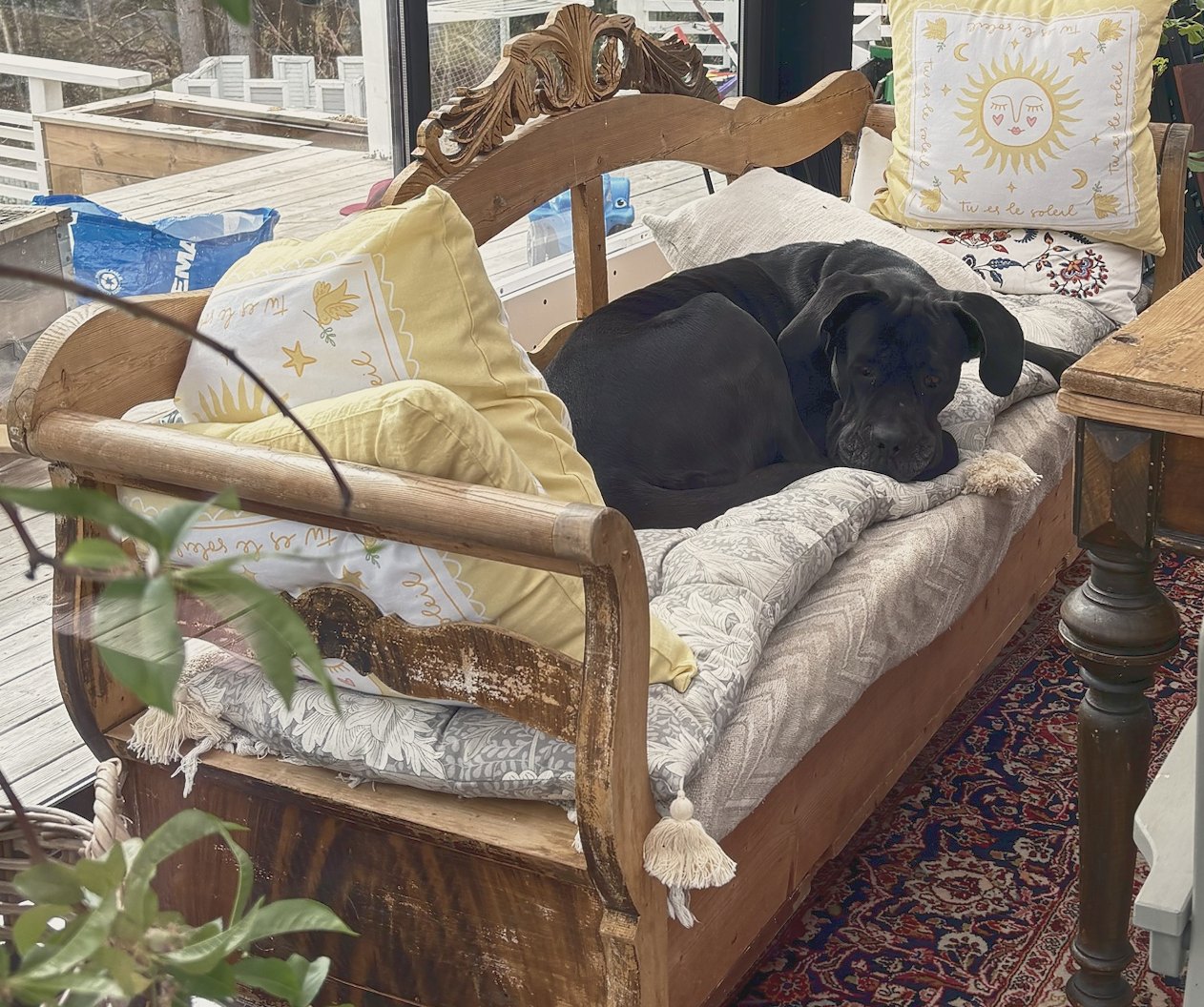
Daily practice is where almost everything else is decided. The Royal Kennel Club’s welfare standard sets out the minimum shape: adult dogs fed at least once daily and puppies several times a day, fresh water in clean containers, a draft-free sleeping area and an exercise space, housing and equipment that can genuinely be cleaned and disinfected, and care proportionate to the number of dogs kept. The Kennel Club’s Assured Breeders Standard, before the scheme closed at the end of 2024, added daily cleaning, waste removed at least twice daily, and a set procedure for routine cleaning.
The building sets the ceiling on all of it. Research on kennel environments is thinner than most breeders expect: some elements have real support, others rest on convention. What the evidence shows about kennel housing and welfare works through space, flooring, noise, light, grouping and enrichment, and is explicit about where the studies are too small or too few to carry a recommendation. Decisions about construction and equipment are better made with that uncertainty visible than hidden behind a confident number.
Records, and the fact that they are evidence
Record-keeping is the part of the operation that most reliably gets postponed, and the part whose absence costs most. The Kennel Club’s former Assured Breeders Standard still gives a usable inventory: registration details, names, sex, dates of birth and ownership, proof of parentage, mating dates, puppy details at birth including deaths and abnormalities, health screening results, permanent identification, veterinary treatment, dates and causes of death, sale dates, buyer contact details and complaints received.
That is almost exactly the dataset needed to evaluate a breeding program later. Every conclusion about a litter, a combination, a dam or a sire depends on observations written down at the time by somebody who did not yet know which of them would matter. What was not recorded cannot be evaluated afterwards, and no amount of recollection repairs it.
Other registries say the same in their own words. The Canadian Kennel Club’s Code of Practice asks breeders to keep current and accurate records of their breeding program, and Dogs Australia’s code requires every living puppy to be registered and to go home with a current vaccination certificate.
Money and risk as welfare questions
A kennel’s finances are not a business matter that happens to involve dogs. They are the mechanism by which a bad outcome either stays a clinical problem or becomes an ethical one. The cost structure is unforgiving in a specific way: fixed costs for the breeding dogs run all year whether or not a litter is born, while the expensive events are concentrated and unpredictable. A cesarean, a week of intensive neonatal care, a litter of two, a bitch who does not conceive — each is normal across a breeding life and ruinous in a plan that assumed the average.
Insurance covers part of this and not the rest, and the line between what an insurer will carry, what a contract must carry and what you absorb differs by country and by policy. The purpose of a buffer is not profit. It is to keep the next decision clinical.
The relationships that carry the operation
Three relationships do most of the work. The first is with a veterinarian, and it needs to exist before it is needed: reproductive competence, out-of-hours arrangements and a shared understanding about cesareans are easier to settle in a quiet month than at two in the morning. The second is with buyers, built mostly before the sale out of what was promised and written down. The third is with the breed, and it decides whether your experience ever becomes anybody else’s knowledge.
Reputation follows from all three, and is made of things that can be checked: published health results, dogs that hold up, buyers who come back. A kennel’s presentation can be improved in an afternoon. What the presentation points at cannot.
Where to start, depending on where you are
If you are planning a first litter, the sequence that wastes least effort is routines, then records, then a veterinary relationship, then a contingency plan. Building them in that order means each one has something to attach to.
If you already breed and the operation feels fragile rather than absent, ask what would happen if you were unavailable for two weeks and write down every answer that turns out to be “I would do it.” Each is a single point of failure. If you are reorganizing an established kennel, the usual finding is that the records exist but cannot be retrieved — a different and much easier problem.
Find out which rules apply to you before you set up your routines. In the United States, breeders who need a USDA license must meet detailed federal care standards for housing temperature, space, cleaning, feeding, water and exercise, and many states, such as Texas, add their own licensing and record rules. In England, breeding three or more litters in a year, or running a breeding business, requires a local authority license with its own conditions. Your registry, your state or national authority and your veterinarian are the people to ask.
Work on it
A few minutes here will teach you more than re-reading the article.
Ask yourself
- If I were hospitalized tomorrow, who would feed the dogs, and would they know which dog eats what?
- Which of my routines exist only in my head, and which are written somewhere a stranger could find?
- Of the last three unexpected expenses in this kennel, how many changed a decision I would otherwise have made differently?
Find out & check
- Find the record-keeping and premises requirements that apply to you — your national kennel club’s breeder scheme, your local licensing authority, and any registry you use — and note the retention period each of them specifies.
Do one thing
- Write the single page a stand-in would need: dogs, feeding, medication, vet and out-of-hours clinic, and where the records are.
Was this article helpful?
Anonymous. We do not store your name, email or IP address.
Sources & further reading
- American Kennel Club — Inspection FAQs: records, identification and emergency plans. akc.org
- The Royal Kennel Club — Kennel Club announces registrations model update and closure of the Assured Breeders Scheme (July 2024). royalkennelclub.com
- Royal Kennel Club — Welfare Standard for Adult Dogs and Puppies. royalkennelclub.com
- Fédération Cynologique Internationale — FCI International Breeding Strategies. fci.be
- Canadian Kennel Club — Code of Practice. ckc.ca
- Dogs Australia — Code of Practice. dogsaustralia.org.au
- Department for Environment, Food and Rural Affairs — Dog breeding licensing: statutory guidance for local authorities. gov.uk
- eCFR (USA) — 9 CFR Part 3, Subpart A: Specifications for the humane handling, care, treatment, and transportation of dogs and cats. ecfr.gov
Where evidence is limited, recommendations rest on established practice and expert judgment, and may be updated as knowledge develops. The standards cited here are national and scheme-specific, used as worked examples of what a documented operation looks like rather than as rules that apply everywhere; licensing thresholds, premises requirements, retention periods and insurance law differ between countries, and nothing here replaces advice from your own veterinarian, registry or qualified adviser.
Next steps
- Read next: Kennel routines and organization.
- Related: Record-keeping and documentation for breeders · Building breeder competence: how to keep learning and stay current.
- Return to the area hub: Running a kennel: operations, records and resilience.