Follow-up only becomes breeding when it changes something — and the honest test of an evaluation is whether the next combination differs from the one you would have made anyway.
The most important first
- Decide what the next litter changes before you decide which dogs are in it; availability is the weakest reason for a mating and the most common one.
- A single litter rarely justifies a conclusion about a parent, but a repeated pattern across several litters and several partners does.
- Estimated breeding values become more informative as more relatives are scored, and the confidence attached to them matters as much as the figure.
- Removing every carrier at once can cost a small breed a great deal of diversity, so the sequence of decisions matters.
- Every conclusion here is an input to Building a breeding program: from goals to combinations, not a closing statement. See also Evaluating breeding stock.
Turning follow-up into a shortlist
The move from evaluation to decision fails most often where everything you have learned has to be reduced to a list of names. The material is uneven: one offspring has screening results and a working qualification, another has a detailed veterinary history because it was ill, and four have nothing recorded because their homes are quiet and content. Waiting for it to even out means waiting past the point at which the dogs are breedable.
A workable approach is to write down what you now believe about the combination and both parents, in plain sentences, before looking at any dog. Something like: the litter was consistent in temperament, two of eight had a trait I had not seen in either parent, the bitch’s forequarters appeared in most of them, the sire’s coat did not. Those sentences are the brief for the shortlist. Dogs then qualify by answering the brief rather than by being the ones you happen to own.
This also exposes the decisions you are not making. If your sentences say nothing about longevity, you will not select on longevity, and in ten years you will not be able to say whether it moved.
Which offspring earn a place in the program
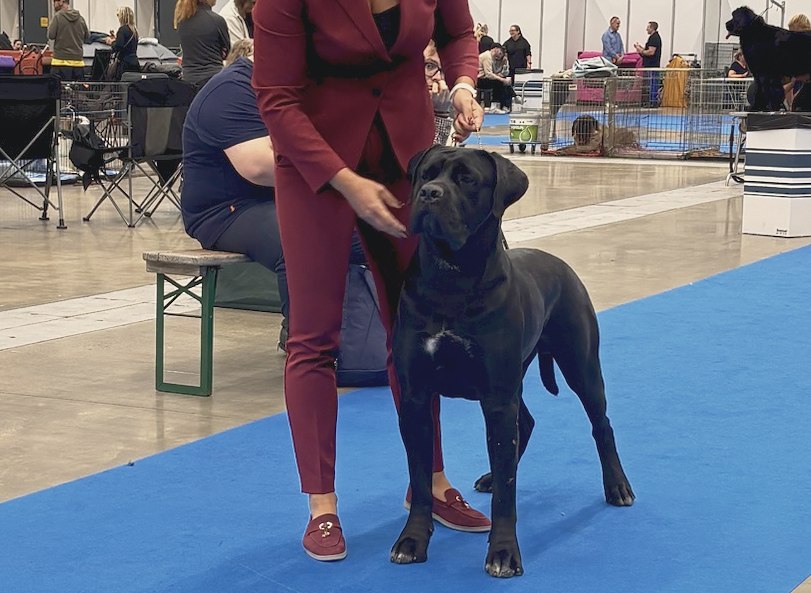
A kept offspring has to be better than its parent in the respects your goals name, or add something the program lacks, and it has to be healthy and sound in its own right. The FCI’s international breeding strategies set the general expectation that breeding stock should come from the better half of the breed population and that only functionally and clinically healthy dogs with breed-typical conformation should be bred from. That is a floor, not a selection criterion, and a dog clearing it is not thereby a reason to breed.
The harder question is what a kept offspring is being kept for. A bitch retained because she is the only one available locally is a different proposition from one retained because she carries the hindquarters her dam lacked. Writing the reason down at the time is useful mostly because it can be checked later: in four years you can see whether she delivered what she was kept for, which is more informative than whether she turned out nice.
Keeping a young dog for one trait is a type decision. It does not replace the health screening your breed requires. Before she is bred, she should meet the same floor as every other breeding dog: functionally and clinically healthy, with the breed’s recommended screening done.
Choosing a breeding prospect and Which puppy to keep cover the assessment itself. The point here is that the decision is made against the evaluation, not against the puppy.
How far your own material can carry a conclusion
Your own data is almost always too small for a statistical conclusion and entirely adequate for a decision. These are different things. A bitch with nine offspring across two litters cannot be compared with a sire who has sixty, and neither figure supports a claim about heritability. What both can support is a judgment about whether what you saw was consistent, whether it appeared with more than one partner, and whether it is the kind of trait that tends to run in families.
The useful discipline is to state the strength of the evidence alongside the conclusion. “Two of eleven offspring across two unrelated sires showed the same fault, so I treat it as coming from the bitch” is a defensible sentence. “She produces bad shoulders” is the same observation with the uncertainty removed, and the removal is where breeders go wrong. Evidence on inbreeding, diversity and longevity illustrates how much data it takes before effects of this kind can be measured at population level.
Where a breed has breeding values, they extend what your own records can tell you. Across 15 UK breeds, hip breeding values were roughly 1.2 to 1.3 times as accurate as selecting on a dog’s own or its parents’ hip scores alone, because they draw on every scored relative. Data from 60 breeds in the US tell the same story over a longer span: decades of selection on screening results reduced hip and elbow dysplasia, and the authors expect breeding values to speed that up.
Where the breed’s data takes over
Where your material stops, the breed’s begins. Estimated breeding values pool a dog’s own screening result with those of its relatives to estimate what it is likely to pass on. The Royal Kennel Club’s scheme for hip and elbow dysplasia expresses each dog’s value against a breed average set at zero, recalculates roughly four times a year, and attaches a confidence level which rises as more relatives are scored: around 60 percent when the dog has its own score, around 40 percent when both parents are scored, around 30 percent with one parent, and at least 60 percent recommended where it can be had.
Two caveats travel with that. The scheme is explicit that a good value is not a guarantee against affected offspring, and that it estimates genetic risk only, taking no account of the non-genetic factors which influence severity. Availability also depends on how many dogs in the breed are scored, which is the point at which Reporting and sharing health data stops being an ethical matter and becomes a practical one: the tool exists only where breeders feed it.
Where no such scheme exists, the serviceable substitute is the health of a dog’s close relatives, read across as many offspring as have been examined; Estimated breeding values and risk assessment covers how such figures are read and misread.
Offspring caps help, but there is no single right number. In one modeling study, a cap of 50 offspring per sire lowered kinship noticeably in one breed, while a very low cap in the smallest breed raised it, because the dogs used most happened to be the least related to the rest of the population. Your breed club’s own analysis is the better guide.

Deciding what to stop
The decisions that improve a program fastest are usually subtractive, and they are the ones breeders defer. A line kept going because it is yours, a sire used again because the inquiries are there — each is a decision, made by default.
Taking a popular dog out of use is the hardest of these and the one with the clearest population-level justification. Analysis of pedigree records across Kennel Club breeds found that popular sires contribute heavily to later generations and are a principal driver of rising inbreeding, that effective population size varies widely between breeds and does not track the number of dogs registered, and that spreading breeding across more males reduces the effect — though substituting a close male relative achieves little, since the genetics are largely shared. The FCI offers a usable ceiling: as a general guideline, no dog should produce more offspring than 5 percent of the puppies registered in the breed over a five-year period.
Carrier status deserves the same restraint. Modeling of breeding strategies in four breeds found that removing all carriers from the breeding pool affects genetic diversity differently depending on the breed and on how common the allele is, and that capping offspring per dog can help preserve diversity, although the right cap differs by breed. In the smallest breed modeled, removing every carrier raised kinship about four times as much as breeding carriers to clear dogs.
A carrier of a recessive condition does not have to leave the program. The approach most veterinary geneticists recommend is to breed a carrier only to a mate that has tested clear for the same variant, then keep a clear offspring that is at least as good as the parent and let it take the parent’s place. Over a few generations the variant becomes less common without the breed losing the rest of what that line carries. Removing every carrier at once is the option that costs a small breed the most diversity.
Choosing the next combination on evidence rather than availability
With a shortlist and a clear view of what has to change, the combination becomes a narrower problem. You are no longer looking for a good dog but for the dog which addresses the specific gap your evaluation named, in a pairing whose relatedness you have checked and whose health results you have actually seen rather than been told about.
Two habits help. Write the expected outcome down before the mating, in terms specific enough to be wrong: what you expect the pairing to improve, what you expect it to risk, and what would make you judge it a mistake. Then settle in advance what you will do if it goes the other way, because abandoning a direction is easier when it was anticipated than when it feels like an admission.
Dog breeding systems covers the mechanics of linebreeding, outcrossing and the rest. What follow-up adds is evidence about whether the system you used did what you expected in your own dogs.
The decision belongs in the strategy, not the notebook
A conclusion recorded only in the litter’s evaluation will not be found when it is needed, because the moment it is needed is the moment you sit down to plan a mating two years later. The conclusions from this generation belong where the planning happens: in the strategy document, in the written goals, in the criteria you apply to a prospective mate.
That is what closes the cycle rather than ending it. The outputs of this area — what the offspring became, what the combination gave, what each parent appears to transmit — are the inputs to Building a breeding program: from goals to combinations, and a program which does not carry them across is planning each generation from the same starting assumptions it used last time.
In practice
A breeder with three litters from the same bitch, by three different sires, reviews all twenty-two offspring at ages between two and seven. Temperament is consistent and good across all three litters; a shoulder fault appears in roughly a third of the offspring regardless of sire; longevity cannot yet be assessed. The breeder keeps one daughter from the litter where the fault was least evident, specifically for her forequarters, records that reason in writing, retires the bitch after the third litter rather than taking a fourth, and adds forequarter construction as an explicit screening criterion for every future mate. The shoulder conclusion rests on a pattern across three sires, not on any single litter.
(Illustrative, composite scenario.)
Work on it
A few minutes here will teach you more than re-reading the article.
Ask yourself
- What will be different about my next combination because of what this litter taught me, stated specifically enough that someone could tell whether I did it?
- Which of my dogs or lines am I continuing by default rather than by decision?
- If I kept an offspring from my last litter, can I say in one sentence what it was kept for?
Find out & check
- Find out whether your breed has estimated breeding values for any trait, and if so what confidence level is attached to the figures for your own dogs.
Do one thing
- Write down, before your next mating, the one thing you expect the pairing to improve and the one thing that would make you call it a mistake.
Was this article helpful?
Anonymous. We do not store your name, email or IP address.
Sources & further reading
- Fédération Cynologique Internationale — FCI International Breeding Strategies. fci.be
- Royal Kennel Club — Estimated breeding values. royalkennelclub.com
- Lewis, T. W., Abhayaratne, B. M. and Blott, S. C. — Trends in genetic diversity for all Kennel Club registered pedigree dog breeds. cgejournal.biomedcentral.com
- Leroy, G. and Rognon, X. (Tufts Breeding & Genetics Conference 2013, via VIN) — Assessing the impact of breeding strategies on inherited disorders and genetic diversity in dogs. vin.com
- Jerold S. Bell, DVM (Tufts, via VIN) — Breeding Strategies for the Management of Genetic Disorders. vin.com
- Jerold S. Bell, DVM (Tufts, via VIN) — Small Population Breeds and Issues of Genetic Diversity. vin.com
- Lewis, T. W., Blott, S. C. and Woolliams, J. A. (2013), BMC Genetics — Comparative analyses of genetic trends and prospects for selection against hip and elbow dysplasia in 15 UK dog breeds. link.springer.com
- Oberbauer, A. M., Keller, G. G. and Famula, T. R. (2017), PLOS ONE — Long-term genetic selection reduced prevalence of hip and elbow dysplasia in 60 dog breeds. pmc.ncbi.nlm.nih.gov
Where evidence is limited, recommendations rest on established practice and expert judgment, and may be updated as knowledge develops. The population modeling cited here was carried out in particular breeds and registries, and the balance between eliminating a disorder and conserving diversity differs with breed size, allele frequency and the structure of the national population, so treat the figures as orders of magnitude rather than thresholds.
Next steps
- Read next: Building a breeding program: from goals to combinations.
- Related: Estimated breeding values and risk assessment.
- Return to the area hub: Closing the loop: follow-up and the next generation.