A pre-breeding examination is the last confirming check before a mating goes ahead — the point where general health, breed-specific screening and reproductive readiness all come together. This guide covers what it typically includes.
The most important first
- Both dogs in a planned mating should have a pre-breeding health check, not just the bitch.
- A general veterinary exam covers vaccination, parasite control and overall body condition.
- Breed-specific health screening (hips, eyes, heart, DNA tests) should be complete before this stage, not done at it.
- Reproductive-specific checks confirm both dogs are actually ready to breed, not just generally healthy.
- This examination works best as a final confirming step, not the first time health has been considered.
The general health check
A pre-breeding veterinary exam typically confirms vaccinations, worming and parasite control are current, and includes a general physical examination — body condition, dental health, and an overall check for anything that would make pregnancy, whelping or stud duty inadvisable. This is a baseline check, not a substitute for the breed-specific screening (hip and elbow scoring, eye testing, cardiac screening, relevant DNA tests) that should already be complete from the genetics and health-screening stage of planning, well before a mating is imminent.
Your veterinarian will also look at body condition. A bitch at a healthy weight conceives and whelps more easily than one that is under- or overweight. Bring a list of everything your dog receives, including supplements and parasite treatments: use only flea, tick and worming products labeled as safe for breeding, pregnant and nursing dogs. Extra calcium during pregnancy can increase the risk of dangerously low calcium (eclampsia) after whelping, so give it only on veterinary advice. Vaccinations should be current, but extra boosters just before mating are generally not needed unless your dog’s status is unknown. For bitches over about five years old, many vets recommend a blood and urine screen.
Hip and elbow scoring has minimum ages: final scores under the BVA/KC schemes need the dog to be at least one year old, and OFA preliminary hip evaluations can be done between about 4 and 23 months. DNA tests can be done at any age.
The reproductive-specific check
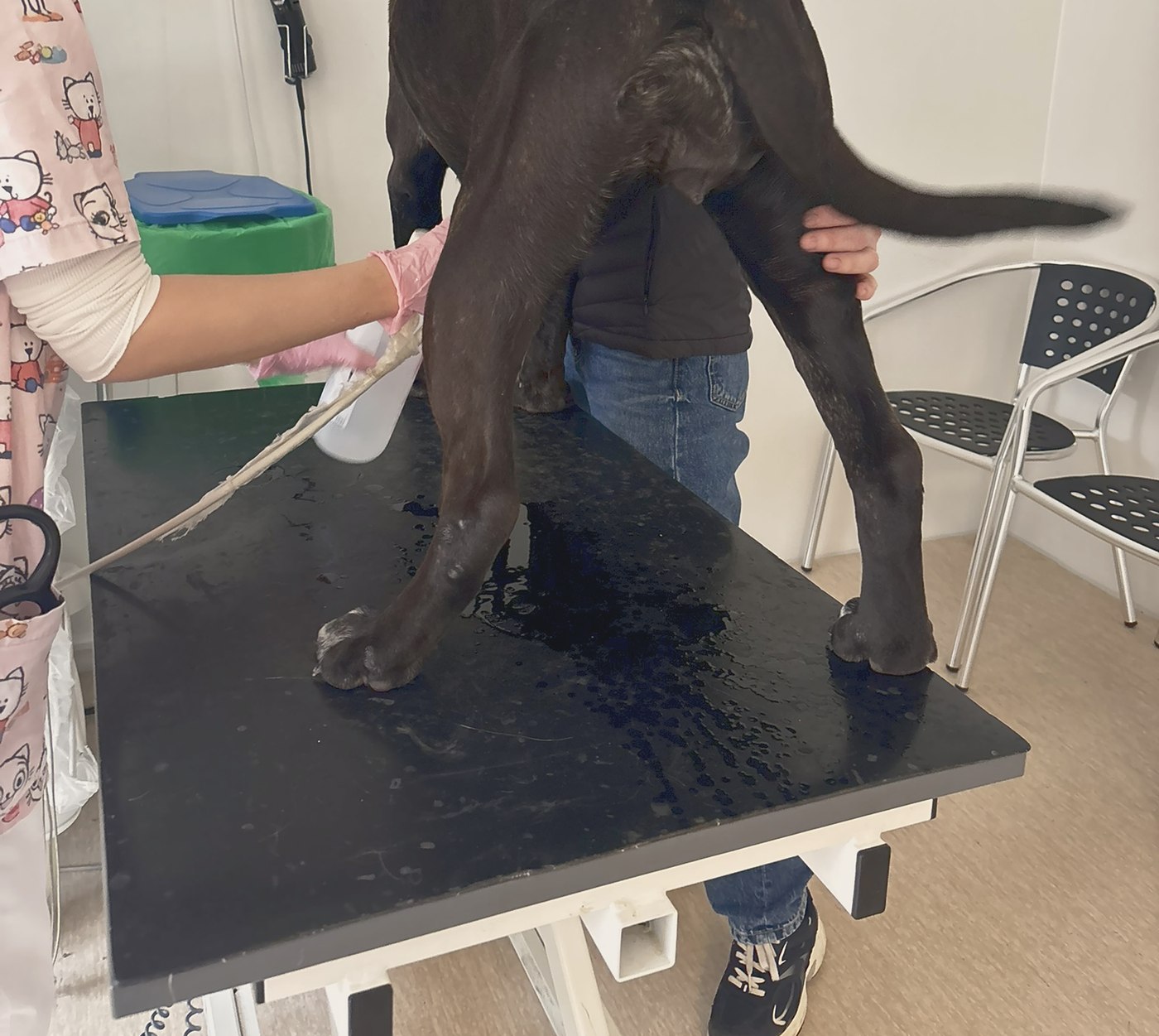
Beyond general health, this examination looks specifically at reproductive readiness: for the bitch, a vulvar and mammary check and confirmation of normal cycling; for the stud, testicular and prostatic health, and — if not already done — a semen evaluation. Brucella canis testing is generally part of this stage for both dogs if not already current. Bringing these checks together shortly before a planned mating catches anything that’s changed since earlier screening, rather than assuming health status from months or years earlier still holds.
For the bitch, the vet checks the mammary glands and nipples (inverted nipples can make nursing harder) and, often during her heat, examines the vagina for narrowings that could make mating or whelping difficult. For the stud, the exam includes the testes and prostate. Prostate enlargement is common in intact males over five. “Current” Brucella status usually means the bitch has been tested ahead of this cycle and the stud within the last six to twelve months; many sources recommend six-monthly testing for active studs. Routine vaginal swabs are not recommended without a reason, because healthy dogs normally carry many bacteria there.
In practice
A breeder has both dogs’ hip scores, eye certificates and DNA results filed from well before the mating was planned, and assumes that’s sufficient. A pre-breeding exam closer to the actual mating date picks up an early prostate change in the stud dog that wasn’t present at his last general check-up — a finding that wouldn’t have surfaced without this final, reproduction-specific step, even though his broader health paperwork was all in order.
(Illustrative, composite scenario.)
(Illustrative, composite scenario.)
Timing this examination well
Both dogs benefit from having reproductive-specific health checks completed with enough lead time to act on any findings, but close enough to the mating that the results are still current — typically within the weeks leading up to the planned cycle, rather than many months in advance. Some parts of the bitch’s exam, such as checking the vagina for narrowings, are easiest during her heat itself, and her Brucella test should be done ahead of each cycle. Both partners should be checked, since infertility investigation later is far easier when a documented pre-breeding baseline exists for both dogs, not just the one that seems, in hindsight, more likely to have been the issue.
Check your registry’s rules
Kennel clubs set minimum ages and litter limits, and these differ between countries. For example, Dogs Australia member bodies require the dam to be over 12 months and the sire over 9 months at mating, limit a dam to two litters in 18 months, and ask for a veterinary certificate of fitness for older or frequently bred bitches. Check your own registry’s current rules alongside your health-testing plan.
When to call your vet
- Either dog’s Brucella canis result is positive, unclear or not current — hold off on mating until your vet advises.
- The bitch has unusual discharge, drinks more than usual, or seems unwell before or after her heat.
- Either dog has a fever above 103 °F (39.5 °C), or the stud has been ill or feverish in the last two months.
- The stud has swelling, pain or a change in size of the testes, or difficulty urinating or passing feces.
- Your bitch is very under- or overweight, over about five years old, or on supplements or parasite products you’re unsure about for breeding.
- If in doubt, call — your vet would rather hear from you early.
Work on it
A few minutes here will teach you more than re-reading the article.
Ask yourself
- Have both dogs had a pre-breeding health check, or only the bitch?
- Is my breed-specific health screening already complete, rather than something I’m hoping to fit in around the mating?
- Do I know the current Brucella canis status of both dogs?
Find out & check
- Find out what your vet includes in a standard pre-breeding examination for each sex.
- Check the dates of both dogs’ most recent relevant screening results.
Do one thing
- Book pre-breeding examinations for both dogs with enough lead time before your planned mating.
Was this article helpful?
Anonymous. We do not store your name, email or IP address.
Sources & further reading
- Merck Veterinary Manual — The Breeding Soundness Examination in Dogs and Cats. merckvetmanual.com
- Merck Veterinary Manual — Breeding Soundness Examination of Male Dogs. merckvetmanual.com
- The Royal Kennel Club — Health Screening for Dog Breeders: A Step-by-Step Guide. royalkennelclub.com
- Purdue University Croney Research Group — Pre-Breeding Health Screening & Testing for Dogs. caninewelfare.centers.purdue.edu
- Orthopedic Foundation for Animals — Hip Dysplasia. ofa.org
- Cornell University Riney Canine Health Center — Canine Brucellosis. vet.cornell.edu
- Dogs Queensland (Dogs Australia member body) — Litter Application Guide. dogsqueensland.org.au
Where evidence is limited, recommendations rest on established practice and expert judgment, and may be updated as knowledge develops.
Next steps
- Read next: Mating agreements and practical planning.
- Related: Infertility in the bitch and dog · Brucella canis: risk, screening and biosecurity · Pre-breeding regulatory checklist: what to confirm before you breed · Reproductive infections and how to prevent them.
- Return to the area hub: Reproduction and fertility.