Every breeder checks bites, but a bite is not fixed at eight weeks: baby teeth can stay put when adult teeth come in, jaws grow at different rates, and some faults that look minor are painful for the puppy — so knowing what to look for, when to involve a veterinarian and what to tell buyers is part of placing a puppy well, and part of deciding what to breed from.
The most important first
- Check every puppy’s bite at the vet check before placement, and note it in the puppy’s records.
- Teeth that dig into the gums or palate need a veterinarian promptly. Early treatment can prevent pain and help the jaws grow normally.
- A baby tooth still in place when the adult tooth erupts should be checked straight away, not left until spay or neuter.
- Tell buyers what you found, what to watch for, and to check the mouth weekly until about seven months.
Last updated: November 8, 2026
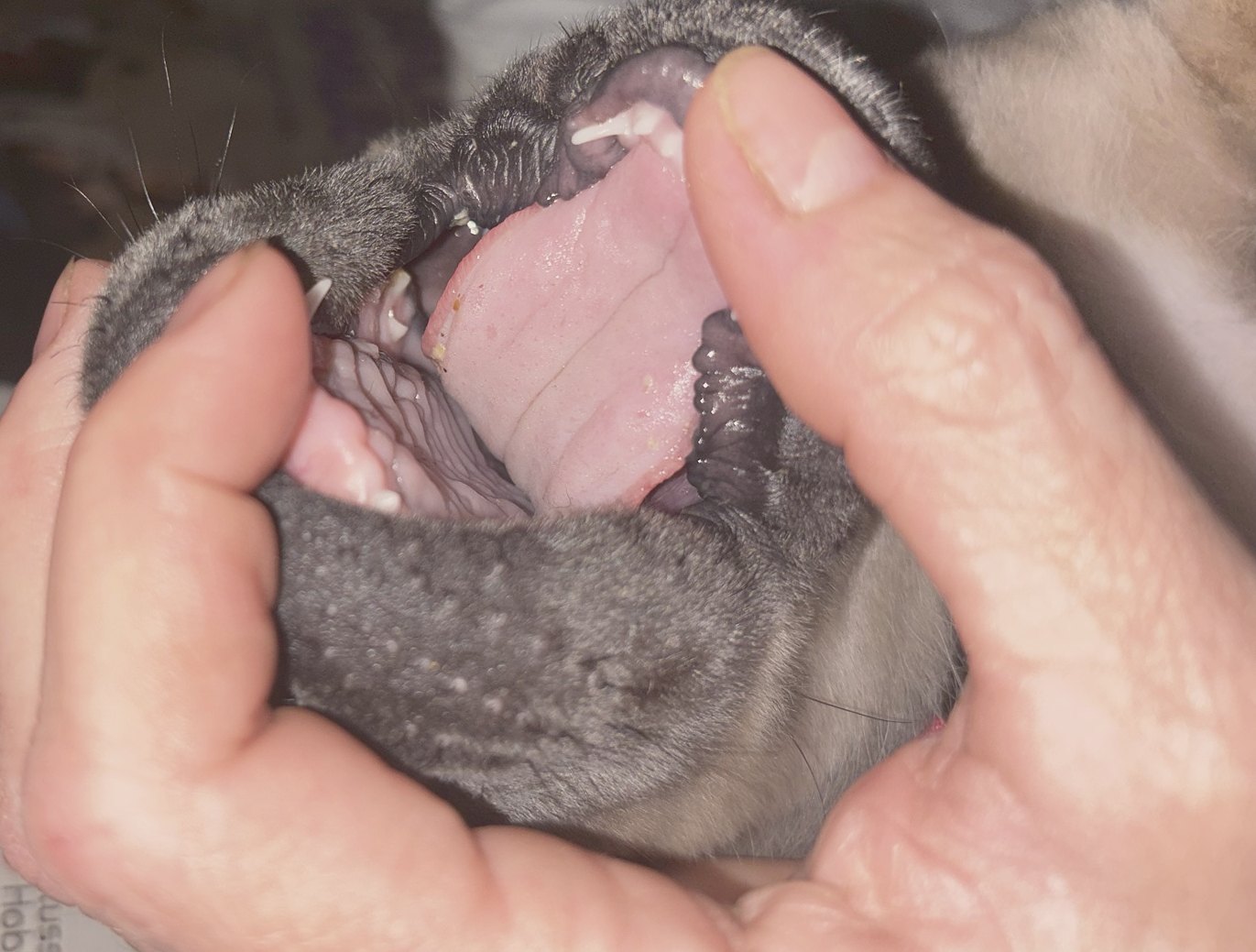
How the teeth develop
According to the veterinary dental specialists writing for VCA, puppies have 28 baby (deciduous) teeth that erupt from about three weeks of age and are usually all through by six weeks. The adult teeth start replacing them at about three and a half to four months, and most dogs have all 42 adult teeth by six to seven months. Upper and lower jaws can grow at different speeds during that time, so the bite you see at eight weeks may change.
What to look for in the litter
- Scissor bite or breed standard. Check how the incisors meet and where the lower canines sit relative to the upper teeth.
- Lower canines pointing inward. If the lower baby canines are angled toward the palate, they can press into the roof of the mouth.
- Teeth trapped against each other. When a tooth on one jaw is locked behind teeth on the other, it can hold back normal jaw growth; dentists call this a dental interlock.
- Missing, extra or crowded teeth.
How common are problems? In an examination of 297 puppies aged 8 to 12 weeks, Hoyer and Rawlinson found that 26% had a malocclusion of the baby teeth. Most were mild, but some were moderate or severe.
Retained baby teeth
A baby tooth that is still present when the adult tooth erupts is called persistent or retained. VCA’s authors note that the upper canines are most often affected, followed by the lower canines and incisors, that it is more common in small breeds and short-nosed breeds, and that it often occurs within the same families of dogs. Two teeth in one place crowd each other, trap food and can push the adult tooth into the wrong position. VCA advises seeing a veterinarian as soon as a persistent tooth is noticed and not waiting for the spay or neuter appointment, because early extraction usually lets the adult tooth move into place.
Extraction has to be complete. In a ten-year review of dental X-rays at a referral clinic, Ziemann and colleagues identified 237 retained root remnants of baby teeth in 143 dogs, most often the upper canines, and evaluated the changes around them. A tooth that “broke off” may still have a root in the jaw.
When early treatment is considered
Removing selected baby teeth to relieve trauma or an interlock is called interceptive orthodontics. It has traditionally been done as soon as the problem is found, often at 6 to 8 weeks and no later than 12 weeks. It is not risk-free: in a study across five veterinary dental practices, Felz and colleagues found enamel defects on 21 adult canine teeth in 13 of 74 puppies who had their lower baby canines extracted. That is a decision for the puppy’s veterinarian or a veterinary dentist, weighing pain now against risk to the adult teeth.
As a breeder, your job is to notice, record and refer: a puppy whose teeth are hitting the palate should be seen before it goes home, and the buyer should know what was found and what was done.
In practice
At the eight-week vet check, a breeder’s vet notices that one puppy’s lower canines are touching the palate. The breeder books a veterinary dental appointment, explains the situation to the waiting family, and offers them the choice to wait or choose again. The puppy has two baby teeth removed, goes home a week later, and the family get the dental notes in the puppy pack with a reminder to check the mouth weekly.
(Illustrative, composite scenario.)
What to tell buyers
- What the bite looked like at the vet check, written in the puppy’s health record.
- That bites can change until about seven months, and VCA’s advice to check the mouth weekly until then.
- That a baby tooth still in place next to an adult tooth should be seen by their veterinarian promptly. The AVMA lists retained baby teeth among the signs that warrant a dental check before the yearly visit.
- That you would like to hear how the adult bite turns out. That information belongs in your post-litter evaluation.
Bite faults and breeding decisions
Dental development is influenced by genes and by the shape of the skull. VCA’s authors note that persistent baby teeth run in families, and breed differences in dental disease are well documented: in a UK study of more than 22,000 dogs, O’Neill and colleagues found that breeds with skull shapes far from moderate had different odds of periodontal disease. Precise heritability figures for most bite faults are not available.
Practical steps:
- Record bites at eight weeks and ask buyers for the adult bite at about a year. One faulty bite tells you little; a pattern across litters from the same dam or sire tells you more.
- Weigh it with everything else. A mild fault in an otherwise excellent dog is a different decision from a painful fault that recurs.
- Be honest with stud owners and co-breeders about what you see.
When to call your veterinarian
- A puppy’s teeth are pressing into the gums or palate, or the puppy seems sore when eating.
- A baby tooth is still in place when the adult tooth has come through.
- A tooth is broken, discolored or loose.
- If in doubt, call — your vet would rather hear from you early.
Work on it
A few minutes here will teach you more than re-reading the article.
Ask yourself
- Do I record every puppy’s bite before placement?
- Do I know how my last litter’s bites turned out as adults?
- Would I recognize a dental interlock?
Find out & check
- Ask your veterinarian to show you what a normal and a faulty bite look like in your breed at eight weeks.
Do one thing
- Add a “bite at 8 weeks” and “adult bite” line to your puppy records.
Was this article helpful?
Anonymous. We do not store your name, email or IP address.
Sources & further reading
- Hunter T, Hiscox L, Bellows J, VCA Animal Hospitals — Persistent Deciduous Teeth (Baby Teeth) in Dogs. vcahospitals.com
- Hoyer NK, Rawlinson JE (2019) — Prevalence of malocclusion of deciduous dentition in dogs: an evaluation of 297 puppies. Journal of Veterinary Dentistry 36:251–256. doi.org
- Felz CL, Arzi B, Taney K, Block K (2024) — Incidence of enamel defects on permanent canine teeth following extraction of linguoverted mandibular deciduous canine teeth in dogs. Frontiers in Veterinary Science. doi.org
- Ziemann D, Schreyer J, Gawor J (2026) — Retained deciduous tooth root remnants in dogs: a ten-year retrospective study. Journal of Veterinary Dentistry 43:380–387. doi.org
- O’Neill DG, Mitchell CE, Humphrey J, Church DB, Brodbelt DC, Pegram C (2021) — Epidemiology of periodontal disease in dogs in the UK primary-care veterinary setting. Journal of Small Animal Practice 62:1051–1061. doi.org
- American Veterinary Medical Association — Pet dental care. avma.org
Where evidence is limited, recommendations rest on established practice and expert judgment, and may be updated as knowledge develops. This is general information and does not replace advice from your veterinarian.
Next steps
- Read next: Pre-sale health checklist.
- Related: Post-litter evaluation template · Vet checks, microchipping and registration.
- Return to the guide: Placing each puppy: the complete guide.