Almost every litter needs worming, however clean the kennel and however well-wormed the dam — because the most important route of infection happens before the puppies are born.
The most important first
- Puppies can be infected with Toxocara canis before birth, across the placenta, and afterwards through the dam’s milk — a spotless environment does not prevent either.
- Treatment starts at two weeks of age. In North America, CAPC recommends treating at 2, 4, 6 and 8 weeks, then a monthly preventive; in Europe, ESCCAP recommends every two weeks until two weeks after weaning, then monthly until six months.
- The nursing bitch should be treated too — alongside the litter (CAPC), starting with the puppies’ first treatment (ESCCAP) — because she commonly develops a patent infection during lactation.
- Roundworm is a genuine zoonosis: hand hygiene and prompt removal of feces protect the people around the litter, especially children.
- Protozoa such as coccidia and Giardia are common in litters and are not treated by standard wormers — they need diagnosis and a specific prescription.
Why puppies are infected before you ever see a worm
Toxocara canis larvae can lie dormant in a bitch’s tissues for years, out of reach of routine worming. During late pregnancy, hormonal changes reactivate them, and they migrate across the placenta into the puppies — which means puppies can be born already infected. A second wave passes to them through the milk in the first weeks of nursing.
This is the single most important thing to understand about parasite control in a litter: prenatal and transmammary transmission are not the result of poor hygiene, and worming the bitch before mating does not prevent them. It is also why treatment starts so early — at an age when it can feel unnecessary.
Hookworms also pass to puppies through the dam’s milk, and they feed on blood. In a young puppy, a heavy infection can cause severe anemia — even death — before any eggs show up in a fecal test. Pale gums, weakness, poor weight gain and dark, tarry stools are reasons to see your veterinarian the same day.
A heavy worm burden of any kind tends to show as a potbelly, poor growth, a dull coat, diarrhea or vomiting. In a small puppy these signs, especially with weakness or dehydration, are a reason to call your vet rather than simply worm again.
The schedule
In North America, the Companion Animal Parasite Council (CAPC) recommends treating puppies at 2, 4, 6 and 8 weeks of age and then moving to a monthly preventive; the nursing dam is treated alongside the litter. CAPC also recommends fecal testing at least four times in a puppy’s first year — the first of these can happen while the litter is still with you.
Current European guidance (ESCCAP) is to treat puppies with an appropriate anthelmintic from two weeks of age, repeat every two weeks until two weeks after weaning, and then continue monthly until six months of age. The nursing bitch should be treated at the same time as the puppies’ first treatment, since lactating bitches frequently develop patent infections at exactly this point.
Some sources and some countries frame it slightly differently — treating at three and six weeks is a common alternative pattern — and products, active ingredients and licensed ages vary considerably between markets. Take the principle from the guideline and the specific product, dose and schedule from your own vet: this is one of the areas where the right answer genuinely depends on where you live and what is licensed there.
Both schedules start early for the same reason: puppies are infected before birth and through milk. Your veterinarian will choose the products and confirm the licensed ages and weights in your country.
The buyer needs to know exactly what was given and when, so they can continue the schedule rather than restart or duplicate it. Product name, active ingredient, dose and date belong in the paperwork that goes home with each puppy.
In practice
A breeder with a meticulously clean kennel and a bitch wormed before mating assumes the litter will not need treatment until they are older. The puppies are dull-coated and pot-bellied at three weeks. Understanding that infection arrived in utero rather than from the floor is what changes the routine — the schedule is a response to the parasite’s biology, not to how clean the room is.
(Illustrative, composite scenario.)
Environment and hygiene
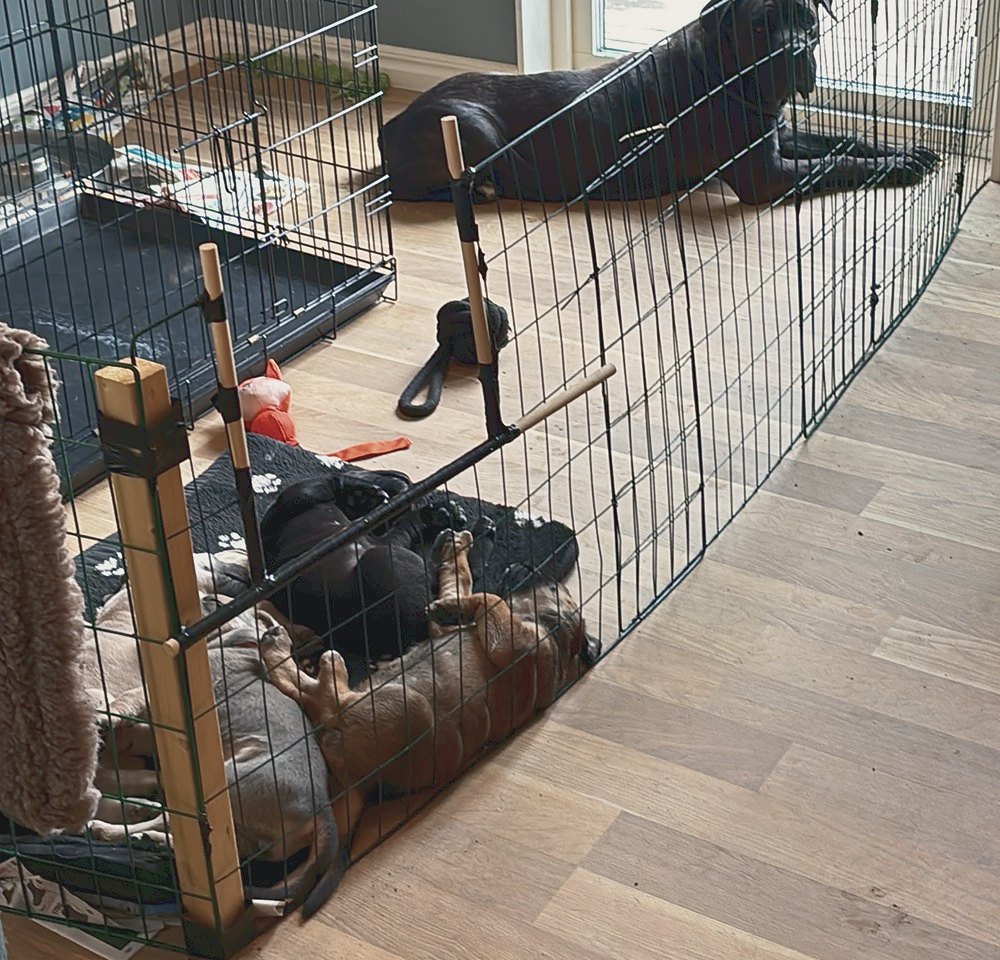
Feces should be picked up promptly and disposed of, not left to accumulate — roundworm eggs are not immediately infective when passed, so removing feces quickly interrupts the cycle before the environment becomes contaminated. This is one of the reasons the elimination routine in daily care and hygiene routines matters beyond appearances.
Once they have matured, roundworm eggs can stay infective in soil for years, and coccidia oocysts survive for months; neither is reliably killed by everyday disinfectants. The most effective steps are mechanical: pick up feces at least daily, keep surfaces dry, wash bedding hot, and let sunlight and drying work on outdoor areas.
Toxocara canis is zoonotic: people, and children in particular, can become infected by ingesting eggs from contaminated environments, and the consequences in humans are occasionally serious. Everybody who handles the litter should wash their hands afterwards, and certainly before eating. Supervise children around the litter and have them wash their hands. This is worth explaining to visitors and buyers rather than assuming — it is the reason for the rule, and people follow rules they understand.
The parasites wormers do not cover
A standard anthelmintic treats worms, and does nothing for the single-celled parasites that also circulate in litters. Coccidia (Cystoisospora) and Giardia are both common where young animals are kept together, both cause diarrhea in puppies, and both need a fecal test to identify and a specific prescription to treat. Persistent or recurring diarrhea in a litter that is being wormed on schedule is a reason to have feces examined rather than to worm again.
Both are common in breeding kennels. Their diarrhea may come and go, and coccidia in particular can lead to dehydration and weight loss in a small puppy. Stress — including going to a new home — can bring on signs. Giardia is shed intermittently, so a fecal test sometimes needs repeating. Tell buyers if the litter has been treated.
External parasites — fleas, ticks and mites — are a separate question again, with their own age restrictions on treatment. Very few products are licensed for very young puppies, so this is another decision to make with your vet rather than from a shelf.
Fleas and young puppies
A heavy flea burden can cause dangerous anemia in a small puppy, and fleas also carry a tapeworm. Use only products labeled for the puppy’s age and weight, ask your vet before treating very young puppies or a nursing dam, and treat every pet in the household so the problem does not return.
What good parasite control looks like
Treat on a schedule rather than in response to seeing worms; most infected puppies never pass a visible worm. Keep the dam in the plan, not just the litter. Remove feces promptly. Test rather than guess when there is diarrhea. And record every treatment, because the schedule continues in the new home and the next owner needs to know where it left off. Illness that does not fit this picture belongs in common illnesses in the growing litter.
When to call your vet
- A puppy has pale gums, is weak, or passes dark, tarry stools — same day.
- Diarrhea lasts more than a day, recurs, contains blood, or comes with vomiting or a flat, unwilling puppy.
- A puppy is not gaining weight, looks potbellied, or has a dull coat despite worming.
- You see a heavy flea infestation on young puppies, or need a product for puppies younger than any label allows.
- Worms are vomited or passed in large numbers after treatment.
- You need a fecal test or a plan for coccidia or Giardia before puppies go home.
- If in doubt, call — your vet would rather hear from you early.
Work on it
A few minutes here will teach you more than re-reading the article.
Ask yourself
- Does my schedule start early enough — at two weeks — given that infection may already have happened before birth?
- Am I treating the dam alongside the puppies, or only the puppies?
- Do I have a plan for diarrhea that involves testing rather than repeating the wormer?
Find out & check
- Find out from your vet which products are licensed for puppies at each age where you live, and what the recommended national schedule is.
Do one thing
- Write the worming schedule for this litter, with dates, into the same record you will hand to buyers.
Was this article helpful?
Anonymous. We do not store your name, email or IP address.
Sources & further reading
- ESCCAP — Worm Control in Dogs and Cats (Guideline 01). esccapuk.org.uk
- Companion Animal Parasite Council — Ascarid (Roundworm). capcvet.org
- Companion Animal Parasite Council — Hookworms. capcvet.org
- Companion Animal Parasite Council — Coccidia. capcvet.org
- Companion Animal Parasite Council — Giardia. capcvet.org
- Companion Animal Parasite Council — Fleas. capcvet.org
- Merck Veterinary Manual — Gastrointestinal Parasites of Dogs. merckvetmanual.com
- VCA Animal Hospitals — Breeding for Dog Owners: Caring for Mother and Puppies After Weaning. vcahospitals.com
Where evidence is limited, recommendations rest on established practice and expert judgment, and may be updated as knowledge develops. Parasite treatment schedules, licensed products and legal requirements differ between countries — confirm yours with your own veterinarian.