A puppy raised where nothing is ever slightly difficult goes home with no experience of persisting — and everything here turns on one distinction: between a problem it can solve and one it cannot.
The most important first
- Frustration tolerance is built by problems a puppy can actually solve: a low step, a food toy it can empty, a two-second pause before the bowl reaches the floor.
- A problem with no solution and no way out teaches the opposite — that what the puppy does makes no difference to what happens.
- Raise difficulty only once the current level is solved easily; a puppy that gives up has met a task that was too hard.
- Unpredictable routines are not useful challenge: lack of predictability and unpredictable consequences are among the factors that may contribute to compulsive behavior in dogs.
- Gentle handling in the first weeks has been linked to calmer, more exploratory puppies in some studies, but the evidence is mixed and long-term effects are unproven: treat it as good husbandry, not a guarantee.
Why a frictionless litter is a disadvantage
Most of what a breeder does for a litter is the removal of difficulty: warmth, food, obstacles cleared away. That is right for the neonatal period, and it quietly becomes a problem from around five weeks, when many puppies are capable of solving things and there is nothing in the pen to solve.
Persistence is learned. A puppy that has pushed at a light flap and got through it, climbed a step it had to try twice, or worked food out of a toy has a small history of effort producing a result. A puppy with no such history has nothing to draw on the first time the world asks it to keep trying — and the world starts asking within days of going home.
Gentle handling in the first weeks has been linked in some studies to calmer, more exploratory puppies, but the evidence is mixed: recent studies, including a controlled trial of early neurological stimulation, found no measurable long-term benefit. Treat early handling as good husbandry, not as a guarantee of a resilient adult.
None of this argues for making a litter’s life hard, only for making it interesting in a way that requires something of them. The physical side — surfaces, levels, objects — belongs to the puppy environment: space, surfaces and setup and enrichment and environmental design. This article is about the emotional skill those things are for.
Solvable, and only just
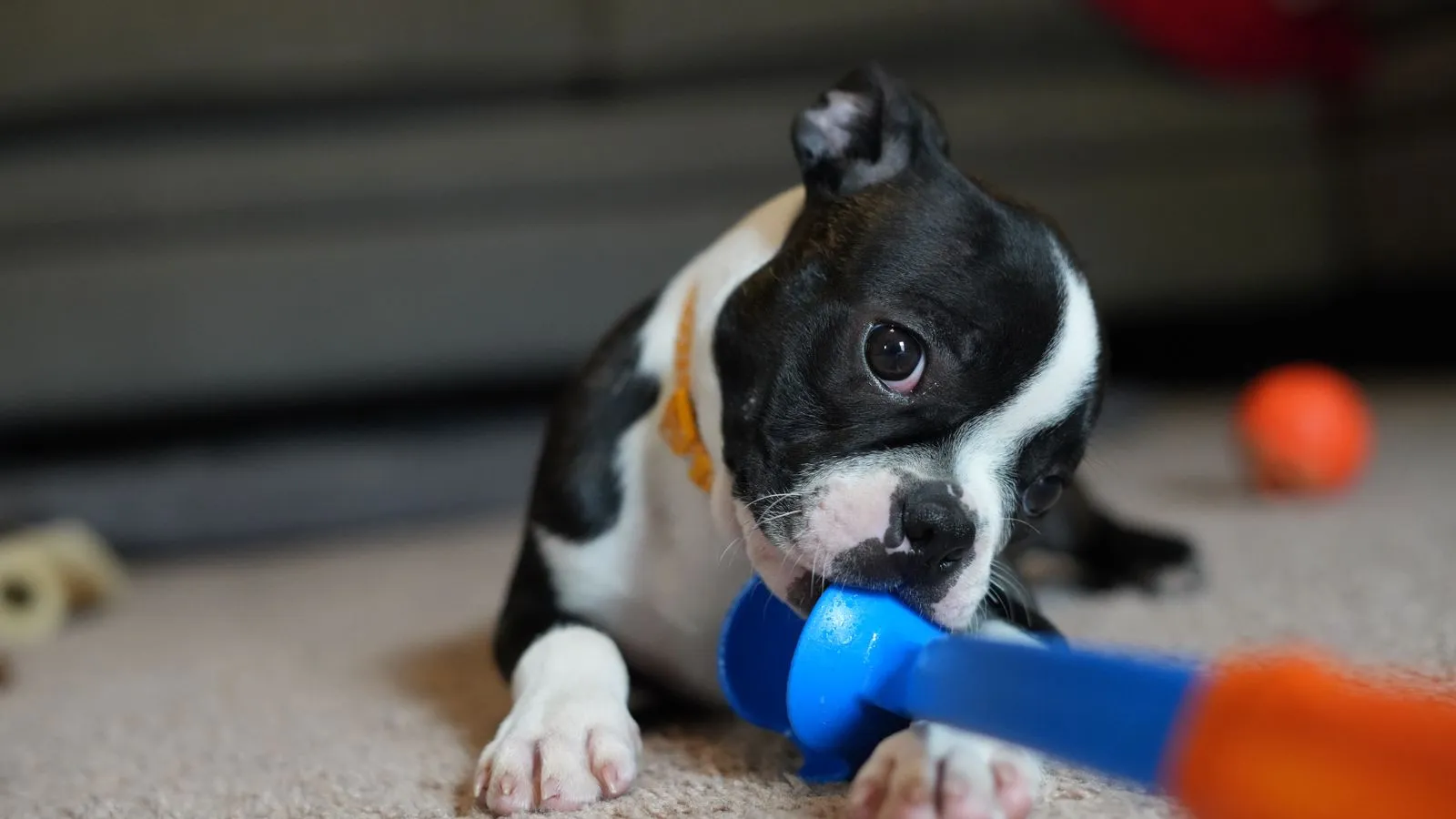
The useful challenge sits narrowly above what the puppy can already do. A five-week-old that walks confidently across a flat pen can be given a low ramp; the same ramp at a steeper angle is not a better exercise, and probably a worse one. A food toy should at first be one the puppy empties within a minute or two, and only later one that takes longer.
What you are watching for is engagement followed by success: the puppy investigates, tries something, and the thing works. If it tries twice and walks away, you have gone too far, and the right response is to make the task easier rather than to wait and see whether the puppy toughens up. The aim of enrichment is to increase a dog’s ability to cope with challenge and its sense of control, and a puzzle that is never cracked serves neither.
Signs a puzzle is too hard: the puppy walks away, or starts biting, pawing frantically or barking at it. Make it easier at once. Use sturdy, size-appropriate food toys, check them after each use and throw away anything cracked or chewed into pieces — a swallowed fragment can block the intestine.
Deliberate waiting is worth treating as its own exercise, because it transfers most directly. Holding the bowl for a second or two while the puppies mill at your feet, and putting it down as the scramble subsides rather than when it peaks, is a small piece of learning about what works. As a practical suggestion, two seconds is enough at five weeks; five or ten by eight, and never long enough that the litter gives up on you. Feeding practicalities are in feeding the growing litter.
Frustration and helplessness are not the same scale
This is the distinction the article exists for, and it is not a matter of degree. Frustration is what a puppy feels when something it wants is briefly out of reach and its own behavior can close the gap. Helplessness is what an animal learns when behavior and outcome have come apart — when nothing it tries changes anything. The first is productive in small doses. The second is not a stronger version of it; it is a different lesson, and an unhelpful one.
The things that teach helplessness in a puppy pen are rarely dramatic. A barrier too high to climb and impossible to get around. A crate door shut on a puppy already distressed, so that crying has no effect. A food toy nobody checked, which cannot be emptied. Noise that cannot be escaped. The theme is the absence of an exit.
Repetitive behaviors — chasing its tail, spinning, sucking on itself or bedding, or fixating on lights and shadows — are not quirks to laugh at. They can be an early sign of chronic stress or a medical problem and are worth raising with your vet.
So the working rule is simple: every challenge you set should have a door in it. The puppy can get over the obstacle, around it, or leave. It can get the food out, or abandon the toy without losing its meal. It can withdraw from handling, the principle running through handling and body-handling exercises. Give a puppy the way out and you can afford to make the problem real. Beyond a certain point a challenge becomes a fright, and a frightened puppy learns nothing about persistence — that ground belongs to fear, recovery and building resilience.
In practice
A breeder introduces food-dispensing toys at six weeks. Two puppies work at them steadily; three lose interest within seconds. The instinct is to leave the toys in and let the quitters learn. Instead she loosens them so food falls out almost immediately, and the three go back. Over ten days she tightens them again, and all five now work for several minutes. The variable was never the puppies’ persistence — it was whether the first attempt paid.
(Illustrative, composite scenario.)
Adding difficulty to food raises the stakes between littermates. Give each puppy its own station, or work with one puppy at a time. A puppy that freezes over food, growls or snaps at littermates or people near its bowl needs more space and separate feeding; if it persists, talk to your veterinarian.
What this buys the new owner, and what it does not
Be careful what you claim. A litter raised with solvable problems and predictable routines goes home with a history of effort being worthwhile, and that makes certain things easier: the first lead, the first closed door, the first evening alone in a strange kitchen. It does not produce a dog that never becomes frustrated, and it does not inoculate against behavior that develops later in a home where nothing is asked.
What you hand over is a starting point and an accurate description of it: what the puppy has worked at, what it can empty, how long it will wait for a bowl. Telling a buyer that the way to keep that is to let the puppy keep succeeding does more good than a list of tricks.
Work on it
A few minutes here will teach you more than re-reading the article.
Ask yourself
- Is there anything in my pen right now that requires a puppy to try something and rewards it for doing so?
- When a puppy gives up on something, do I make the task easier or leave it and hope?
- Does every challenge I set have a way out — over, round, or away?
Find out & check
- Check your notes from the last litter for the week the puppies first became able to climb and problem-solve, and compare it with the week you added anything to the pen.
Do one thing
- Add one solvable obstacle today — a low step, a hanging cloth, a shallow tray — easy enough that every puppy manages it on the first afternoon.
Was this article helpful?
Anonymous. We do not store your name, email or IP address.
Sources & further reading
- Merck Veterinary Manual — Behavior Problems of Dogs. merckvetmanual.com
- VCA Animal Hospitals — Using Predictability, Scheduling, and Enrichment to Train Your Dog. vcahospitals.com
- Purdue University Center for Animal Welfare Science — Enrichment. caninewelfare.centers.purdue.edu
- Gazzano A et al. — Effects of early gentling and early environment on emotional development of puppies, Applied Animal Behaviour Science, 2008 (Purdue summary). caninewelfare.centers.purdue.edu
- Boone G et al. — The Effect of Early Neurological Stimulation on Puppy Welfare in Commercial Breeding Kennels, Animals, 2023. mdpi.com
- McEvoy V et al. — Canine Socialisation: A Narrative Systematic Review, Animals, 2022. mdpi.com
- American Animal Hospital Association — 2015 AAHA Canine and Feline Behavior Management Guidelines. aaha.org
- Cornell University College of Veterinary Medicine, Riney Canine Health Center — Gastrointestinal foreign body obstruction in dogs. vet.cornell.edu
Where evidence is limited, recommendations rest on established practice and expert judgment, and may be updated as knowledge develops.
Next steps
- Read next: Early learning and a puppy’s first training.
- Related: Fear, recovery and building resilience.
- Return to the area hub: Behavior and development.