Every dog you breed will spend the rest of its life having its feet held, its ears looked into and its mouth opened by people it has only just met — and the weeks it spends in your house are when that becomes either unremarkable or frightening.
The most important first
- Handling can begin in the first days of life: veterinary behavior guidelines place gentle tactile and thermal handling in the neonatal period, birth to around thirteen days.
- Work through a body map rather than a general cuddle — feet and toes, ears, mouth, tail and rear, being lifted, standing on a raised surface.
- Keep sessions to a minute or two, several times a day, and end them while the puppy is still relaxed rather than when it stops struggling.
- Reward during the touch, not after it: when your hands are on the puppy food appears, and when they come off it stops.
- The same hands already do the daily health check in daily care and hygiene routines — handling is that routine done deliberately, not an extra job.
What handling is really preparing for
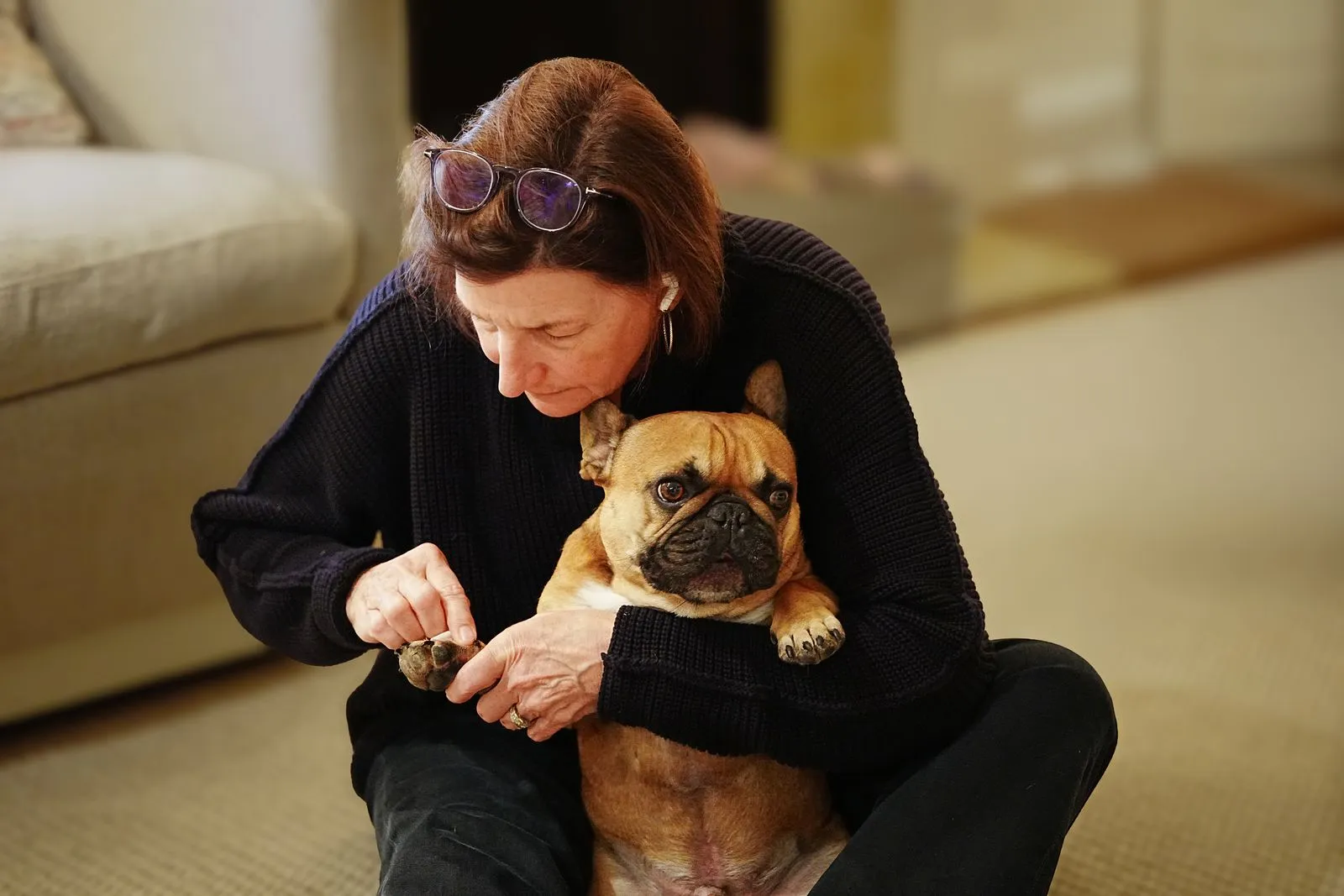
The immediate argument is veterinary. The 2015 AAHA behavior management guidelines cite one study of 135 dogs in which 78.5% showed fear on the examination table, and note that forceful handling and manual restraint can interfere with the outcome of a case: a dog held down is harder to examine and more likely to injure someone. The guidelines single out the procedure that goes wrong first — a nail trim needing several people to hold the animal. That is rarely a training failure at four years old; it is usually something never taught at four weeks.
Development sets the timing. Established veterinary behavior guidance is that puppies should be handled from birth and learn to accept manipulation of all body parts, with the first three months the easiest period for it — the reasons are in critical developmental periods and windows.
A body map, not a cuddle
A puppy that enjoys being cuddled has not necessarily learned anything useful. Work through the specific things that will be done to it, one at a time: feet held and turned, each toe separated and each nail touched, then touched with the clippers, then clipped; ears lifted, looked into and wiped; lips lifted to see the teeth, then the mouth opened; tail and rear, including where a thermometer goes; the collar hold, which is how most dogs are caught for the rest of their lives; being lifted and set down; being held lying on one side; and standing still on a raised surface with a non-slip mat, the posture of both the grooming table and the consulting room.
Build in two variations. The first is being handled by someone who is not you, which falls in the weeks the litter is least protected against infection — so manage it rather than banning visitors: known healthy people, clean hands, shoes off, no dogs brought along, as in infection control and biosecurity and vaccination and immunity. The second is being handled alone, away from the litter, which is also a small dose of crate, travel and short separations.
Consent, recovery and the length of a session
The change that matters is from restraint to cooperative care. Restraint asks how to keep the puppy still; cooperative care asks how to make it willing to stay still, and treats a puppy that moves away as information rather than disobedience. In practice: short sessions after a meal or a nap rather than mid-play, food arriving while your hands work and stopping when they lift off, few repetitions, then finish. Know the signs that say stop — squirming, leaning away, cowering, whining, nipping, refusing food it would normally take, or hiding when the clippers appear.
A puppy wriggling because it is eight weeks old needs a steadier hold and a shorter session. A puppy trying to get away needs you to pause, let it re-settle and resume at a smaller step. What you should not do is hold on until the struggling stops: that removes the early warning signs rather than the fear behind them.
A puppy that tolerated a touch yesterday and pulls away today is telling you something. Before you treat it as a training setback, check the area. A sore ear, a split nail, a small wound or a tender belly can make a puppy guard one body part. If the reluctance is new, sudden and limited to one area, ask your veterinarian to take a look.
In practice
A breeder has handled a litter every day and is confident about it, but the first nail trim at six weeks goes badly: one puppy screams, and the session ends with two people holding it. Reviewing what was practiced, the breeder finds feet had been touched but the clippers never introduced on their own. The rebuild takes two weeks of ten-second sessions — clippers visible and food, clippers touching a foot and food, one nail and stop.
(Illustrative, composite scenario.)
Early neurological stimulation, and what is known about it
Buyers and other breeders will ask about early neurological stimulation, usually under the name “Bio Sensor” or the Battaglia protocol. As published it is five brief exercises — tactile stimulation between the toes, the puppy held with its head erect, held with the head pointed down, held on its back, and placed briefly on a cool damp towel — each for three to five seconds, once a day, from the third to the sixteenth day of life. The claimed benefits are improved cardiovascular performance, stronger adrenal function, greater tolerance of stress and greater resistance to disease.
Be straight about the evidence. Those claims are attributed to earlier military work rather than supported by data in the article that popularized them, and the few controlled studies in dogs have found little or no clear benefit. In a 2011 study of 81 puppies from ten litters bred as mine detection dogs, ENS made no difference to development or later training compared with littermates given the same amount of attention. A randomized study in a commercial kennel found no improvement in health or stress responses at eight weeks. One study of working dogs did find some later differences, but its authors suggest that caregivers’ extra attention may explain them. Neither endorsement nor dismissal is warranted. Gentle, brief daily handling of newborns has better support (one small study linked it to calmer, more exploratory puppies at eight weeks), and it is what the veterinary guidelines recommend, so a short daily routine that gets you to pick up every puppy is unlikely to do harm — but do not present it as proven, or let it stand in for socialization and habituation and environmental exposure, where the evidence is stronger.
Where your work ends
Handling tolerance is not banked permanently at eight weeks; it fades without maintenance, and adolescence tends to test it. What you hand over is something genuinely started — a puppy whose feet, ears and mouth have been handled by more than one person, that has been on a table, and that has never been held down — with a written note of what has been practiced and what has not. After that it belongs to the new owner, and no early work makes a dog permanently easy to handle.
Veterinary behaviorists suggest getting professional help, rather than more practice, when a puppy stops eating as soon as it is touched, growls or snarls, yelps, nips or hides during handling, or stays distressed even after you have made each step smaller. Strong distress repeated across sessions can leave a lasting fear of handling. An individual plan made early works far better than one made after the fear has set in.
Work on it
A few minutes here will teach you more than re-reading the article.
Ask yourself
- Can I list, body part by body part, what every puppy in this litter has had done to it — or only that they are “used to being handled”?
- Do my sessions end while the puppy is still relaxed, or when it gives up?
- Has anyone other than me handled these puppies, and has each been handled on its own?
Find out & check
- Ask your veterinary practice which handling they find puppies least prepared for — usually feet, mouths or the examination table — and practice that one first.
Do one thing
- Add the clippers to today’s handling round without cutting anything: show, touch a foot, feed, stop.
Was this article helpful?
Anonymous. We do not store your name, email or IP address.
Sources & further reading
- American Animal Hospital Association (AAHA) — 2015 AAHA Canine and Feline Behavior Management Guidelines. aaha.org
- VCA Animal Hospitals — Puppy Behavior and Training: Handling and Food Bowl Exercises. vcahospitals.com
- Schoon, A. & Berntsen, T. G., Journal of Veterinary Behavior 2011;6(2):150–157 — Evaluating the effect of early neurological stimulation on the development and training of mine detection dogs. sciencedirect.com
- Boone, G. et al., Animals 2023;13(1):71 — The Effect of Early Neurological Stimulation on Puppy Welfare in Commercial Breeding Kennels. mdpi.com
- Gazit, I., Terkel, J. & Goldblatt, A., Applied Animal Behaviour Science 2022;249:105588 — Are there long-term effects of early neurological stimulation (ENS) on working dogs? cris.haifa.ac.il
- Gazzano, A. et al., Applied Animal Behaviour Science 2008;110:294–304 — Effects of early gentling and early environment on emotional development of puppies. eprints.soton.ac.uk
- American Veterinary Society of Animal Behavior (AVSAB) — Position Statement on Puppy Socialization (2008). avsab.org
- Battaglia, C. L. — Early Neurological Stimulation & Puppy Development (conference paper, 2005; origin of the ENS claims, not evidence for them). vin.com
Where evidence is limited, recommendations rest on established practice and expert judgment, and may be updated as knowledge develops. Nothing here is veterinary advice: a puppy that cannot be handled without distress should be discussed with your veterinarian.
Next steps
- Read next: Play and social communication between puppies.
- Related: Daily care and hygiene routines.
- Return to the area hub: Behavior and development.