The hard part of keeping a puppy from your own litter is not knowing what to look for — it is making the decision in a way that survives contact with eight weeks of living with them, because by then you are the least impartial judge in the room.
The most important first
- Write the criteria down before the puppies are evaluated, ideally before they are born, and rank them: what is non-negotiable, what you would trade, what you are simply curious about.
- One session on one day is weak evidence. In a longitudinal study of Border collies — 99 puppies tested as neonates, 134 at 40–50 days and 50 again at 1.5–2 years — exploratory activity was the only behavior significantly correlated between the puppy test and the adult test.
- Use several independent kinds of evidence: repeated observation over weeks, structure assessed more than once, health results, and at least one opinion you did not produce yourself.
- The decision does not have to be final at eight weeks. Running on two or three, keeping one back longer, or placing on co-ownership terms all buy time, and experienced breeders caution against a firm verdict before about a year old.
- Keeping none is a legitimate outcome, and the discipline to reach it is what separates a breeding program from a collection of dogs you happened to like.
Decide what you are selecting for before you look
A selection decision is only as good as the question it answers. Before the litter is on its feet, write down what this mating was meant to produce and what you would need to see to say it worked: the traits your program is short of, the faults you are trying not to reproduce, the health results you will insist on, the function the dog must perform. That belongs with the reasoning in designing a long-term breeding program and choosing a future breeding prospect, and the useful version is specific: not “good temperament” but “recovers from a startle within a minute, settles alone, works in noise”.
Then rank the list. Almost every litter forces a trade — the best-made puppy is not the boldest, the bitch with the temperament you want carries a fault you have been breeding away from. Ranked in advance, that trade is made on purpose. Ranked afterwards, you will promote whichever criterion your favorite happens to satisfy, and you will not notice you have done it.
Why one evaluation is not evidence
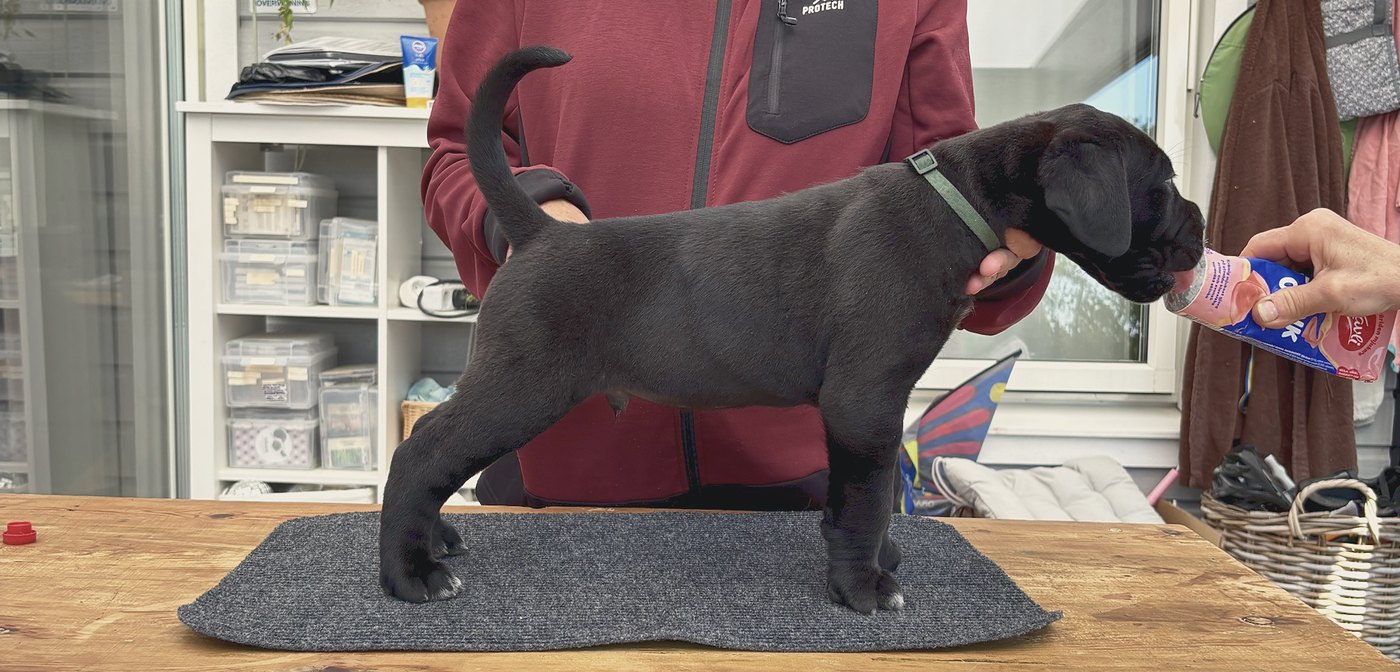
Formal puppy tests are usually run in a single session at around seven weeks, and they are far weaker as predictors than their popularity suggests. The Border collie study above found little correspondence between behavior in the neonate, puppy and adult tests, and concluded that the predictive validity of early tests for specific adult traits is limited; one study found no relationship between social behavior scores at seven and sixteen weeks. That does not make testing pointless — it makes it one reading among several, as set out in puppy aptitude tests and their limits and what puppy tests can and can’t predict.
This cuts both ways. A review of many studies found puppy behavior is only moderately consistent over time — less so than in adult dogs — so a single test is weak evidence, but repeated, dated observations do tell you something real.
What replaces it is not intuition but density of observation — the whole argument of observing and documenting individual puppies. Ten short dated notes across four weeks on how a puppy handles frustration, noise, being alone and being handled beat one scored test, because they show the trait’s range rather than one point on it.
Several kinds of evidence, including one that is not yours
Behavior is only one strand. Structure needs looking at more than once, because puppies pass through phases that flatter and then deceive: assess it as evaluating conformation and physical development in puppies describes, at intervals and from photographs taken the same way each time, so you are comparing the puppy with itself. Health is a gate rather than a preference — findings from evaluating puppy health before placement and the results your breed’s schemes require under health screening and health schemes can rule a prospect out whatever else it has. If the dog is meant to work, assessing working aptitude and function belongs in the file too.
The FCI’s breeding strategies put it plainly: only functionally and clinically healthy dogs with a sound temperament typical for the breed should be bred, and dogs with excessive fear or unprovoked aggression should be left out. Write those exclusions into your criteria before you look at the litter.
The strand most breeders skip is the outside eye. Invite someone who knows the breed, owes you nothing and did not breed the litter, and ask them to go through the puppies without being told which you like — best, worst, and why. A mentor relationship of the kind described in mentorship and continuing education is worth more here than anywhere else.
In practice
A breeder writes three criteria on the litter card before whelping: hips and elbows clear of the line’s weak point, a bitch, and a puppy that settles alone by seven weeks. At eight weeks her favorite is the puppy that runs to meet her at the pen door, which satisfies none of the three. She runs on two instead of choosing, tells both prospective homes they are second in line, and at eleven months the quieter bitch is unambiguously the better animal. The puppy she would have kept on day fifty-six is now a much-loved pet in a home two hours away.
(Illustrative, composite scenario.)
Keeping the decision open — and what it costs
There are legitimate ways to delay. You can run on two or three puppies and place the others later, which is why experienced show breeders advise against a firm verdict until a dog is at least a year old and through its adolescent awkwardness. You can keep one back a few weeks longer. Or you can place a puppy in a home that agrees in advance to breeding terms or shared ownership — what guardian homes, breeding rights and co-ownership exists to structure — which gives the dog a normal life while you keep an option on it.
Each has a price, and the puppy pays it. A puppy held back alone loses the litter as a social partner at exactly the age it most needs varied experience, and puppies become steadily less ready to accept new people, places and sounds from about three to four months of age — so it needs its own outings and visitors now, not a quiet pen while its siblings go out into the world. Co-ownership has a different cost: it is a relationship, and in our experience it fails on unclear expectations more often than on the dog.
Learning does not stop at three to four months, but it gets slower and harder. A puppy you hold back while its littermates leave needs a plan of its own: daily short outings to new places, new people of different ages, other safe, vaccinated dogs, and time alone in small steps. Keep its vaccination and worming on the schedule your veterinarian set, and keep weighing it — a puppy left alone can go off its food.
Kennel blindness, and the courage to keep none
Kennel blindness is the ordinary failure here, and worth naming plainly rather than treating as something other breeders have: your own dogs become the standard you judge by, so their faults stop being visible and their virtues are weighted more heavily each generation. Its companion in puppy selection is choosing the puppy that has bonded to you. The blunt warning in the breeder literature is that you can sell the best puppy and keep the least, then defend it on the grounds that he was so sweet.
Two habits protect you. The first is the written criteria, set when you had no favorite and checkable afterwards. The second is accepting “none of them” as an answer: a litter that produces no prospect has still done its job if the puppies are healthy and well placed, whereas keeping a mediocre animal because you felt owed one commits your program to it for years. Waiting for the next litter is cheaper than breeding from a compromise you talked yourself into at eight weeks.
Talk to your vet when planning: book a full examination before you finalize a keeper, including heart, bite, hernias, eyes and testicles in males, and ask when preliminary hip and elbow screening fits.
Work on it
A few minutes here will teach you more than re-reading the article.
Ask yourself
- Are my criteria for this litter written down somewhere I can check, and were they written before the puppies were evaluated?
- Which puppy have I become attached to, and can I state honestly whether it meets the criteria or the criteria have been quietly adjusted?
- If no puppy in this litter reaches the standard, what do I actually do — and am I willing to do it?
Find out & check
- Ask one person who knows the breed and did not breed this litter to assess the puppies without being told your preference, and write down what they say before you argue with it.
Do one thing
- Write your three non-negotiable criteria for this litter on the litter card today, dated, and leave them there.
Was this article helpful?
Anonymous. We do not store your name, email or IP address.
Sources & further reading
- American Kennel Club — “The One”: Thoughts on Puppy Selection. akc.org
- American Kennel Club — Picking a Show Prospect Puppy From Your Litter. akc.org
- Riemer S et al. (2014), PLOS ONE — The Predictive Value of Early Behavioural Assessments in Pet Dogs. journals.plos.org
- Fratkin JL et al. (2013), PLOS ONE — Personality Consistency in Dogs: A Meta-Analysis. journals.plos.org
- FCI — International Breeding Strategies. fci.be
- Orthopedic Foundation for Animals — Preliminary Evaluations. ofa.org
- American Veterinary Society of Animal Behavior — Position Statement on Puppy Socialization. avsab.org
- Merck Veterinary Manual — Normal Social Behavior in Dogs. merckvetmanual.com
Where evidence is limited, recommendations rest on established practice and expert judgment, and may be updated as knowledge develops.
Next steps
- Read next: Assessing prospective puppy buyers.
- Related: Choosing a future breeding prospect.
- Return to the area hub: Understanding and placing each puppy.