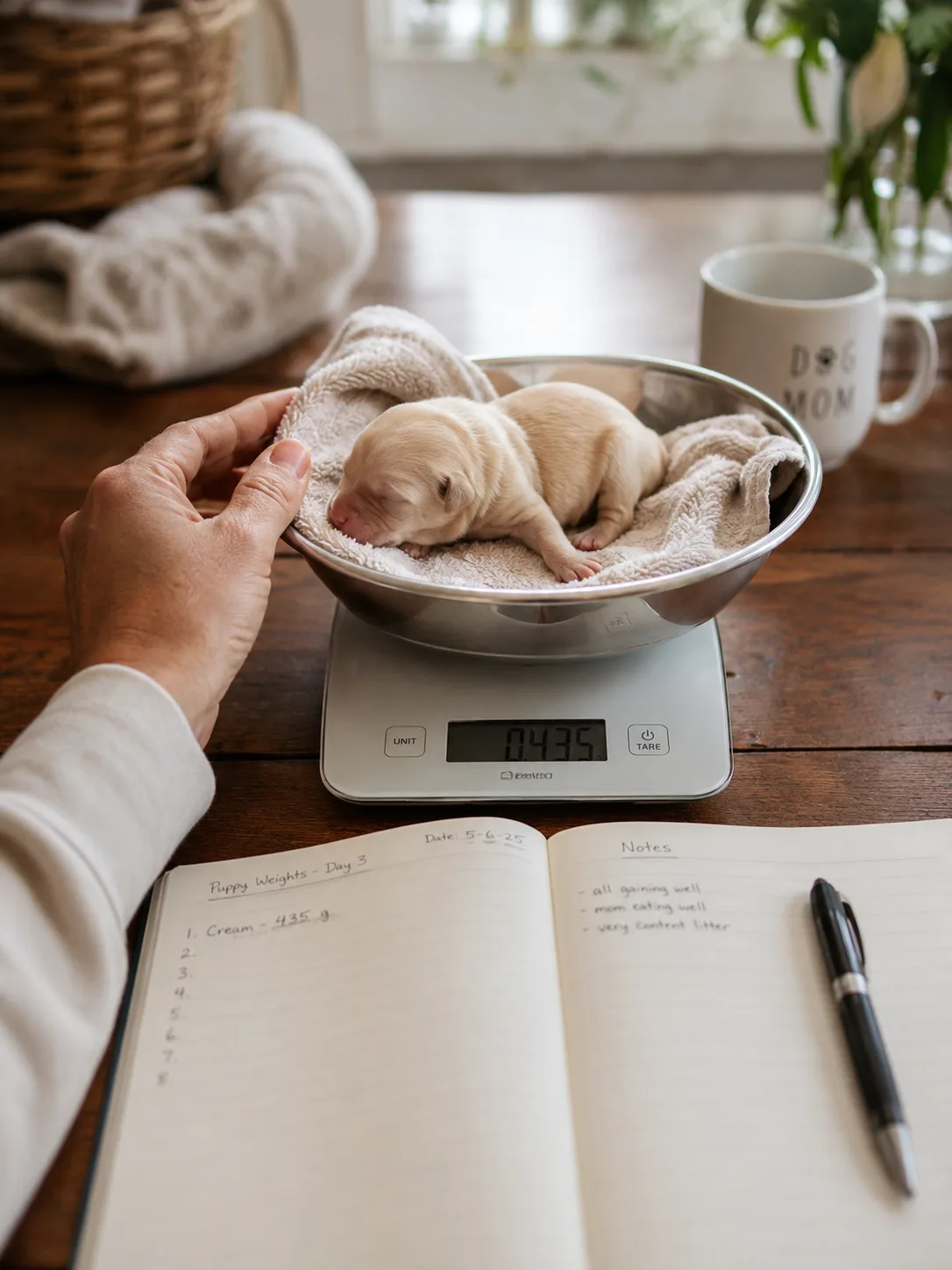
A condensed, practical run-through of what needs to be ready before your bitch whelps — the space, the supplies, the signs, and the point at which you stop managing and start calling.
The most important first
- Set the whelping area up at least two weeks (ideally two to three) early so the bitch has time to settle into it before labor.
- Supplies need to be gathered and within reach in advance — not sourced once labor has started.
- The temperature drop below 99°F (37.2°C) is the most reliable single sign that whelping is close.
- Knowing your limits in advance — and having your vet’s out-of-hours number ready — matters more than any supply on the list.
- For the full itemized version, use the whelping preparation checklist.
Prepare the space early
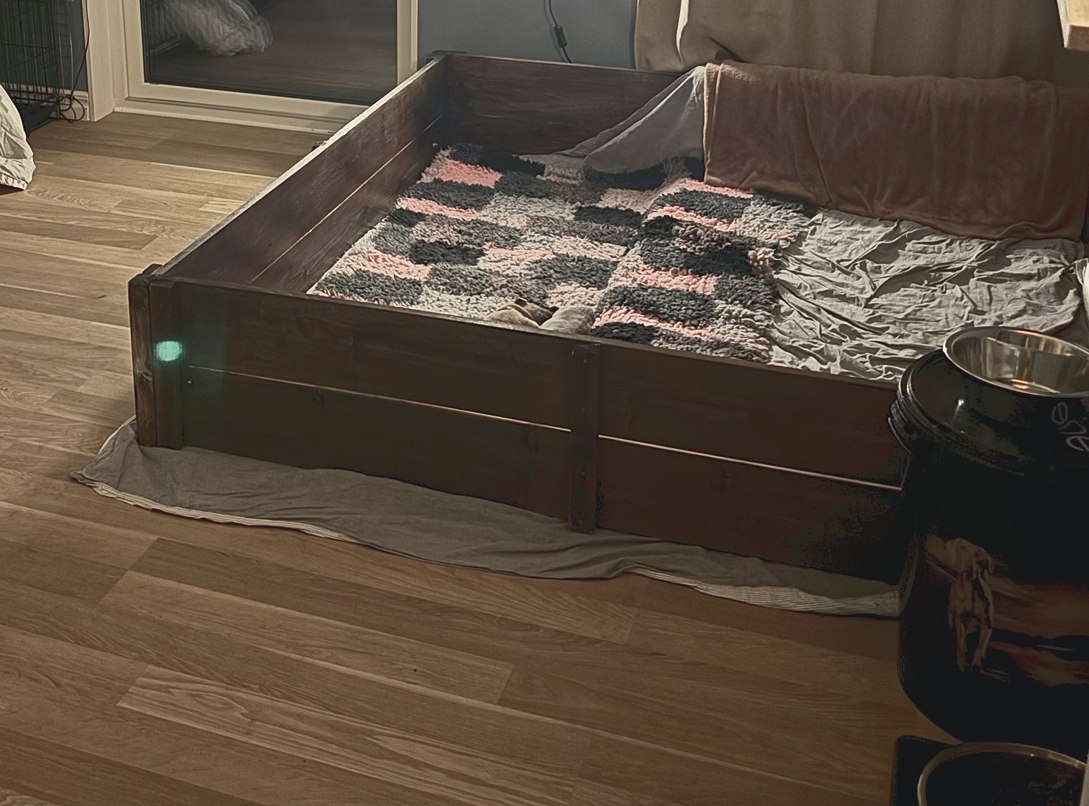
The whelping box should be in place and in use well before the due date — at least two weeks, and ideally two to three, is a reasonable margin. A bitch that has already chosen to sleep in the box is far less likely to try to whelp somewhere inconvenient, and the extra time lets you find problems with heating, traction, or placement while there’s still time to fix them. Setting up the whelping area and equipment covers sizing, pig rails, heating, and bedding in detail.
Have your supplies ready
The essentials are unglamorous: clean towels in quantity, a digital thermometer, a gram-accurate scale, a bulb syringe or mucus trap, non-slip bedding, a heat source with a genuine cooler zone alongside it, and a notebook or log for recording times and weights. Gather these into one place rather than leaving them scattered — the point of preparation is that nothing needs finding at two in the morning.
In practice
A breeder assembles a thorough supply kit but stores it in a cupboard in another room. When labor starts unexpectedly early, the time spent fetching it is time not spent observing the bitch. Keeping the kit physically beside the whelping box — not merely owned, but positioned — is the difference between prepared and nearly prepared.
(Illustrative, composite scenario.)
Recognize the signs of labor
Nesting behavior, restlessness, panting, and sometimes loss of appetite can begin a day or two ahead and usually intensify in the last 6 to 12 hours before labor, but the most reliable single indicator is a rectal temperature drop below 99°F (37.2°C) from her normal 99.5–102.5°F (37.5–39.2°C), which typically occurs within 24 hours of birth. The drop can last only a few hours, which is why taking her temperature two or three times a day in the final week matters — signs that whelping is near covers what to watch for and how to interpret it.
A normal whelping helps you judge an abnormal one. Once strong contractions begin, the first puppy usually arrives within anything from half an hour to a few hours. Later puppies often come 15–60 minutes apart, sometimes with longer rests, and the whole litter is usually born over roughly 3–12 hours. Flat-faced, short-legged and large-headed breeds, and very small breeds, more often have difficulty, so if you breed these, agree a plan with your veterinarian before the due date. Keep count of puppies and placentas, and compare the total with the X-ray count (taken from about day 55) so you know when she has finished.
Know your limits
The most important preparation isn’t a supply — it’s deciding, calmly and in advance, what you will handle and what you will hand over. Have your vet’s contact details including out-of-hours somewhere you can find instantly, and read when whelping doesn’t go to plan before the due date rather than during an emergency. Knowing the specific thresholds — 20–30 minutes of strong straining with no puppy, more than about two hours between puppies when more are expected, green or black discharge before the first puppy — is what turns a vague sense that something is wrong into a decision you can act on.
Alongside those, contact your veterinarian if:
- her temperature has dropped and labor has not started within 24 hours of the drop;
- she has weak or on-and-off contractions for about 2 hours without producing a puppy (never wait more than 4 hours);
- the whole whelping has gone on for more than 24 hours;
- there is heavy bleeding, or a foul-smelling discharge;
- a puppy or sac is visible at the vulva and isn’t moving out with her pushes;
- she has a fever above 103°F (39.5°C), collapses, vomits repeatedly or seems in severe pain;
- she reaches about 70 days after the first mating (or about day 66 from the LH surge).
Dark green or black discharge before the first puppy is an emergency: call your vet immediately, because it can mean a placenta has separated while the puppy is still inside. Once it appears during whelping, a puppy should follow promptly.
When to call your vet
- Green or black discharge before the first puppy — emergency, call immediately.
- Strong straining for 20–30 minutes with no puppy.
- Weak or intermittent contractions for about 2 hours with no puppy — never wait more than 4 hours.
- More than about 2 hours between puppies when more are expected.
- No labor within 24 hours of the temperature drop, or about 70 days after the first mating.
- Fever above 103°F (39.5°C), heavy bleeding, or a puppy stuck at the vulva.
- If in doubt, call — your vet would rather hear from you early.
Work on it
A few minutes here will teach you more than re-reading the article.
Ask yourself
- Is the whelping box already set up and being used, or still on my to-do list?
- Is my supply kit physically beside the box, or stored somewhere I would have to go and fetch it?
- Have I read the warning-signs article already, rather than planning to read it if something goes wrong?
Find out & check
- Check that your vet’s out-of-hours number works, before you need it at 3am.
- Find out what your vet considers “too long” between puppies for your particular bitch and breed.
Do one thing
- Work through the full whelping preparation checklist and mark off what is genuinely done.
Was this article helpful?
Anonymous. We do not store your name, email or IP address.
Sources & further reading
- Cornell University, Riney Canine Health Center — The Normal Whelping Process. vet.cornell.edu
- VCA Animal Hospitals — Breeding for Pet Owners: Whelping in Dogs. vcahospitals.com
- American Kennel Club — Best Practices for Whelping & Caring for Newborn Puppies. akc.org
- Merck Veterinary Manual — Dystocia in Small Animals. merckvetmanual.com
- Merck Veterinary Manual — Whelping and Queening in Bitches and Queens. merckvetmanual.com
- The Royal Kennel Club — Whelping Your First Litter. royalkennelclub.com
- Purdue University College of Veterinary Medicine and Extension (J. H. Koziol) — What to Expect When… Your Dog is Expecting. extension.purdue.edu
- Purdue University, Croney Research Group (Canine Welfare Science) — Setting Up a Welfare-Friendly Whelping Area. caninewelfare.centers.purdue.edu
Where evidence is limited, recommendations rest on established practice and expert judgment, and may be updated as knowledge develops. This is general information, not a substitute for immediate veterinary care during an actual whelping emergency.
Next steps
- Read next: Preparing for whelping: the final two weeks.
- Related: Whelping preparation checklist · Signs that whelping is near · Warmth and the whelping-box microclimate.
- Return to the area hub: Whelping: the complete guide.