In the final hours before labor begins, a bitch’s body and behavior both signal that whelping is close — knowing these signs means you’re ready when it starts, rather than caught off guard.
The most important first
- Behavioral changes — restlessness, nesting, panting — commonly appear 6 to 12 hours before labor.
- A temperature drop below 99°F (37.2°C) is often brief (around 8 hours) and easy to miss; labor usually follows within about 24 hours.
- Clear to white vaginal discharge is normal in this window; green or black discharge before the first puppy is an emergency — call your vet immediately.
- Not every sign appears in every bitch — the temperature drop is the most reliable single indicator.
- This is the point to have your whelping preparation checklist fully complete, not in progress.
Behavioral signs
In the 6 to 12 hours before labor, many bitches show clear nesting behavior — digging at or shredding bedding, restlessness, an inability to settle — alongside visible discomfort and increased panting. Not every bitch shows dramatic nesting behavior, so its absence isn’t reassuring on its own; it’s one signal among several, not a required one.
The temperature drop: the most reliable sign
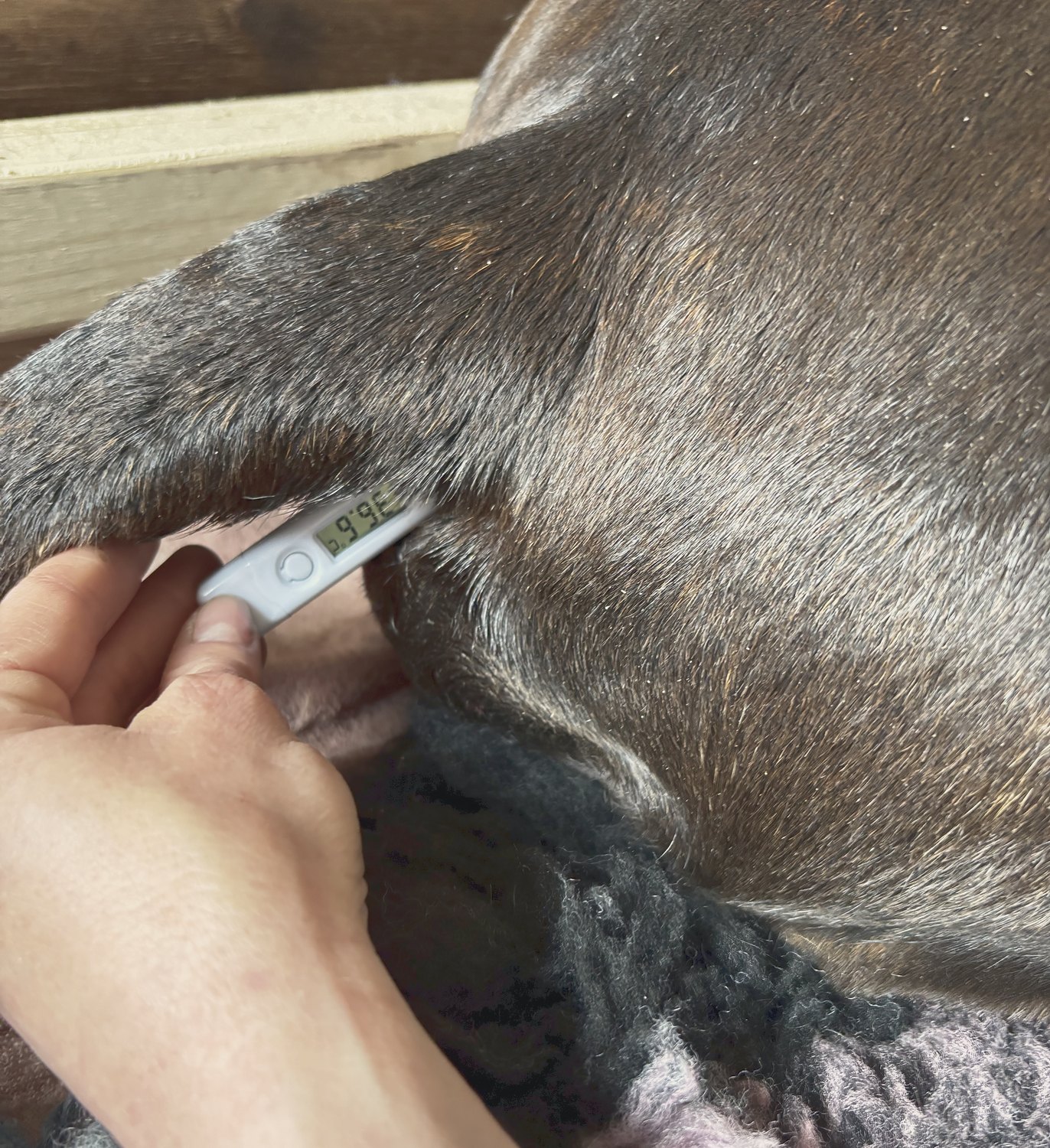
A pregnant bitch’s normal temperature runs roughly 99.5–102.5°F (37.5–39.2°C). A drop below 99°F (37.2°C) — often brief (around eight hours) and easy to miss, with labor usually following within about 24 hours — is the single most reliable physiological sign that whelping is close — which is why monitoring and documentation recommends regular temperature checks in the final days of pregnancy, rather than relying on behavior alone.
In practice
A breeder notices their bitch seems unusually restless one evening but her temperature, checked that afternoon, was still normal — so they assume it’s a false alarm and don’t check again until morning. Checking temperature again that evening would have caught the drop as it happened, giving several more hours of preparation time than waiting until the next scheduled check.
(Illustrative, composite scenario.)
Because the drop can be short, it is easy to miss between readings, and some bitches never show a clear dip — so a missing drop does not mean labor is far off. Take at least two readings a day at roughly the same times and write each one down. Once you see a reading below about 99°F (37.2°C), labor usually starts within the next 24 hours. If 24 hours pass after the drop with no signs of labor, call your vet.
Discharge as a signal
Clear to white vaginal discharge in the final stretch of pregnancy is generally normal, but a green-tinged discharge is a specific and important signal — it indicates placental separation and means a puppy should follow promptly. This is different from the abnormal discharge (bloody, foul-smelling, or green well before this stage) covered in the pregnant bitch’s health: what’s normal and what’s not — context and timing both matter for interpreting discharge correctly.
If you see green or black discharge before the first puppy has been born, treat it as an emergency and call your vet immediately — the unborn puppy may be short of oxygen. Between later puppies, a little green fluid just before or after a birth can be normal, but if no puppy follows within about 15–30 minutes, call.
If she seems overdue
Due dates counted from mating are imprecise, because sperm survive for days and ovulation timing varies. If labor has not started by about day 70 after the first mating (or about day 66 from the LH surge, if your vet timed ovulation), call your vet. Your vet can check her progesterone, which falls shortly before labor begins, and use ultrasound to check the puppies’ heartbeats. A progesterone test is also how vets confirm timing for a planned cesarean.
When to call your vet
- Green or black discharge appears before the first puppy — call immediately.
- Labor has not started within 24 hours of the temperature drop.
- She reaches about day 70 after the first mating (or about day 66 from the LH surge) without labor.
- Her temperature rises above 103 °F (39.5 °C) instead of dropping.
- Once labor starts: strong straining for 20–30 minutes with no puppy.
- If in doubt, call — your vet would rather hear from you early.
Work on it
A few minutes here will teach you more than re-reading the article.
Ask yourself
- Am I checking her temperature regularly in the final days before the due date, or only when I notice other signs?
- Would I recognize green discharge as a specific signal, distinct from other discharge changes?
- Is my whelping area, and everything on the preparation checklist, genuinely ready right now?
Find out & check
- Find out how often your vet recommends checking temperature as the due date approaches.
- Check that you have a reliable digital thermometer and know how to use it correctly.
Do one thing
- Start twice-daily temperature checks once you’re within about a week of the estimated due date.
Was this article helpful?
Anonymous. We do not store your name, email or IP address.
Sources & further reading
- Cornell University Riney Canine Health Center — The Normal Whelping Process. vet.cornell.edu
- Merck Veterinary Manual — Whelping and Queening in Bitches and Queens. merckvetmanual.com
- UC Davis School of Veterinary Medicine — Whelping in the Bitch. healthtopics.vetmed.ucdavis.edu
- Purdue University Extension — What to Expect When Your Dog Is Expecting (VA-29-W). extension.purdue.edu
- Cornell University Riney Canine Health Center — Dystocia in Dogs: Understanding Difficult Births. vet.cornell.edu
- VCA Animal Hospitals — Breeding for Dog Owners: Problems at Birth. vcahospitals.com
Where evidence is limited, recommendations rest on established practice and expert judgment, and may be updated as knowledge develops.
Next steps
- Read next: What a normal whelping looks like.
- Related: Calculating the due date.
- Return to the area hub: Whelping: the complete guide from first contractions to recovery.