When a dog flies as cargo or checked baggage, the crate is the dog’s entire environment for the journey, and a crate that fails the airline’s check at the counter means the dog does not fly — so the container rules are worth knowing in detail before the booking, not on the day.
The most important first
- Airlines carrying live animals work to the IATA Live Animals Regulations (LAR). The container standard for dogs and cats is widely called CR82; IATA’s current pet container document, for LAR Edition 52 (January 2026), numbers it Container Requirement 1, with a separate requirement for animals traveling in the cabin. Whichever label your airline uses, the content is what counts.
- Size the crate from the dog, not the label on the box: internal length is the dog’s nose-to-tail-base length plus half its elbow height, width twice the shoulder width, and height the standing height plus bedding. Snub-nosed breeds need a container 10% larger.
- Construction matters as much as size: no all-wire crates, wheels removed or disabled, a door forming one whole end, ventilation on all four sides, and a water bowl fixed inside that can be filled from outside without opening the door.
- Up to three weaned puppies that are used to living together may share a crate if they are no older than six months and weigh no more than 14 kg (31 lb) each. Dogs over 14 kg travel alone.
- The airline’s own rules sit on top of IATA’s and can be stricter: breed bans for snub-nosed dogs, temperature limits and seasonal embargoes are common. In the US, dogs must be at least eight weeks old and weaned before they can be transported commercially.
Rules last checked: November 1, 2026
We checked this page against the official sources listed below on the date above. IATA publishes a new edition of the Live Animals Regulations regularly, airlines change their own rules and embargoes, sometimes by season, and no single page can cover every route, so something that matters for your flight may have been amended since, or may not be covered here at all. Before you book, check these as well:
- The airline’s current live-animal policy: accepted breeds, crate sizes for the aircraft on your route, temperature limits, embargoes and whether puppies can fly at all.
- The current LAR edition: ask the airline which edition it applies and whether anything in the container requirement has changed.
- The destination country or state: health certificate, vaccination, identification, import permit, minimum age and quarantine rules — see export and international sales.
- Transit points: a connection in another country can bring that country’s rules and an extra handling stage.
- Your own legal position as a seller: shipping a puppy to a buyer who has not seen it can change which rules apply to you, as in breeding and selling puppies in the United States.
Ask the airline to confirm the crate and the booking in writing, and keep the confirmation with the puppy’s papers.
What CR82 is, and why the name varies
The International Air Transport Association publishes the Live Animals Regulations, the standard airlines use to decide whether an animal and its container can be accepted. Within it, each kind of animal has a container requirement. The one for dogs and cats has been known for years as CR82, and you will still see that name on crate packaging, airline pages and transport companies’ checklists. IATA’s pet container document for the January 2026 edition lists the requirement for domestic cats and dogs as Container Requirement 1 and gives in-cabin travel its own, partly relaxed, requirement. The practical point is the same: what the airline checks at the counter is the size and construction of the crate, not the label.
Sizing the crate
IATA sizes the container from four measurements of the dog standing naturally: A, the length from the tip of the nose to the base of the tail; B, the height from the ground to the elbow joint; C, the width across the shoulders or the widest point, whichever is greater; and D, the height from the floor to the top of the head or the ear tips, whichever is higher. For one dog, the internal length is A plus half of B, the width is C times two, and the height is D plus the height of the bedding. For two animals the width becomes C times three, and for three animals C times four, always measuring the largest animal. Snub-nosed breeds need a container 10% larger.
Measure on the day you book, not weeks earlier: a ten-week-old puppy can outgrow a crate between booking and departure. And remember that the airline must be able to fit the crate on the aircraft serving your route, so check the maximum size with them before you buy.
How the crate must be built
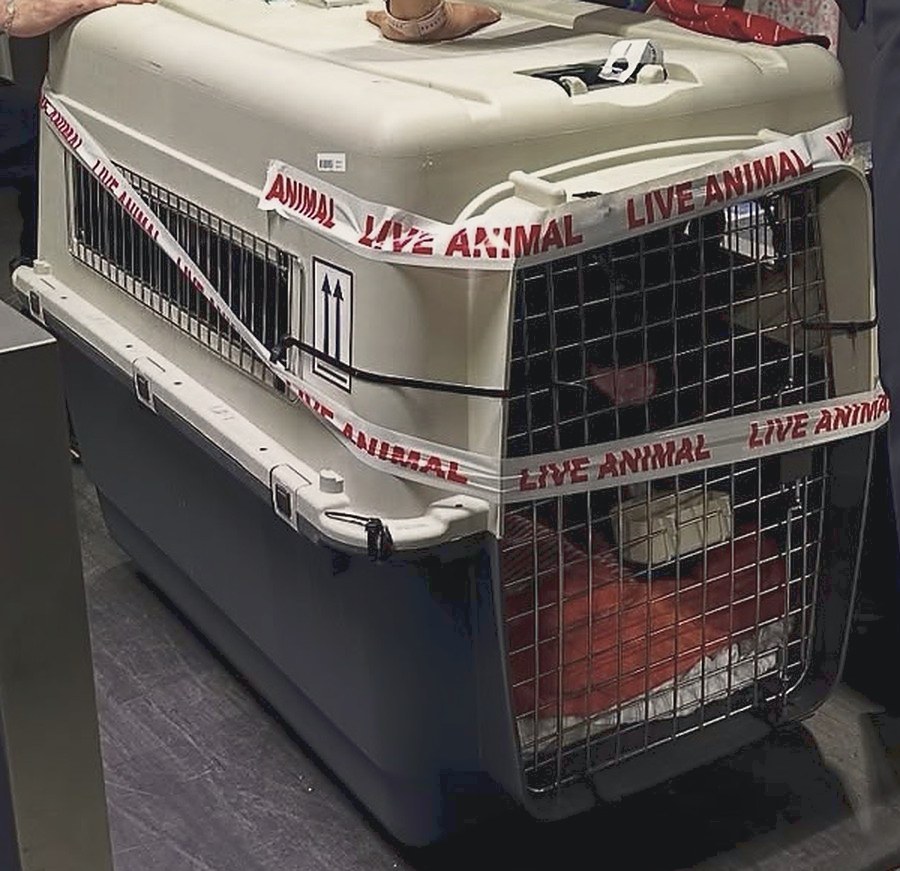
IATA’s container requirement sets out construction rules that most failed check-ins come down to:
- Materials: fiberglass, metal, rigid plastics, welded wire mesh, solid wood or plywood, with wood meeting international phytosanitary standards. Crates made entirely of welded wire mesh are not accepted, and some airlines will not carry wooden crates.
- Wheels: removed or made inoperable.
- Door: forming one whole end of the crate, made of sufficiently thick plastic, wood, plywood or welded or cast metal; a plastic door is acceptable only if its hinges and locking pins are sufficiently thick metal, and locking pins must engage by at least 1.6 cm (about 5/8 in).
- Ventilation: at least 16% of the surface of the four sides, with openings on all four sides; on the sides and back they must be in the upper two-thirds, and one whole end must be welded mesh.
- Floor and bedding: a solid, leak-proof floor with absorbent bedding suitable for the animal.
- Water and food: a water container fixed inside, which can be filled from outside without opening the crate; food containers inside if sealed, or attached to the crate.
- Handling: spacers along both long sides and along the back, suitable handles, and forklift spacers if the total weight exceeds 60 kg.
- Labels: a green “Live Animals” label and “This Way Up” labels on at least two opposite sides. The US Department of Transportation also advises labeling the crate with your name, address and phone number, and putting the same details on a tag on the dog.
Veterinary organizations name defective crates as the most common reason animals escape or are injured during air travel. On the day of travel, check every bolt, pin and door catch, and look for cracks, even in a crate that passed inspection before.
How many dogs per crate
IATA allows weaned puppies to travel together if they are used to living together (they do not have to be littermates), are no older than six months, weigh no more than 14 kg each, and number no more than three per container. Two adult dogs of comparable size, up to 14 kg each, may share if they are compatible and used to living together; anything heavier travels alone. IATA notes that animals from the same household can become aggressive toward each other in transit, so they should not share unless they are young, and that some countries require individual crating in all cases. For a single puppy flying to a new home, its own crate is almost always the better choice.
Airline and US rules on top
IATA sets the floor; airlines set their own policies above it, as the US Department of Transportation reminds travelers. American Airlines Cargo, for example, does not accept snub-nosed (brachycephalic) breeds of dogs and cats, treats 45–85°F (7–29°C) as its safe temperature range, and embargoes warm-blooded pet shipments to, from or through several hot-climate airports from May 1 to September 30. Other carriers have different lists and limits, so confirm for the airline and route you are actually booking.
In the United States, USDA APHIS states that dogs must be at least eight weeks old and weaned before an owner or operator of a regulated business, a commercial carrier or an intermediate handler can transport them. The Department of Transportation adds that most airlines require a health certificate from a licensed veterinarian who examined the animal within ten days before shipment. International journeys bring their own age, vaccination and permit requirements, which can make the earliest possible flight much later than the age at which the puppy is ready to leave you.
US rules also set a cold limit: animals may not be exposed to temperatures below 45°F (7°C) unless a veterinarian certifies that they are acclimated to lower temperatures. Some airlines limit how many animals they carry per flight, so book early and reconfirm at least 48 hours before departure.
Preparing the dog
The crate should be familiar long before the flight. Start crate conditioning weeks in advance, as described in crate, travel and short separations, with the actual travel crate if possible, and put a piece of bedding that smells of home inside on the day. IATA advises reducing the amount of food the day before while giving enough water, and a light meal at least two hours before handing the dog to the carrier; the Department of Transportation advises avoiding solid food in the six hours before the flight. Ask your veterinarian and the airline which applies to your dog and route, especially for young puppies, whose needs differ from adults’.
Do not sedate. IATA recommends against sedating or tranquilizing animals in transit, warns that some sedatives can affect balance and breathing, and says that where sedation is needed for a valid medical reason it should be under veterinary direction, with the drug, time and dose noted on the health certificate. Choose a nonstop flight where you can, avoid busy holiday periods and hot weather, and confirm drop-off and pick-up times; the heat risks are covered in heatstroke, and the buyer’s side of the journey in the first journey and the first days at home.
Heat, breathing and snub-nosed breeds
Short-nosed (brachycephalic) dogs have a harder time cooling themselves and breathing under stress. This is why many airlines refuse them as cargo or restrict when they can fly. Any dog can overheat in a hold or on a hot ramp, so book flights in the cooler part of the day in warm months. Before you book a snub-nosed breed, ask your veterinarian whether flying is reasonable for that individual dog.
In practice
A breeder ships a twelve-week-old puppy to a buyer in another state in a crate bought online and labeled “airline approved”. At the cargo counter the agent points out that the plastic door has plastic locking pins and that the water bowl can only be filled by opening the door. The flight leaves without the puppy. The breeder now buys crates only after checking the airline’s own list against IATA’s requirements, fixes the bowl and labels the day before, and photographs the crate from all sides to send with the booking.
(Illustrative, composite scenario.)
On arrival
Arrange for the buyer to collect the dog as soon as it is released. Open the crate in a quiet, enclosed space, not in a parking lot. Offer water and a chance to relieve itself. Watch the dog’s breathing, gum color and alertness. Small and toy-breed puppies can run low on blood sugar after a long fast and stress, so the buyer should offer a small meal soon after arrival and know where the nearest emergency veterinary clinic is.
When to call your vet
- Before booking: if your dog is a short-nosed breed, very young, elderly, or has any heart or breathing condition.
- If anyone suggests sedation for the flight: only use it if your vet directs it and records it on the health certificate.
- On arrival: if the dog is panting heavily, drooling, weak, wobbly, confused, vomiting or collapsing. This can be heatstroke, which is an emergency — start cooling the dog and go to the nearest vet.
- If a small puppy is trembling, weak, uncoordinated or unusually sleepy after the journey: low blood sugar needs a vet immediately.
- If the dog has diarrhea, refuses food, or is not acting normally within a day of arrival.
- If in doubt, call — your vet would rather hear from you early.
Work on it
A few minutes here will teach you more than re-reading the article.
Ask yourself
- Have I measured the dog for A, B, C and D this week, or am I guessing the crate size from its age?
- Does my crate’s door, ventilation and water bowl meet the requirement, or does it only say “airline approved” on the box?
- Does the airline I am booking accept this breed, at this age, on this route and at this time of year?
Find out & check
- Ask the airline for its current live-animal policy in writing, including accepted crate sizes for the aircraft, breed restrictions, temperature limits and the LAR edition it applies.
Do one thing
- Make a crate checklist from this page and tick it off, with photos, the day before every flight.
Was this article helpful?
Anonymous. We do not store your name, email or IP address.
Sources & further reading
- International Air Transport Association — Container Requirements (Live Animals Regulations, Edition 52, January 2026). iata.org
- International Air Transport Association — Traveler's Pet Corner. iata.org
- USDA APHIS — Minimum Age Requirements for Transporting Dogs and Cats. aphis.usda.gov
- US Department of Transportation — Plane Talk: Traveling with Animals. transportation.gov
- American Veterinary Medical Association — Traveling with your pet: FAQs. avma.org
- Cornell University College of Veterinary Medicine, Riney Canine Health Center — Heatstroke: a medical emergency. vet.cornell.edu
- American Airlines Cargo — Summer Safety Measures – Pets & Animals (airline policy, example). aacargo.com
Where evidence is limited, recommendations rest on established practice and expert judgment, and may be updated as knowledge develops. Airline policies, the IATA Live Animals Regulations and national rules change; the airline’s current requirements and the destination’s official rules always take precedence over this page. This is general information and does not replace advice from your veterinarian, your airline or the authorities concerned.
Next steps
- Read next: Export and international sales.
- Related: Crate, travel and short separations.
- Return to the area hub: From first inquiry to settled puppy.