When a planned mating doesn’t result in a pregnancy, it’s easy to assume the worst — but infertility is usually investigable, and timing errors are by far the most common underlying cause. This guide covers how a proper investigation actually works.
The most important first
- Poor timing is the single most common cause of apparent infertility in dogs.
- A proper investigation starts with history — of both dogs, and of the mating itself.
- Vaginal cytology and progesterone records help establish whether timing was actually correct.
- Both the bitch and the stud dog should be evaluated — infertility isn’t automatically a “her problem.”
- A single failed mating doesn’t necessarily mean either dog has an infertility problem.
- Every infertility or pregnancy-loss investigation should include Brucella canis testing of both dogs.
Why timing is investigated first
Timing errors are consistently identified as the most common cause of apparent infertility, which is why a proper investigation starts by reviewing exactly how and when the mating was timed — ideally against actual progesterone log records rather than memory. Without records, it can be genuinely difficult to distinguish a timing problem from a true fertility problem, which is one of the strongest practical reasons to keep detailed records for every mating attempt, not just the ones that seem to be going wrong.
What a full investigation covers
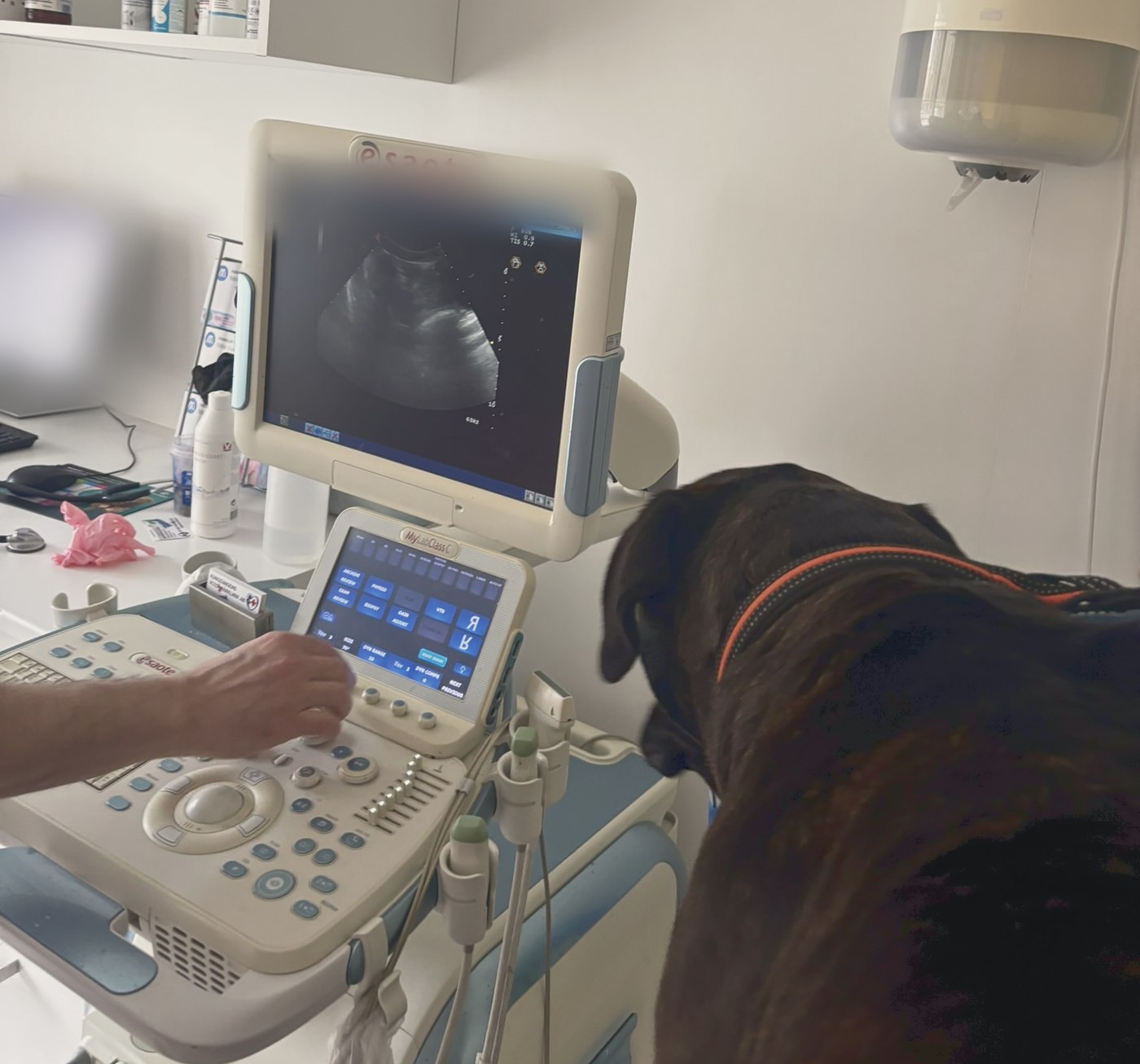
Beyond timing, a thorough infertility work-up takes a detailed history from both dogs — prior illnesses, vaccination status, previous cycles or breedings, and the reproductive history of close relatives, since some fertility issues run in families. Physical examination checks mammary and vulvar conformation in the bitch, and testicular and prostatic health in the male. Vaginal cytology and vaginoscopy can confirm what stage of the cycle a bitch was actually in at the time of mating, and microbial cultures can identify an infection contributing to the problem. On the male side, a full fertility evaluation — physical exam plus semen analysis — checks whether sperm quality, not just mating ability, might explain the outcome.
Every infertility or pregnancy-loss investigation should include Brucella canis testing of both dogs, even if they tested negative before, because the infection often causes no other signs. If a bitch aborts or resorbs a litter, wear gloves when handling any discharge or tissue, and ask your veterinarian about testing it.
Start with the stud
Veterinary guidance is to evaluate the male first, because it is quicker and easier. If his semen is normal on evaluation, he is rarely the cause. A single poor sample is not enough to label a dog infertile: semen should be re-checked on another day, at least 48 hours later. A fever, illness, heat stress or some medications in the previous two months can temporarily lower semen quality.
In practice
A bitch fails to conceive after what seemed like a well-timed natural mating. Rather than assuming she’s simply “not fertile,” her vet reviews the progesterone log, repeats vaginal cytology, and requests a semen evaluation on the stud used. The investigation finds the mating actually happened a day or two outside the fertile window — a timing issue, not a fertility problem with either dog — which changes what’s tried differently next time.
(Illustrative, composite scenario.)
(Illustrative, composite scenario.)
When to investigate, and what comes next
A single unsuccessful mating, particularly a natural one without progesterone-confirmed timing, doesn’t necessarily indicate an infertility problem in either dog — it may simply mean the timing was off. Investigation becomes more clearly warranted after repeated failures with confirmed correct timing, or when other signs (irregular cycles, unusual discharge, known infection, or a male with poor semen quality on evaluation) point to something beyond timing alone. Working through this systematically, rather than guessing, is what turns a frustrating outcome into a specific, addressable finding.
For perspective, most healthy, proven pairs produce a litter within one or two well-timed cycles. Keep a record of each heat, including start date, length, and the interval since the previous one. Intervals of roughly five to eight months are typical for many breeds, but some breeds cycle only once a year. Very short intervals, split heats or heats that seem to go on for weeks are worth raising with your veterinarian. An underlying uterine condition (cystic endometrial hyperplasia, which can lead to pyometra) is also a common cause of repeated failure to conceive.
When to call your vet
- A bitch that has not conceived develops vaginal discharge, drinks more than usual, vomits, seems lethargic or has a swollen belly in the weeks after her heat — call the same day; this can be a uterine infection (pyometra).
- A bitch aborts, resorbs or has stillborn puppies — wear gloves, keep any material chilled for your vet, and ask about Brucella testing.
- A male has a swollen, painful or shrinking scrotum or testes, or a poor semen result.
- Either dog has a fever above 103 °F (39.5 °C) around mating or in the weeks after.
- Heats are very close together, split, or seem to last for weeks, or a bitch stops cycling.
- Two well-timed matings with a proven partner have failed — time for a structured investigation.
- If in doubt, call — your vet would rather hear from you early.
Work on it
A few minutes here will teach you more than re-reading the article.
Ask yourself
- Do I have detailed enough records from the mating in question to review timing properly?
- Have both dogs been considered in the investigation, not just the bitch?
- Am I distinguishing a single unsuccessful mating from a pattern that actually warrants investigation?
Find out & check
- Find out what a full infertility work-up involves and costs at your vet or a reproduction specialist.
- Check whether the stud dog used has had a recent semen evaluation.
Do one thing
- Gather your progesterone log and mating records together before your next vet consultation about fertility.
Was this article helpful?
Anonymous. We do not store your name, email or IP address.
Sources & further reading
- Merck Veterinary Manual — Clinical Investigation of Canine Reproduction Disorders. merckvetmanual.com
- American Kennel Club / AKC Canine Health Foundation — Infertility in the Bitch (podcast with Dr. Cheryl Lopate, theriogenologist). akc.org
- Merck Veterinary Manual — Breeding Soundness Examination of Male Dogs. merckvetmanual.com
- Merck Veterinary Manual — Breeding Management of Bitches. merckvetmanual.com
- Joonè, C. — Evidence-based practice in canine artificial insemination, Australian Veterinary Journal, 2024. pubmed.ncbi.nlm.nih.gov
- Merck Veterinary Manual — Pyometra in Small Animals. merckvetmanual.com
- Cornell University Riney Canine Health Center — Canine Brucellosis. vet.cornell.edu
Where evidence is limited, recommendations rest on established practice and expert judgment, and may be updated as knowledge develops.
Next steps
- Read next: Pre-breeding examinations and reproductive health checks.
- Related: Timing the mating: finding the fertile window · Progesterone timing log.
- Return to the area hub: Reproduction and fertility.