Good records during whelping aren’t just for afterward — the timing data you note down in the moment is often exactly what your vet needs to decide, quickly, whether something requires intervention.
The most important first
- Track rectal temperature at least twice a day in the final week, so you catch the pre-labor drop as it happens.
- Log the exact time of each puppy’s birth — this is what lets you (or your vet) judge whether a gap is normal or not.
- Record presentation (head-first or breech) and placenta count for each puppy as you go.
- Note discharge changes: green or black before the first puppy is an emergency; later, green with no puppy within about 15–30 minutes, or foul-smelling discharge, is a reason to call.
- Objective timing data helps a vet make a faster, better-informed call than a general description of “it’s been a while.”
What to track before labor starts
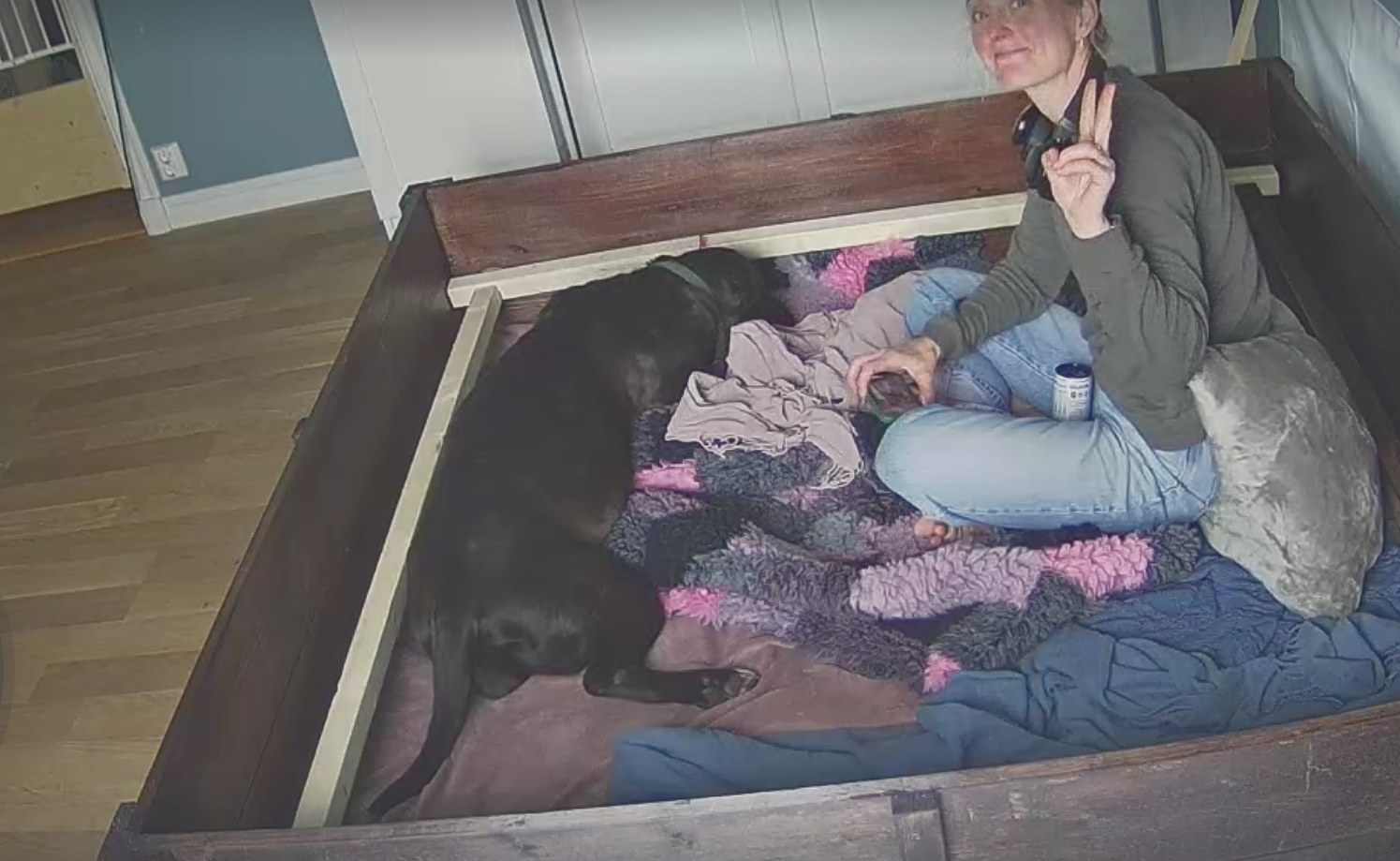
At least twice-daily temperature checks in the final week before the due date are what let you catch the drop below 99°F (37.2°C) that signals stage 1 is beginning, with labor usually following within about 24 hours — this is covered in more detail in signs that whelping is near. Recording each reading, not just checking and moving on, means you can see the trend rather than relying on memory of “it seemed normal earlier.” A pregnant bitch normally reads about 99.5–102.5°F (37.5–39.2°C); if labor has not started within 24 hours of the drop, call your vet.
If your vet has taken an x-ray (from about day 55 of pregnancy), write the expected number of puppies at the top of your sheet. Tick off puppies and placentas as they arrive, so you can see at a glance whether she is finished or has stalled.
What to track during labor
For each puppy: the exact time of birth, sex, presentation (head-first or breech), and whether a placenta was delivered with or shortly after it. The time-of-birth log is what turns a vague sense of “it’s been a while since the last one” into an actual number you or your vet can act on — the specific triggers covered in the stages of labor (20–30 minutes of strong, unproductive straining, or more than about 2 hours of rest with more puppies expected) only work if you know precisely when the last puppy arrived.
So for each puppy, write down two times: when strong, visible straining began and when the puppy was born. The first is the one your vet will ask about — if strong straining has lasted 20–30 minutes without a puppy, call. Also note the time you first see any dark green or black discharge: before the first puppy it is an emergency, and later, if no puppy follows within about 15–30 minutes, call your vet.
In practice
A breeder calls their vet partway through a whelping, and the first question is “how long has it been since the last puppy?” Because they’ve been noting times as each puppy arrives rather than trying to reconstruct it from memory under pressure, they can answer immediately and precisely — which speeds up the vet’s assessment of whether this is normal spacing or a reason for concern.
(Illustrative, composite scenario.)
Discharge and what changes mean
Discharge that’s clear to white through labor, briefly green just before a birth (placental separation), is normal. Green or black discharge before the first puppy (an emergency — call immediately), green discharge with no puppy following within about 15–30 minutes later in the whelping, or discharge that’s foul-smelling or unusually heavy, is not — noting the color and timing of discharge changes, alongside your puppy-birth log, gives you and your vet a fuller picture than either piece of information alone.
After the last puppy
Weigh each puppy once it is dry, again at about 12 and 24 hours, and then twice a day for the first week. Check that every puppy nurses within the first 24 hours, so it gets colostrum. A healthy puppy should weigh at least 1.5 times its birth weight by day 7 and double it by about day 10–14; one that loses weight after the first day, or is not gaining, needs prompt attention from your vet.
For the dam, note her temperature, appetite, discharge and the feel of her mammary glands every day. Normal discharge after birth is dark red to brown, decreases over the following weeks and has no bad smell. A foul smell, a sudden increase, a fever above 103°F (39.5°C), or a hard, hot gland are reasons to call your vet.
Why this documentation matters afterward, too
Beyond the whelping itself, a record of exactly what happened — timing, presentation, placenta count, any concerns noted in the moment — is useful input for postpartum vet checks and for your own whelping log, which carries this information forward into each puppy’s individual records as the litter grows.
When to call your vet
- Strong straining for 20–30 minutes without a puppy (this is why you log when straining starts).
- Weak or on-and-off contractions for about 2 hours with no puppy — never wait more than 4 hours.
- More than about 2 hours between puppies when your count says more are expected.
- Green or black discharge before the first puppy — call immediately.
- No labor within 24 hours of the temperature drop.
- A fever above 103°F (39.5°C) in the dam, or a puppy losing weight after the first day.
- If in doubt, call — your vet would rather hear from you early.
Work on it
A few minutes here will teach you more than re-reading the article.
Ask yourself
- Do I have a system ready for logging times and details in the moment, rather than planning to remember them?
- Would I be able to answer “how long since the last puppy” precisely if my vet asked mid-whelping?
- Am I tracking discharge changes, not just puppy arrivals?
Find out & check
- Find out what specific details your vet wants noted during labor, beyond the basics.
- Check that your temperature log from the final week is complete, not just the last reading.
Do one thing
- Set up your whelping log — see the whelping log tool — before labor begins, not during it.
Was this article helpful?
Anonymous. We do not store your name, email or IP address.
Sources & further reading
- Cornell University Riney Canine Health Center — The Normal Whelping Process. vet.cornell.edu
- UC Davis School of Veterinary Medicine — Whelping in the Bitch. healthtopics.vetmed.ucdavis.edu
- Merck Veterinary Manual — Whelping and Queening in Bitches and Queens. merckvetmanual.com
- Purdue University Extension — What to Expect When Your Dog Is Expecting (VA-29-W). extension.purdue.edu
- Cornell University Riney Canine Health Center — Dystocia in Dogs: Understanding Difficult Births. vet.cornell.edu
- Merck Veterinary Manual — Labor, Delivery, and Postpartum Care in Bitches and Queens. merckvetmanual.com
- American Kennel Club — Best Practices for Whelping & Caring for Newborn Puppies. akc.org
Where evidence is limited, recommendations rest on established practice and expert judgment, and may be updated as knowledge develops.
Next steps
- Read next: Whelping log.
- Related: The stages of labor, step by step.
- Return to the area hub: Whelping: the complete guide from first contractions to recovery.