Most whelpings go smoothly. Knowing what “smoothly” actually looks like — timing, presentation, placentas — is what lets you supervise calmly instead of second-guessing every normal moment.
The most important first
- Labor has three stages, with stages two and three (delivering puppies and placentas) overlapping in dogs.
- A rest of up to about two hours between puppies can be normal; strong straining for 20–30 minutes with no puppy is not.
- Puppies can be born head-first or tail-first — both are normal, as long as legs are extended straight.
- The dam typically eats the placentas, often without it being obvious this has happened.
- Call your vet after 20–30 minutes of strong straining with no puppy, or if more than about 2 hours pass between puppies when more are expected.
The three stages of labor
Stage one is uterine contractions and cervical dilation — often not visibly obvious from outside, though restlessness and nesting behavior usually continue or intensify. Stage two is the actual delivery of puppies, and stage three is delivery of the placentas; in dogs, unlike some species, these two stages effectively overlap, with a placenta often following each puppy rather than all placentas coming at the end. Understanding that stages two and three run together is part of why counting placentas as they come, rather than waiting for a distinct “placenta stage,” is the practical approach.
Timing between puppies
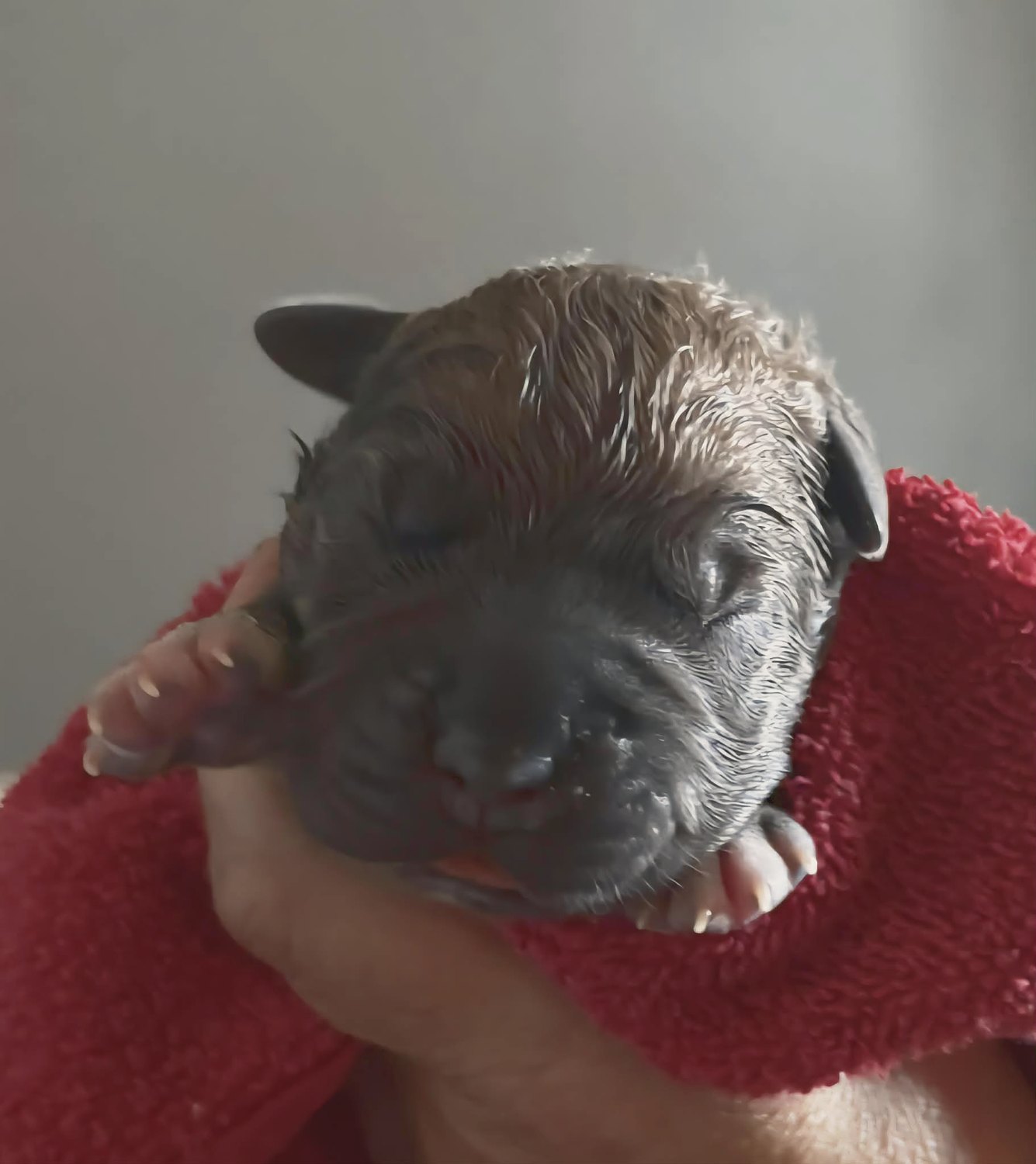
Once active labor is underway, a rest of anywhere from a few minutes up to about two hours between successive puppies is still considered within normal range — labor doesn’t proceed at a perfectly even pace, and gaps of this length don’t necessarily mean anything is wrong. When whelping doesn’t go to plan covers what genuinely counts as too long in more detail, but as a general marker, if more than about two hours pass without a puppy while more are expected, call your vet.
Two different clocks matter. The first is the rest between puppies, described above. The second is the time she spends actively straining: once strong, visible pushing starts, a puppy usually arrives within an hour, and often much sooner. If she strains hard for 20–30 minutes without producing a puppy, call your vet — do not wait for the two-hour mark. Weak or on-and-off contractions with no puppy for about 2 hours are also a reason to call; never wait more than 4 hours. First-time mothers often have longer rests than experienced ones.
In practice
A breeder becomes anxious after 90 minutes pass between the second and third puppy, despite the bitch resting calmly with no signs of distress. Understanding that up to two hours between puppies is within the normal range helps distinguish ordinary variation in labor’s pace from an actual concern, rather than treating every gap as a developing emergency.
(Illustrative, composite scenario.)
Presentation: head-first or tail-first
Puppies can be born either head-first or tail-first (breech), and both are considered normal presentations in dogs, unlike some other species — what matters is that the legs are extended straight rather than folded back, since a folded-leg presentation is more likely to cause a genuine delivery problem. This is a useful distinction to know in advance, since a first-time observer might assume tail-first delivery is automatically a problem when it typically isn’t.
If part of a puppy or a fluid-filled sac is visible at the vulva and has not moved forward for about 15 minutes despite pushing, call your vet for advice. Do not pull on the puppy unless your vet talks you through it.
Placentas
The dam typically eats each placenta as it’s delivered, which is a normal behavior, though it can happen quickly enough that it’s not always obvious to an observer that it occurred. Keeping a rough count of placentas delivered against puppies born, where practical, is useful for the whelping log — a placenta that seems to be missing is one of the things a vet will want to know about afterward.
A placenta often follows each puppy within minutes, but sometimes two puppies come before two placentas, some pass later, and a “missing” one has often simply been eaten unnoticed. If your count does not match, mention it to your vet at the postpartum check — sooner if she is unwell, has a fever above 103 °F (39.5 °C) or a foul-smelling discharge.
Discharge during delivery
Clear or slightly bloody fluid, and a small amount of green fluid immediately after a puppy is born, are normal. Green or black discharge before the first puppy is an emergency — call your vet immediately. Later in the whelping, thick dark green or black discharge with no puppy following, heavy bright-red bleeding, or a foul smell are reasons to call.
How long the whole whelping takes
Most litters are born within about 6–12 hours of the first puppy, though a large litter can take longer. A whelping that has not finished within 24 hours is never normal and needs veterinary attention. While she delivers the rest, keep the puppies already born warm and dry, and make sure each one nurses within the first 24 hours so it gets colostrum.
When to call your vet
- Strong straining for 20–30 minutes without a puppy.
- Weak or on-and-off contractions for about 2 hours with no puppy — never wait more than 4 hours.
- More than about 2 hours between puppies when more are expected.
- Green or black discharge before the first puppy — call immediately.
- A puppy or sac visible at the vulva without progress for about 15 minutes.
- Whelping not finished within 24 hours, heavy bleeding, or a fever above 103 °F (39.5 °C).
- If in doubt, call — your vet would rather hear from you early.
Work on it
A few minutes here will teach you more than re-reading the article.
Ask yourself
- Do I understand why stages two and three overlap in dogs, rather than happening as separate phases?
- Would I recognize a normal tail-first delivery as normal, rather than assuming it’s a problem?
- Do I know the two-hour marker for when a gap between puppies becomes a reason to call the vet?
Find out & check
- Find out your vet’s specific guidance on when to call during labor for your particular bitch or breed.
- Check that you have a way to keep rough time and count notes during labor itself.
Do one thing
- Review the stages of labor once more, calmly, before your bitch’s due date arrives.
Was this article helpful?
Anonymous. We do not store your name, email or IP address.
Sources & further reading
- Cornell University Riney Canine Health Center — The Normal Whelping Process. vet.cornell.edu
- UC Davis School of Veterinary Medicine — Whelping in the Bitch. healthtopics.vetmed.ucdavis.edu
- Merck Veterinary Manual — Labor, Delivery, and Postpartum Care in Bitches and Queens. merckvetmanual.com
- Cornell University Riney Canine Health Center — Dystocia in Dogs: Understanding Difficult Births. vet.cornell.edu
- PDSA — Whelping: a guide to your dog giving birth. pdsa.org.uk
- Lezama-García K et al. (Frontiers in Veterinary Science, 2023) — Uterine dynamics, blood profiles, and electronic fetal monitoring of primiparous and multiparous bitches. doi.org
Where evidence is limited, recommendations rest on established practice and expert judgment, and may be updated as knowledge develops.
Next steps
- Read next: The stages of labor, step by step.
- Related: Signs that whelping is near · When whelping doesn’t go to plan: warning signs.
- Return to the area hub: Whelping: the complete guide from first contractions to recovery.