Dystocia — difficulty delivering puppies without assistance — has both maternal and fetal causes, and understanding the difference helps you follow what your vet is assessing and why, whether the path forward is medical or surgical.
The most important first
- Dystocia means the dam can’t expel puppies through the birth canal without assistance; active labor over 4 hours without delivery meets the clinical threshold.
- Uterine inertia — contractions that never establish (primary) or that weaken after exhaustion (secondary) — is one of the most common causes.
- Brachycephalic breeds (Bulldogs, Pugs) and toy breeds face substantially higher dystocia risk — over half of brachycephalic births may need intervention.
- Diagnosis uses physical exam, x-rays, ultrasound (fetal heart rate), and bloodwork — not guesswork.
- Medical management (oxytocin, calcium) is vet-administered only; it’s contraindicated if there’s a physical obstruction.
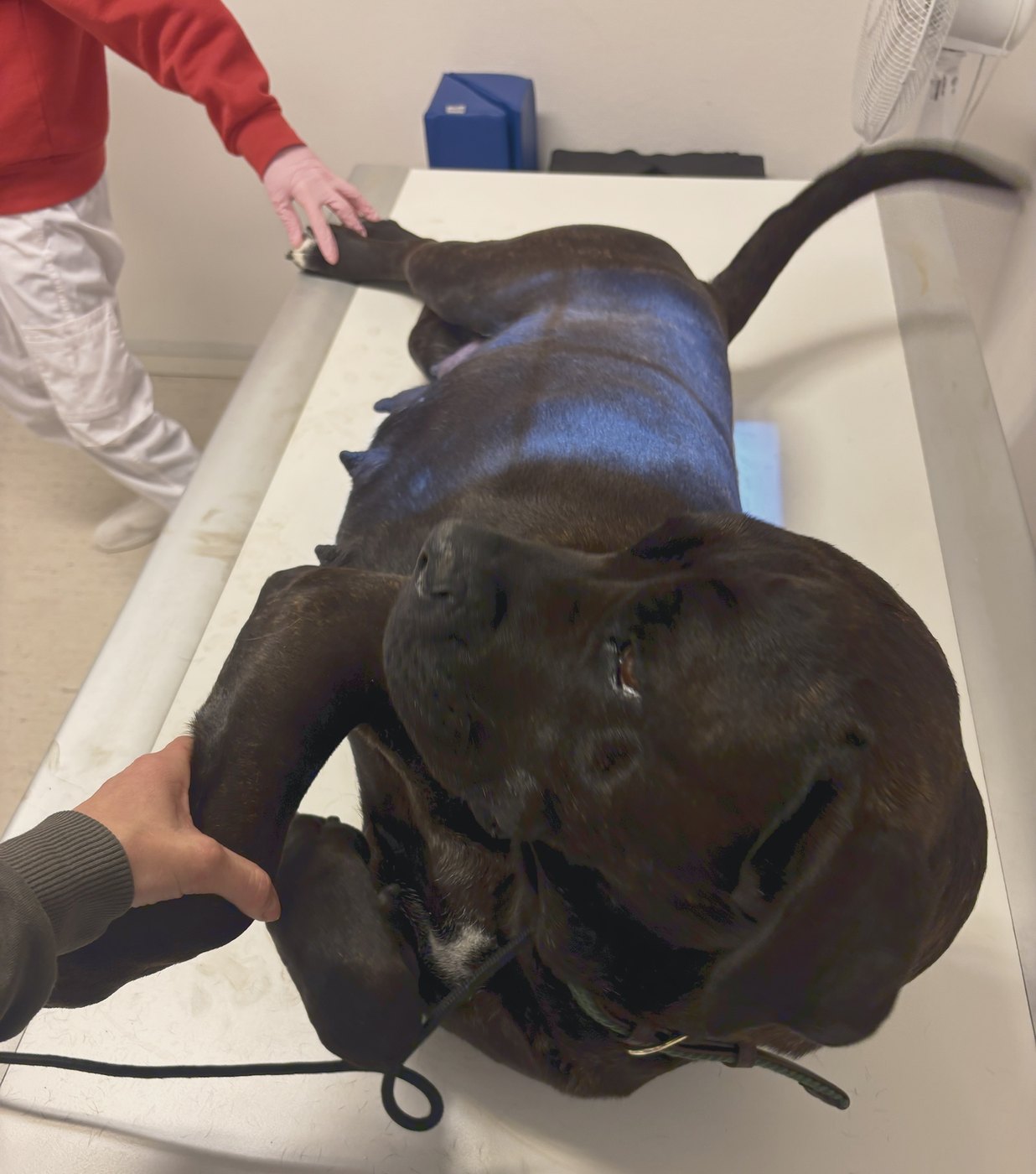
What dystocia means
Dystocia is the clinical term for a whelping that can’t progress normally without help — the dam is unable to deliver one or more puppies through the birth canal on her own. It’s diagnosed against specific thresholds: active labor lasting more than 4 hours without a puppy delivered, or a whelping that runs longer than 24 hours overall, both meet the criteria. The warning signs article covers the specific in-the-moment markers; this article covers what’s actually happening and why.
Dystocia is also suspected when pregnancy runs past about 70 days from the first mating (or about day 66 from the LH surge, if her ovulation was timed), or when labor has not started within 24 hours of her temperature drop. Ring your vet for advice in either case.
What you see at home: when to phone the vet now
Most dystocia is first noticed by the breeder, not the vet. The 4-hour figure above is a clinical definition, not a reason to wait. Phone your veterinarian straight away if you see any of the following:
- Green or black discharge before the first puppy has been born. This is an emergency: call immediately.
- Strong straining for 20–30 minutes without producing a puppy.
- Weak or occasional contractions for about 2 hours with no puppy. Never wait more than 4 hours.
- A puppy or its membranes visible at the vulva for more than about 15 minutes.
- More than about 2 hours between puppies when you know more are coming.
- Heavy bleeding, a foul smell, a temperature above 103 °F (39.5 °C), or a dam who seems exhausted, weak or ill.
Do not try to pull a stuck puppy out yourself unless your vet is talking you through it.
Uterine inertia: primary and secondary
Primary uterine inertia is when the uterus never mounts adequate contractions to begin with — the hormonal and mechanical triggers that should start labor don’t produce a strong enough response. Secondary uterine inertia is when contractions start normally but the uterine muscle exhausts itself, often after an obstruction or a very large litter has already required sustained effort. In both cases, the physiological feedback loop that should keep labor progressing (contractions triggering more contractions) breaks down.
Maternal risk factors
- Breed: brachycephalic breeds (Bulldogs, Pugs, and similar) carry substantially elevated risk — more than half of these births may require some form of intervention. Toy breeds such as Chihuahuas are also at higher risk, often related to pelvic size relative to puppy size.
- Obesity in the dam.
- Pelvic abnormalities, including old fractures that narrowed the birth canal.
- Age and parity: older dams carry increased risk, and a nervous first-time (primiparous) dam can hold back labor, especially if she is disturbed or in an unfamiliar place.
- Litter size at both extremes: very large litters (more than about 8 puppies) can exhaust the uterus through sustained effort, while very small litters — including a single puppy (singleton pregnancy) — may not provide enough stimulation to trigger normal labor, and a lone puppy is often oversized.
In a large UK study of first-opinion veterinary practices, about 4% of bitches had dystocia overall, but risk varied enormously by breed. French Bulldogs had roughly sixteen times the odds of crossbreds, and several other brachycephalic and toy breeds were also at clearly higher risk. In some brachycephalic and achondroplastic breeds, assisted delivery is close to the norm.
Fetal causes
- An oversized puppy relative to the dam’s pelvis.
- Malpresentation: a genuinely difficult presentation such as transverse position or a laterally deviated head — distinct from the normal variation of head-first vs. tail-first covered in what a normal whelping looks like.
- Congenital defects in the puppy, such as hydrocephalus.
- Fetal death, which can also stall labor.
Rarely, the cause is acute and life-threatening: a twisted uterus (uterine torsion) or a tear in the uterine wall (uterine rupture). Signs can include sudden pain, collapse, pale gums or labor that simply stops. These need emergency surgery.
In practice
A breeder whose bitch is confirmed pregnant with a single puppy via ultrasound is warned in advance by their vet that singleton pregnancies carry a higher dystocia risk — both because a lone puppy tends to grow larger than it would in a bigger litter, and because labor may not trigger normally without the hormonal signal multiple puppies typically provide. Knowing this ahead of time means the breeder and vet plan for closer monitoring around the due date, rather than being caught off guard.
(Illustrative, composite scenario.)
How vets diagnose it
Diagnosis combines abdominal palpation, radiographs (to assess fetal number, size, and position, and the dam’s pelvic dimensions), ultrasound (to check fetal heart rate — a rate below about 200 beats per minute suggests the puppy is under stress, and persistently lower rates (for example under 160 beats per minute) usually mean surgery is needed), and bloodwork checking glucose and ionized calcium levels.
Medical management vs. surgery
Where there’s no physical obstruction, a vet may attempt medical management: oxytocin in small, carefully spaced doses to stimulate contractions, sometimes preceded by calcium gluconate given intravenously to strengthen contraction response. These are vet-administered treatments only — oxytocin is contraindicated if an obstruction is present, since it risks premature placental separation without a way for the puppy to actually be delivered. When there’s a confirmed obstruction, an uncorrectable malpresentation, oversized puppies, inertia that doesn’t respond to medical treatment, or signs of maternal illness, the situation moves to surgery — covered in cesarean section.
Oxytocin and calcium are not first-aid drugs for breeders, and should never be given at home. Given when a puppy is blocked, oxytocin can separate placentas and kill puppies that cannot be delivered, and it can rupture a compromised uterus. It should only be given after your vet has examined her and ruled out an obstruction, usually with an X-ray or ultrasound.
When to call your vet
- Green or black discharge before the first puppy: an emergency, call immediately.
- Strong straining for 20–30 minutes with no puppy.
- Weak or intermittent contractions for about 2 hours with no puppy (never wait more than 4 hours).
- More than about 2 hours between puppies when more are expected.
- No labor within 24 hours of her temperature drop, or no labor by about day 70 after the first mating (about day 66 from the LH surge).
- A temperature above 103 °F (39.5 °C), heavy bleeding, or a dam who is weak, collapsed or in obvious pain.
- If in doubt, call — your vet would rather hear from you early.
Work on it
A few minutes here will teach you more than re-reading the article.
Ask yourself
- Does my breed, or this specific litter size, put my bitch at elevated dystocia risk?
- Do I understand the difference between primary and secondary uterine inertia?
- Would I recognize the difference between a normal variation in presentation and a genuine malpresentation?
Find out & check
- Find out whether a prenatal x-ray or ultrasound has flagged any risk factors — litter size, puppy size, presentation — for this pregnancy specifically.
- Check with your vet in advance what their approach to medical management vs. early surgical intervention is for high-risk cases like yours.
Do one thing
- If your breed or litter size is high-risk, discuss a monitoring or delivery plan with your vet before the due date, not after labor starts.
Was this article helpful?
Anonymous. We do not store your name, email or IP address.
Sources & further reading
- Merck Veterinary Manual — Dystocia in Small Animals. merckvetmanual.com
- Cornell University Riney Canine Health Center — Dystocia in Dogs: Understanding Difficult Births. vet.cornell.edu
- Merck Veterinary Manual — Labor, Delivery, and Postpartum Care in Bitches and Queens. merckvetmanual.com
- O’Neill DG et al. (2017), Veterinary Record — Canine dystocia in 50 UK first-opinion emergency-care veterinary practices: prevalence and risk factors. rvc-repository.worktribe.com
- AKC Canine Health Foundation — Whelping and Dystocia (podcast transcript, Dr Cindy O’Connor). akcchf.org
- Moon PF et al. (2000), Journal of the American Animal Hospital Association — Perioperative risk factors for puppies delivered by cesarean section in the United States and Canada. jaaha.kglmeridian.com
Where evidence is limited, recommendations rest on established practice and expert judgment, and may be updated as knowledge develops. This is general information, not a substitute for immediate veterinary care during an actual whelping emergency.
Next steps
- Read next: Cesarean section.
- Related: When whelping doesn’t go to plan: warning signs.
- Return to the area hub: Whelping: the complete guide from first contractions to recovery.