Newborn puppies can’t warm themselves — getting the whelping box’s temperature right, and adjusting it as they grow, is one of the most important things you’ll manage in these first weeks.
The most important first
- Puppies can’t effectively regulate their own body temperature until around 4 weeks old — they have no shiver reflex and lose heat quickly relative to their size.
- Target ambient nest temperature: roughly 85–90 °F (29–32 °C) in week 1, dropping to 80 °F (26.7 °C) in weeks 2–3, and 69–75 °F (20.5–24 °C) by week 4 onward.
- Always leave a cooler “escape” zone in the box so puppies can move away from the heat source if needed.
- Puppies piling together tightly usually means they’re cold; puppies scattered and panting usually means too warm.
- A chilled puppy should be warmed slowly — over at least 30 minutes, and often an hour or more for a very cold puppy — and never fed until it is warm.
Why puppies can’t warm themselves
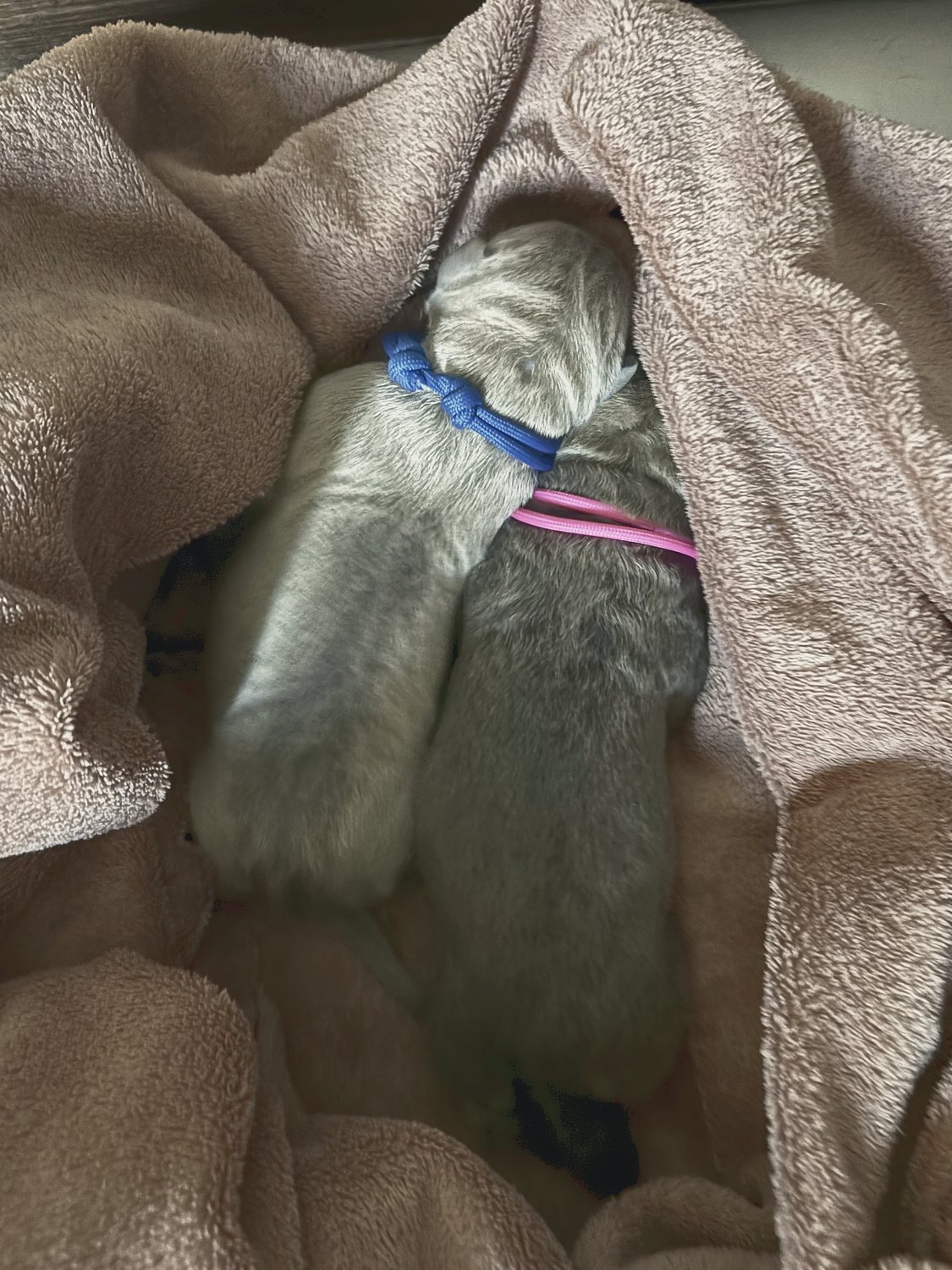
Newborn puppies have no shiver reflex and a high surface-area-to-body-size ratio, meaning they lose heat quickly and can’t generate or retain it the way an adult dog can. This immaturity in temperature regulation persists until roughly 4 weeks of age, which is why the whelping box’s ambient temperature — not just the dam’s presence — does a lot of the work in these early weeks.
Target temperatures by week
- Week 1: roughly 85–90°F (29–32°C)
- Weeks 2–3: roughly 80°F (26.7°C)
- Week 4 onward: roughly 69–75°F (20.6–23.9°C)
A humidity level of roughly 55–65% is also generally recommended for the whelping area.
Heating methods and setup
Most veterinary sources prefer an overhead heat source over a pad underneath, because a newborn can’t crawl off a surface that is too hot. If you do use a pad, cover only part of the floor with it, use a thermostat, and keep the cord out of reach of the dam and puppies. Whatever you use, the setup matters: puppies should never be able to make direct contact with a heating element (burn risk), and the box should always include a cooler zone puppies can move to if they get too warm — puppies regulate their comfort behaviorally by moving toward or away from heat sources, so they need somewhere to go both ways.
In practice
A breeder notices the whole litter piled tightly together in one corner of the box and assumes this is just normal puppy behavior. Recognizing tight piling as a common behavioral sign that the box is running cold — rather than dismissing it — prompts a temperature check and adjustment, rather than leaving puppies to compensate on their own.
(Illustrative, composite scenario.)
Reading behavior alongside a thermometer
A thermometer gives you the number, but behavior is a useful secondary check: puppies piling together tightly usually signals the box is too cold, while puppies scattered apart and panting usually signals it’s too warm. As a rough practical guide, a box that runs clearly below these targets risks chilling, while one that runs too hot or too humid can cause breathing problems and dehydration — checking both the thermometer and how the litter is behaving gives a fuller picture than either alone.
Measure the temperature where the puppies lie, at bedding level, not at room height. Comfortably warm puppies lie loosely together, often on their sides, and are quiet. Puppies that are too hot spread to the edges, pant or breathe with open mouths, and cry persistently. Under a heat lamp they can also dry out, so watch their weight and urine color. Damp bedding pulls heat away fast, so change it whenever it gets wet.
If a puppy does get chilled
A puppy that’s become hypothermic should be warmed slowly — over at least 30 minutes, and often an hour or more for a very cold puppy — rather than rapidly, because abrupt rewarming can itself be dangerous. This ties directly into neonatal emergencies, where hypothermia is covered as one of the specific emergencies every breeder needs to recognize quickly.
Don’t feed a cold puppy, not even from the dam. When a newborn is chilled its gut slows down or stops, and milk can sit in the stomach, come back up and be breathed in. Warm it slowly first: against your body, or under the heat source, wrapped in a dry towel. Allow it to feed only once it feels warm and is moving and rooting normally. If you need to take it to the vet, carry it in a warmed box.
When to call your vet
- A puppy feels cold, or its rectal temperature is below about 95 °F (35 °C) in the first week (normal is about 95–99 °F / 35–37.2 °C).
- A chilled puppy doesn’t warm up within about an hour of gentle rewarming.
- A puppy is limp or unresponsive, or won’t suckle once it is warm.
- Puppies are panting, crying persistently or spreading to the edges even after you lower the heat — or show dark yellow urine or weight loss under a heat lamp.
- A puppy has burns or red skin from contact with a heat source.
- The dam seems unwell herself — for example a temperature above 103 °F (39.5 °C), or she stops eating.
- If in doubt, call — your vet would rather hear from you early.
Work on it
A few minutes here will teach you more than re-reading the article.
Ask yourself
- Do I know this week’s target temperature for my litter’s current age?
- Does my whelping box setup include both a heat source and a genuine cooler escape zone?
- Would I recognize piling or scattering as a temperature signal, not just normal behavior?
Find out & check
- Check that your heating setup has reliable thermostatic control, not just a fixed-output lamp or pad.
Do one thing
- Place a thermometer in the whelping box now and confirm it’s holding this week’s target range.
Was this article helpful?
Anonymous. We do not store your name, email or IP address.
Sources & further reading
- Merck Veterinary Manual — Table: Environmental Warmth Required for Neonatal Dogs and Cats. merckvetmanual.com
- Merck Veterinary Manual — Management of the Neonate in Dogs and Cats. merckvetmanual.com
- American Kennel Club (with Fran Smith DVM PhD DACT) — Best Practices for Whelping & Caring for Newborn Puppies. akc.org
- Royal Canin Veterinary Academy (Chastant S., ENV Toulouse) — Dealing with the sick newborn puppy. academy.royalcanin.com
- Lawler DF — Neonatal and pediatric care of the puppy and kitten, Theriogenology 2008;70:384–392. confluence.cornell.edu (PDF)
- The Royal Kennel Club — Whelping your first litter. royalkennelclub.com
- American Kennel Club — Raising Newborn Puppies. akc.org
- Dogs NSW (Hedberg K., BVSc) — Care of puppies birth to 10 days. dogsnsw.org.au (PDF)
Where evidence is limited, recommendations rest on established practice and expert judgment, and may be updated as knowledge develops.
Next steps
- Read next: Colostrum and passive immunity.
- Related: Neonatal emergencies: hypothermia, hypoglycemia and fading puppy.
- Return to the area hub: The neonatal period.