The first vet check, within 24 to 48 hours of birth, exists largely to catch congenital problems while they’re still most treatable — knowing what’s being checked helps you understand what the vet is looking for and why.
The most important first
- The first vet exam specifically checks for cleft palate, a normal umbilicus, and functional urethral and anal openings.
- Cleft palate and lip are checked by looking directly in the mouth — the main risk is milk entering the airway during nursing.
- Small umbilical hernias are common; your vet will advise whether to monitor or repair, and because a hereditary cause is suspected, record them in your breeding notes.
- Cardiac defects are usually first detected as a murmur on the vet’s exam, with severity ranging from minor to serious.
- Not every defect has the same implications — some are entirely compatible with a good life, others are not, and this is a conversation to have directly with your vet.
What the first exam checks for
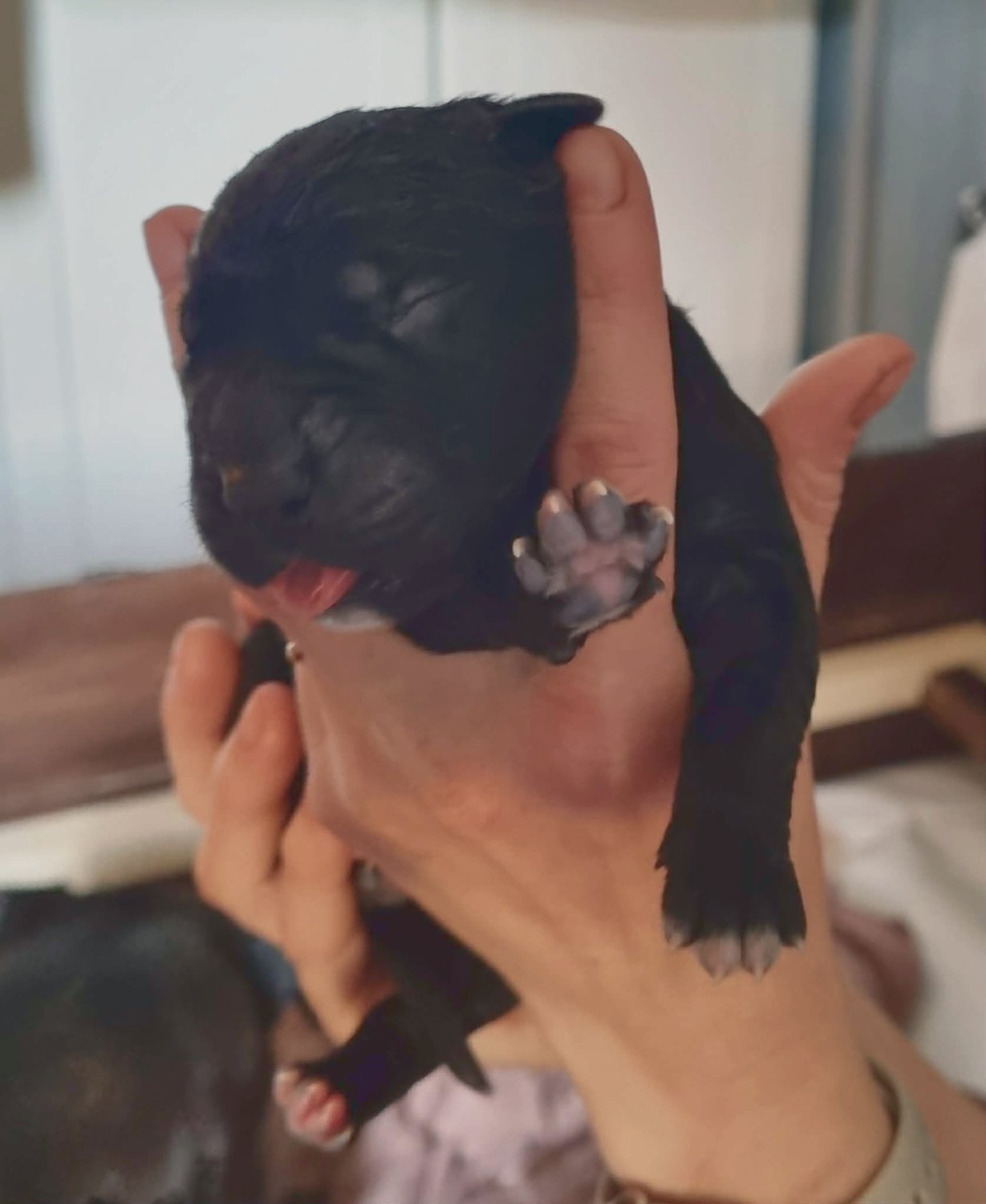
The standard first check — ideally within the first 24 hours of birth, and no later than 48 — specifically verifies a normal palate, a normal umbilicus, and functional urethral and anal openings, alongside a general assessment of the puppy’s overall condition. Catching a problem at this stage, while it’s most treatable, is a large part of why this early check matters so much, covered more generally in the normal newborn puppy.
Cleft palate and lip
A cleft palate or lip is checked by direct visual examination of the mouth. The main risk isn’t cosmetic — it’s that milk can enter the nasal cavity or airway during nursing, risking aspiration. Depending on severity, a cleft palate can sometimes be managed with careful supportive feeding until the puppy is old enough for surgical correction.
At home, the classic sign is milk bubbling from the nose during or after nursing. A puppy may also cough or sneeze while feeding and fail to gain weight. Because milk can reach the lungs, any of these signs needs a veterinary check promptly. Breathing that becomes fast or labored is urgent. Puppies that go on to surgery are usually tube-fed until then. Repair is generally not attempted before around 12 weeks, and success rates vary. Cleft palate is often inherited, so discuss with your vet what it means for the parents and for future matings.
Umbilical hernias and imperforate anus
Small umbilical hernias are common. Your vet will advise whether to monitor or repair — veterinary references recommend surgical closure in most cases, to prevent a loop of gut becoming trapped later — and because a hereditary cause is suspected, record them in your breeding notes. An imperforate anus (a missing anal opening) is checked for at the same exam, since it’s not always obvious without a direct look.
A puppy without a working anal opening cannot pass stool. Watch for a belly that keeps swelling, straining, or a puppy that stops feeding, and contact your vet urgently. With umbilical hernias, some breeds are over-represented. Note every finding in your litter records.
Cardiac defects
Heart defects are usually first picked up as a murmur heard during the vet’s exam, and severity varies widely — some murmurs are minor and have little impact, while others indicate a more serious structural problem. This is one of the clearer reasons the first vet check matters, since a cardiac issue often isn’t visible from the outside at all.
Soft murmurs are common in young puppies and are often “innocent”, fading by about six months; ask your vet to recheck any murmur at vaccination age. Louder murmurs, or ones that persist, deserve further investigation, usually with an ultrasound of the heart. The most common inherited heart defects in dogs include subaortic stenosis, pulmonic stenosis and patent ductus arteriosus. Some are treatable if caught early, and screening helps keep them out of breeding lines.
Limb deformities and swimmer puppy syndrome
Some limb deformities are visible at birth, while “swimmer puppy syndrome” — a flattened chest and legs that splay outward rather than supporting normal standing — tends to become apparent as a puppy starts trying to move. It’s often manageable with early intervention such as changes to bedding traction and gentle physical therapy, and many affected puppies go on to develop normally with the right support.
In a study of 115 affected puppies, signs were usually noticed at around two weeks. Most puppies were standing by about four to five weeks and had recovered by about six weeks, typically with physiotherapy and a non-slip surface. Ask your vet to confirm the diagnosis and show you safe exercises.
In practice
A breeder notices one puppy in the litter seems to be struggling to stand properly at around ten days old, with its legs splaying out to the sides rather than under its body. Recognizing this pattern as a known, often manageable condition — rather than assuming the worst — prompts an early vet visit to discuss supportive measures like non-slip bedding and gentle exercises, which can make a real difference to outcome.
(Illustrative, composite scenario.)
When a defect raises harder questions
Some findings — a very large fontanel (the soft spot on top of the skull, which should normally be small), a severe cardiac murmur, or a significant abdominal wall defect — genuinely affect a puppy’s likely quality of life, and these are the cases where your vet may raise humane euthanasia as a kinder option than prolonged suffering. This isn’t a decision to make alone or in the moment; it’s exactly what the early vet check and an honest conversation with your vet are for.
When to call your vet
- Milk comes from the nose during or after nursing, or the puppy coughs or sneezes while feeding — call promptly (possible cleft palate).
- Fast, noisy or labored breathing after feeding — this is urgent, as milk may have reached the lungs.
- No stool, a belly that keeps swelling, or straining — contact your vet urgently (possible imperforate anus).
- A swelling at the navel that gets bigger, feels firm, turns red or seems painful.
- A puppy that is not gaining weight (at least 1.5 × birth weight by day 7) or is falling behind its littermates.
- Legs that splay out and a flattening chest as the puppy starts to move — early help gives the best outcome.
- If in doubt, call — your vet would rather hear from you early.
Work on it
A few minutes here will teach you more than re-reading the article.
Ask yourself
- Do I know what the first vet check specifically screens for, so I understand what’s being assessed?
- Would I recognize the signs of swimmer puppy syndrome early enough to seek support?
- Am I prepared to have an honest conversation with my vet if a serious defect is found?
Find out & check
- Find out exactly what your vet’s first-check protocol covers, so you know what to expect.
Do one thing
- Confirm your first litter vet check is booked within the 24–48 hour window.
Was this article helpful?
Anonymous. We do not store your name, email or IP address.
Sources & further reading
- Merck Veterinary Manual — Management of the Neonate in Dogs and Cats. merckvetmanual.com
- Merck Veterinary Manual — Congenital and Inherited Anomalies of the Mouth in Animals. merckvetmanual.com
- Merck Veterinary Manual — Hernias in Animals. merckvetmanual.com
- Merck Veterinary Manual — Congenital and Inherited Anomalies of the Cardiovascular System in Animals. merckvetmanual.com
- Rumpel L et al. (2023), Frontiers in Veterinary Science 10:1233277 — A questionnaire-based investigation of the swimming puppy syndrome: 115 dogs. pmc.ncbi.nlm.nih.gov
- Banchi P et al. (2023), Vlaams Diergeneeskundig Tijdschrift 92 — Clinical approach to neonatal mortality in dogs. iris.unito.it
Where evidence is limited, recommendations rest on established practice and expert judgment, and may be updated as knowledge develops.
Next steps
- Read next: Neonatal infections and illness.
- Related: Caring for weak and orphaned puppies.
- Return to the area hub: The neonatal period.