A routine is not a timetable you keep because you are organized — it is the thing that decides what happens to your dogs on the days you are least able to decide anything.
The most important first
- Write routines for a stand-in, not for yourself. What you know without thinking is exactly what the person covering for you will miss, and it belongs in the emergency plan as well as the daily list.
- Published standards give a usable baseline: adult dogs fed at least once daily and puppies several times a day, fresh water in clean containers, accommodation cleaned daily and waste removed at least twice daily.
- One UK code of practice recommends that single housing not exceed four hours without welfare or veterinary justification, and that singly housed dogs receive daily human interaction. Most domestic kennels beat that easily; few have written down what they provide.
- In the enrichment literature, contact with people and with other dogs has more support than any object you can buy. Toys matter less than the ten minutes you spend in the run.
- A breeding year has predictable peaks — season, mating, late pregnancy, whelping, weeks three to eight, placement. Each needs cover arranged before it arrives, because none of them can be rescheduled.
What a routine is actually for
Most kennels run on an unwritten routine that works well. It works because one person holds all of it, adjusts continuously and notices the deviations that matter — the bitch who left food, the dog who is quieter than usual. The system is efficient and it is brittle, because its single component is a person who can get flu.
Writing a routine down is therefore not about self-discipline but about transferability. A routine on paper can be handed to a partner, a neighbor or a professional sitter, and audited against what you intended rather than what you remember. The Kennel Club’s Assured Breeders Standard took this view of cleaning specifically, asking for a set standard operating procedure rather than a general undertaking to keep things clean, until the scheme closed on 31 December 2024.
A written routine also makes deviation visible. If the sheet says the dogs are checked at seven and at nine and the evening check keeps slipping, that is information about capacity rather than about character. Breeders who keep more dogs than their routine can absorb usually find out this way first, which is better than finding out through a welfare problem.
The day
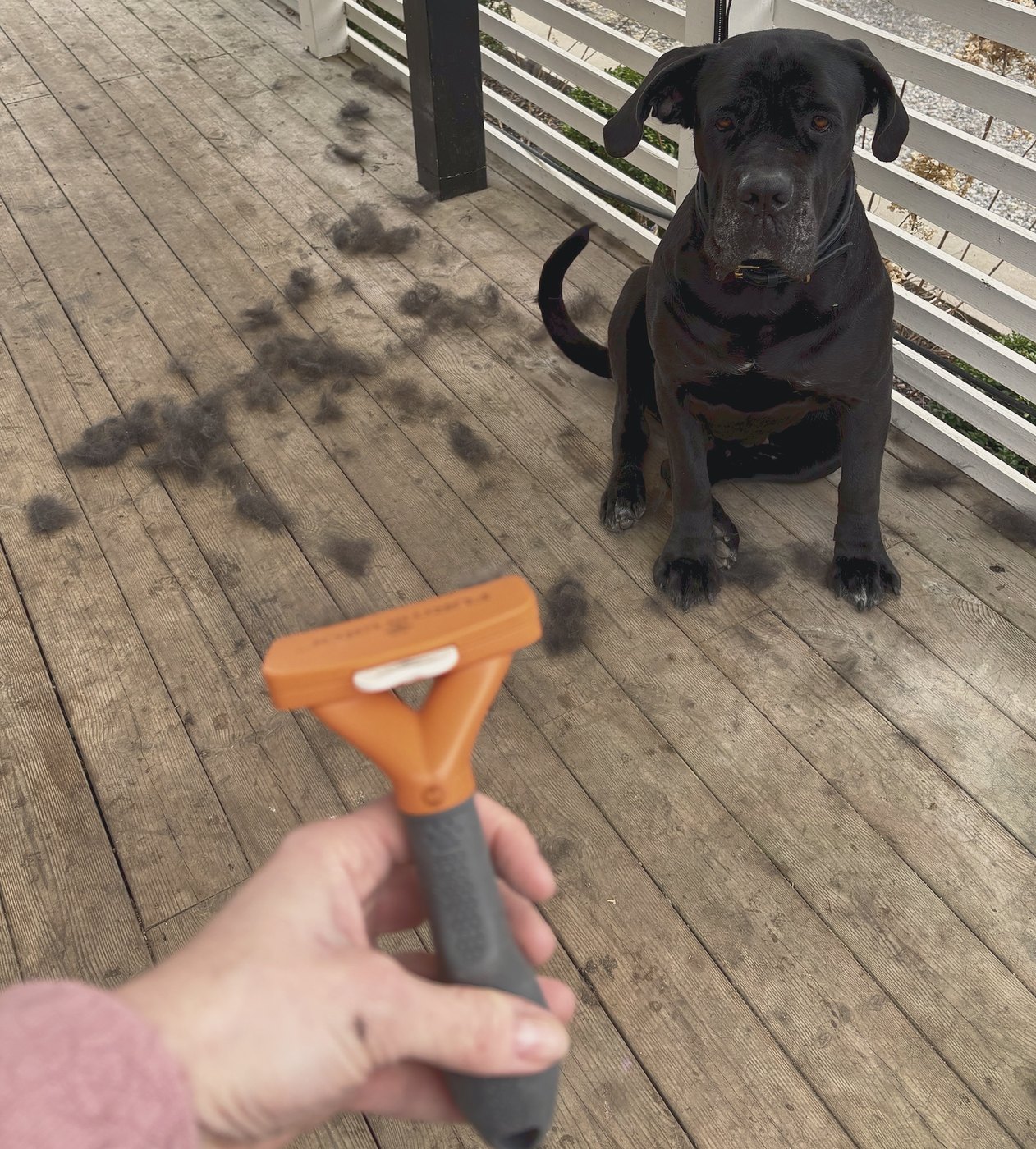
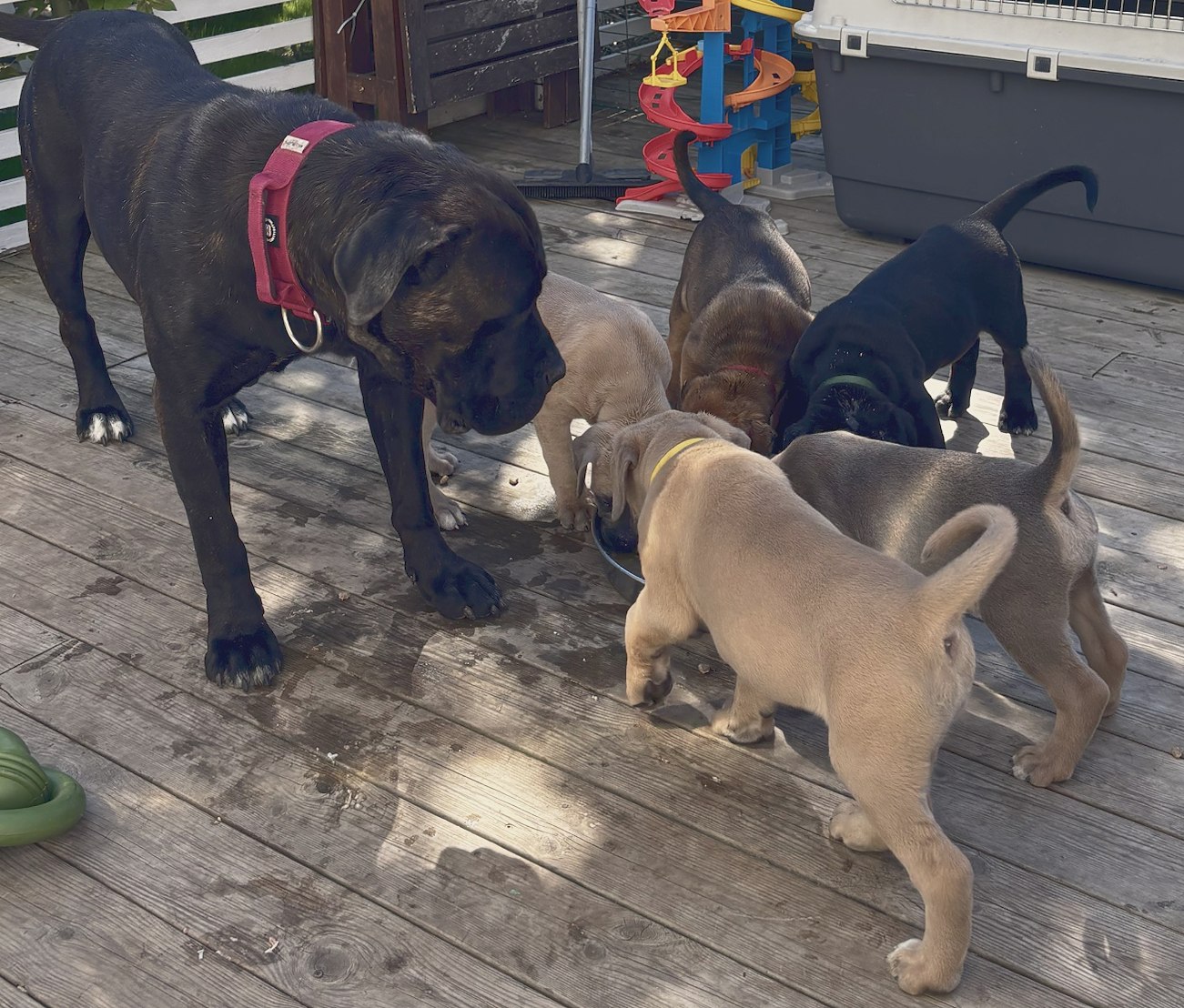
A workable daily structure has fewer moving parts than most people expect. Dogs are fed, watered, let out, observed, exercised and their accommodation cleaned, and somebody looks closely at every dog at least once. The Royal Kennel Club’s welfare standard sets the minimum shape: adult dogs fed at least once daily and puppies several times a day, water kept fresh in clean containers, a draft-free sleeping area and an exercise space for every dog, and regular chances for a nursing bitch to toilet and exercise away from her puppies.
Cleaning is where daily routines most often drift, and the published codes are specific: each occupied enclosure cleaned at least daily, excreta removed from all dog areas daily or more often, waste removal at least twice daily under England’s breeding license guidance (and, before it closed at the end of 2024, the Kennel Club’s Assured Breeders Standard). One code adds a detail breeders frequently miss — wet cleaning should not leave dogs wet, so dogs are moved to a dry place while an enclosure is hosed and returned only once it is reasonably dry.
Observation deserves a slot of its own rather than being folded into the other tasks. A dog who is slightly off is easiest to miss when your hands are full, and one deliberate pass through the kennel with nothing else to do catches more than a longer pass combined with chores.
Build a short health check into the first round of the day, the same way every time. Note whether each dog ate its last meal, drank, and passed normal feces and urine. Look at how it moves, its eyes, nose and coat, and any discharge. For a bitch with a litter, also check that every puppy is nursing and that her mammary glands look normal. The check takes a minute per dog and is how a cover person spots a problem you would have noticed by instinct. Write down anything unusual, and agree with your veterinarian in advance which findings mean “call today”.
The week, and who does it when you are not there
Weekly tasks get postponed indefinitely because no single day requires them: weighing, grooming and nail care, parasite treatment according to your veterinarian’s plan, deep cleaning on a rota, checking stock, and bringing records up to date. Giving each a fixed day turns them from intentions into routine, and makes a skipped week obvious.
Cover is the part almost no kennel arranges in advance. It needs one person who can run the whole routine unsupervised and has done it once with you present, written instructions they can follow without ringing you, and access to keys, food, medication and records. Standards for licensed establishments assume staffing sufficient for the number of animals; a domestic kennel has to generate that from a much smaller pool of people, which is precisely why the arrangement has to be explicit.
Licensing rules show what good cover looks like. England’s breeding license guidance asks for a written emergency plan and a named key holder who can reach the premises within about 30 minutes, and the AKC also expects a written emergency plan. Even if no rule applies to you, give your stand-in the plan, the key holder’s number and your veterinarian’s out-of-hours details.
The honest test is whether a stand-in could manage a problem as well as a normal day — not clinical decisions, but which practice to ring, what the out-of-hours arrangement is, and which dog has a condition that changes the answer. That overlap is why crisis and contingency planning belongs beside this article rather than at the end of the area.
Human contact and exercise are part of the routine, not extras
In the enrichment literature on kenneled dogs, the most consistently supported intervention is social contact. Wells’s review concluded that contact with people and with other dogs is the most important form of enrichment for confined dogs, with lower stress responses, greater approachability and fewer fear reactions reported after daily handling, grooming and play. Evidence for toys is mixed: laboratory dogs engage with novel, chewable or noisy items, shelter dogs largely ignore them, and dogs habituate quickly, so rotation matters more than quantity.
Time with the dogs should therefore be scheduled as firmly as feeding, because it is what gets sacrificed when the day compresses. England’s licensing guidance expects at least one walk a day or time in a secure open space, unless a veterinarian advises otherwise; how much suits a given dog depends on breed, age and individual, as covered in caring for breeding dogs.
In the United States, USDA standards for licensed facilities require dogs to be fed at least once a day and to have water continuously available, and the facility must have a written exercise plan approved by its veterinarian.
Group composition sits inside this too. Social housing has reasonable support where dogs are compatible, but compatibility has to be monitored rather than assumed, and group housing also carries risks of aggression and faster transmission of infection.
Scaling the routine when a litter arrives
A litter does not add tasks to the existing routine so much as replace it with a different one. Checks become shorter and more frequent, the whelping area has its own hygiene regime, weighing becomes daily, and from around three weeks the socialization program starts to consume real time. The detail belongs in daily care and hygiene for a litter; the operational point is that the adult dogs’ routine has to survive the litter, and it usually does not unless somebody planned for the collision.
This is where the breeding year has to be read as a workload calendar rather than a biological one. Late pregnancy, whelping and the first two weeks demand near-continuous presence; weeks three to eight demand attention at predictable intervals and a stream of visitors; placement demands long conversations. None of it moves when your own commitments move, which is why the most useful planning question before a mating is not only whether the combination is right but whether the eight weeks after the due date are genuinely free.
In practice
A breeder with four adult dogs writes her routine on one laminated sheet after influenza leaves her unable to go out to the kennel for three days. The sheet lists feeding times and amounts per dog, which dog is fed separately and why, the cleaning order, the medication one older bitch receives, the practice’s daytime and out-of-hours numbers, and where the records are kept. She walks her neighbor through it once in a quiet week. Eighteen months later she is in hospital for nine days; the neighbor runs the kennel, rings twice, and the only thing missing from the sheet turns out to be that the youngest dog will not drink from a metal bowl.
(Illustrative, composite scenario.)
When to call your vet
- A dog skips more than one meal, drinks much more or less than usual, or has vomiting or diarrhea that lasts or contains blood.
- A dog is lame, stiff, weak or reluctant to move, or has a swollen, hot or painful area.
- A bitch has a vaginal discharge outside her normal season, or seems unwell after a season. Pyometra can follow a season.
- A nursing bitch has hot, hard, red or painful mammary glands, a fever above 103 °F (39.5 °C), or loses interest in her puppies.
- A puppy is not nursing, is not gaining weight (it should reach at least 1.5 × its birth weight by day 7), cries constantly or feels cold.
- Your stand-in reports anything they are unsure about. Make sure they have your vet’s out-of-hours number.
- If in doubt, call — your vet would rather hear from you early.
Work on it
A few minutes here will teach you more than re-reading the article.
Ask yourself
- Which parts of my daily routine exist only in my head?
- When in the day do I look at each dog with nothing else in my hands?
- If I could not go out to the dogs tomorrow, who would, and have they ever done it with me watching?
Find out & check
- Check what your own national kennel club’s breeder scheme or your local licensing authority specifies for daily care, cleaning frequency and staffing, and compare it with what you actually do.
Do one thing
- Write this week’s routine on one page, in the order the tasks happen, and leave it where a stand-in would find it.
Was this article helpful?
Anonymous. We do not store your name, email or IP address.
Sources & further reading
- Royal Kennel Club — Welfare Standard for Adult Dogs and Puppies. royalkennelclub.com
- The Royal Kennel Club — Kennel Club announces registrations model update and closure of the Assured Breeders Scheme (July 2024). royalkennelclub.com
- UK Home Office — Code of Practice for the Housing and Care of Animals Bred, Supplied or Used for Scientific Purposes: dogs. publishing.service.gov.uk
- Wells, D. L. — A review of environmental enrichment for kennelled dogs. slu.se
- Department for Environment, Food and Rural Affairs — Dog breeding licensing: statutory guidance for local authorities. gov.uk
- eCFR (USA) — 9 CFR Part 3, Subpart A: Specifications for the humane handling, care, treatment, and transportation of dogs and cats. ecfr.gov
- American Kennel Club — Inspection FAQs. akc.org
Where evidence is limited, recommendations rest on established practice and expert judgment, and may be updated as knowledge develops. Several figures quoted here come from codes written for licensed or laboratory establishments, which are more prescriptive than most domestic kennels need to be; they are included because they are published and specific, not because they are the standard that applies to you. Feeding, exercise and grouping decisions should follow your own veterinarian’s advice for the individual dog, and legal requirements for premises and staffing vary by jurisdiction.
Next steps
- Read next: Hygiene, quarantine and disease control.
- Related: Crisis and contingency planning for a kennel.
- Return to the area hub: Running a kennel: operations, records and resilience.