The dogs who founded your lines often stay with you long after their last litter. Their old age deserves the same planning you gave their breeding years. Aging is not a disease, as the American Animal Hospital Association (AAHA) puts it in its senior care guidelines, but it does bring changes that are easier to manage when you catch them early.
The most important first
- Dogs become senior in roughly the last quarter of their expected lifespan. Giant breeds get there years before toy breeds.
- Plan a vet visit at least once and preferably twice a year, with bloodwork, urine tests and blood pressure checks.
- Stiffness, slowing down and night-time restlessness are not just “old age.” Pain and cognitive decline can both be treated.
- Track good and bad days on a calendar. It helps you and your vet see quality of life clearly when the time comes to decide.
What “senior” means, by size
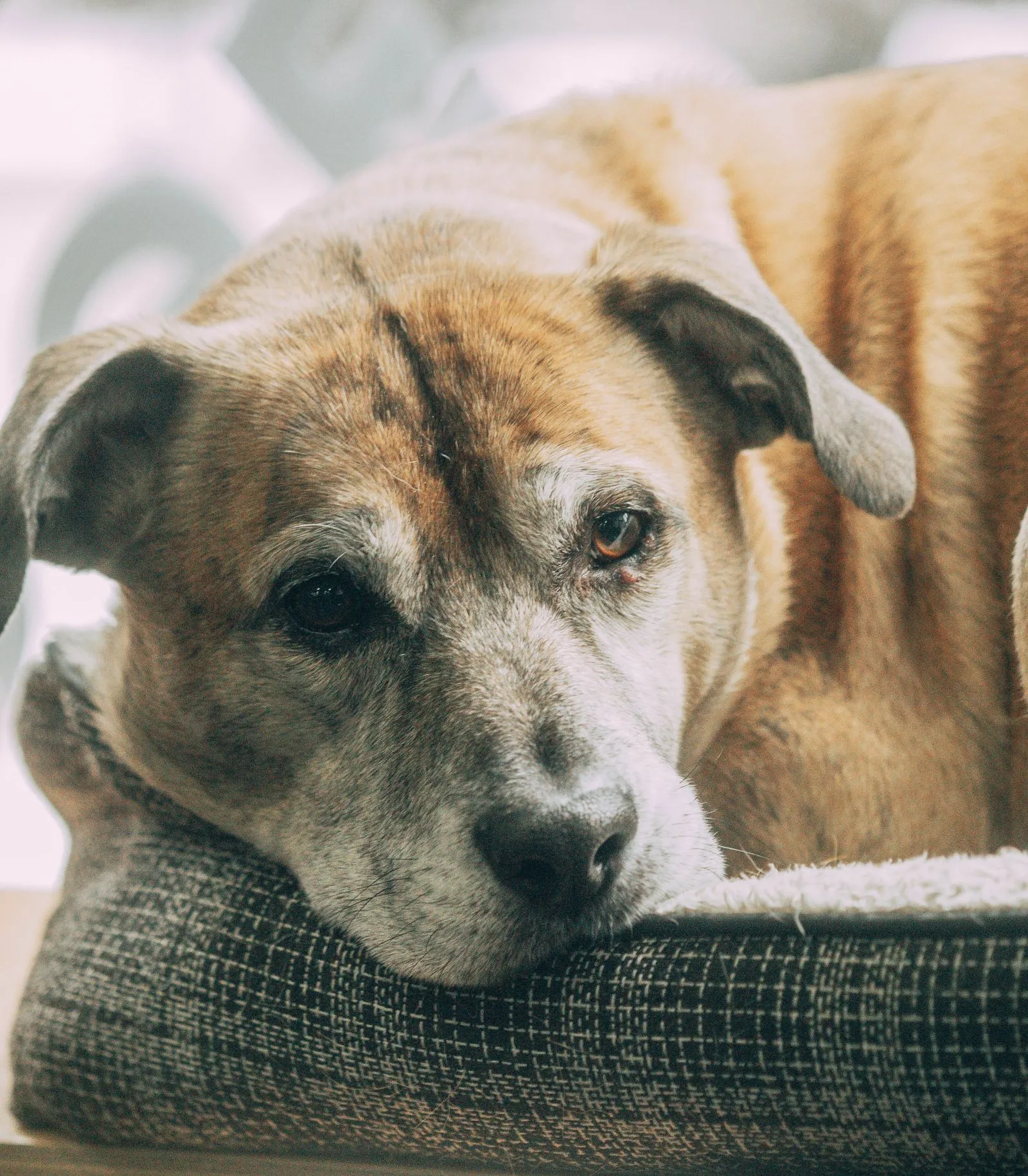
There is no single senior age. AAHA defines a senior dog as one in the last 25% of its estimated lifespan through the end of life, and notes that the onset varies within breeds. Bigger dogs age faster. In a large study of dogs that died under the care of English veterinary practices, median longevity was 12 years, and the heavier the dog, the shorter its life tended to be. Great Danes and Dogues de Bordeaux had among the shortest lives.
The American Veterinary Medical Association (AVMA) gives approximate senior ages by adult weight:
- Small and toy dogs (under 20 lb, about 9 kg): 8 to 11 years
- Medium (20 to 50 lb, about 9 to 23 kg): 8 to 10 years
- Large (50 to 90 lb, about 23 to 41 kg): 8 to 9 years
- Giant (over 90 lb, about 41 kg): 6 to 7 years
Use your own breed’s typical lifespan as the guide. A giant-breed bitch may be senior before some toy bitches have retired.
Many registries also treat age as a breeding question. The Royal Kennel Club does not normally register a litter from a bitch who is eight or older at whelping, except by prior permission with veterinary evidence, and Dogs Australia requires a current veterinary certificate of good health before mating any bitch aged eight or over. See litter limits and age rules.
What the kennel clubs say
The Swedish Kennel Club (SKK) bars mating a bitch after her 10th birthday, requires a veterinary examination before mating from age 7, and allows at most five litters.
Source: Swedish Kennel Club (SKK), Basic rules (Grundregler), in force from January 1, 2026.
Last updated: November 8, 2026
Rules change, so always check with your own kennel club.
A note on legal information
This is general information, not legal advice; rules differ by country and change — check your registry and local law.
Routine screening: what AAHA recommends
AAHA’s 2023 Senior Care Guidelines recommend a medical workup once or twice a year, with a full physical exam and a look in the mouth at every visit. The AVMA advises at least twice a year. For senior dogs, the AAHA screening table includes:
- Blood count, biochemistry panel and urinalysis every 6 to 12 months
- Thyroid hormone (T4) and blood pressure once a year
- Heart screening tests yearly where indicated, and an ECG yearly for breeds at higher risk of heart disease, such as Boxers and Dobermans
- Fecal parasite tests and, where relevant, heartworm and tick-borne disease tests
AAHA also encourages owners to bring videos of the dog walking, climbing and jumping at home, because dogs often move differently in the clinic. A short phone video of your old girl getting up from her bed can tell your vet more than a minute on the exam table.
Common age-related problems
The AVMA lists the conditions most often seen in older dogs: cancer, heart disease, kidney, urinary and liver disease, diabetes, arthritis, obesity, vision and hearing loss, and cognitive dysfunction. Cancer is a cause of death in nearly half of dogs over ten, and cancer, musculoskeletal and neurological disorders were the most common causes of death in the English study.
Watch for lumps or skin changes, sores that do not heal, weight loss or gain, changes in thirst or appetite, persistent vomiting or diarrhea, coughing and breathing changes. Intact bitches remain at risk of pyometra, and older intact males of prostate and testicular problems, so reproductive status belongs in every senior check.
Pain and mobility
Osteoarthritis is very common and often missed. The Merck Veterinary Manual notes that up to 40% of young adult dogs already show joint changes on X-rays, but signs are often not recognized until somewhere between five and thirteen years of age. Look for slowness getting up after rest, rising front end first or back end first, trouble with stairs, less jumping and play, and stiffness. Lameness can be subtle even when both legs are affected.
Keeping her lean is the single most useful thing you can do: fat tissue releases substances that increase inflammation and pain, and even modest weight loss improves function in overweight dogs with arthritis. Regular, controlled exercise helps. Your vet can build a plan that may combine pain relief, rehabilitation and other therapies; AAHA describes this as integrative and multimodal. At home, rugs or traction mats on slippery floors, ramps, a supportive bed and raised bowls make a real difference.
Cognitive dysfunction
Canine cognitive dysfunction is similar to dementia in people. AAHA cites estimates that roughly 14 to 22.5% of dogs over eight years show age-related cognitive impairment. Cornell’s Riney Canine Health Center describes signs that often creep in slowly from about nine years: getting lost or stuck in familiar places, staring into space, changes in how she interacts with people, night waking and pacing with more daytime sleep, house-soiling, new anxiety or irritability, and forgetting known cues.
It is a diagnosis made after ruling other things out. Pain, vision or hearing loss, and illnesses such as kidney disease can look the same, so blood and urine tests come first. Early action works better. Your vet may suggest a licensed medication, a diet formulated for brain aging, and treatment of any anxiety or pain. Gentle daily play, short training sessions, scent games and a predictable routine help keep her engaged.
Quality of life and end-of-life decisions
There is no perfect scale for this. AAHA notes that very few quality-of-life scales for animals have been validated, and that most found online have not. What helps is structure. Dr. Jane Shaw of Colorado State University suggests listing your dog’s favorite things and the behaviors that show she is enjoying life, then noting which she still does. Look at both her physical comfort (pain, appetite, mobility, toileting) and her emotional life (interest in you, in the household, in her surroundings), and mark good and bad days on a calendar. When bad days start to outnumber good ones, that pattern is information you and your vet can act on.
AAHA recommends palliative care early in a chronic or terminal illness, and discussing euthanasia options early rather than in a crisis, with time to come back to the conversation. Age alone should not decide anything; persistent pain, loss of appetite, progressive illness and loss of mobility are the factors that matter. Ask your vet about home euthanasia if your dog would be calmer there.
From one breeder to another: the decision is often hardest for the dogs who mattered most. Making it a little early, on a good day, is a kindness. Grief afterward is normal, and veterinary schools such as Colorado State offer support services.
When to call your vet
- New lumps, or any lump that grows or changes.
- Drinking or urinating more, weight loss, or eating less for more than a day or two.
- Vomiting, diarrhea, coughing or breathing changes that do not settle quickly, or any collapse.
- New stiffness, lameness, reluctance to climb stairs, or crying out when touched.
- Disorientation, night-time pacing or new house-soiling.
- An intact bitch who is unwell, drinks more or has a vaginal discharge after a heat.
- If in doubt, call — your vet would rather hear from you early.
Work on it
A few minutes here will teach you more than re-reading the article.
Ask yourself
- Which of your dogs are senior for their size right now, and when was each last checked?
- What are your oldest dog’s three favorite things, and does she still enjoy them?
Find out & check
- Ask your vet which senior screening tests from the AAHA list make sense for each dog, and how often.
- Watch each senior dog get up from her bed and climb a step. Record a short video for your next visit.
Do one thing
- Start a good-day, bad-day calendar for your oldest dog this week.
Was this article helpful?
Anonymous. We do not store your name, email or IP address.
Sources & further reading
- American Animal Hospital Association — 2023 AAHA Senior Care Guidelines for Dogs and Cats. aaha.org
- American Veterinary Medical Association — Senior pets. avma.org
- O’Neill DG, Church DB, McGreevy PD, Thomson PC, Brodbelt DC — Longevity and mortality of owned dogs in England. The Veterinary Journal, 2013. doi.org
- Merck Veterinary Manual — Osteoarthritis in Dogs and Cats. merckvetmanual.com
- Cornell University College of Veterinary Medicine, Riney Canine Health Center — Cognitive dysfunction syndrome. vet.cornell.edu
- Colorado State University (Jane Shaw, DVM, PhD) — Pet health: Euthanasia decisions involve quality-of-life considerations. source.colostate.edu
- The Royal Kennel Club — Application to register a litter from a dam over 8 years of age. royalkennelclub.com
- Dogs Australia — Code of Practice (July 2023). dogsaustralia.org.au
Where evidence is limited, recommendations rest on established practice and expert judgment, and may be updated as knowledge develops. This article is general information and does not replace an examination by your veterinarian. If you suspect an emergency, contact a veterinarian immediately.
Next steps
- Read next: When to retire a breeding dog.
- Related: Rehoming retired breeding dogs.
- Related: Caring for breeding dogs.