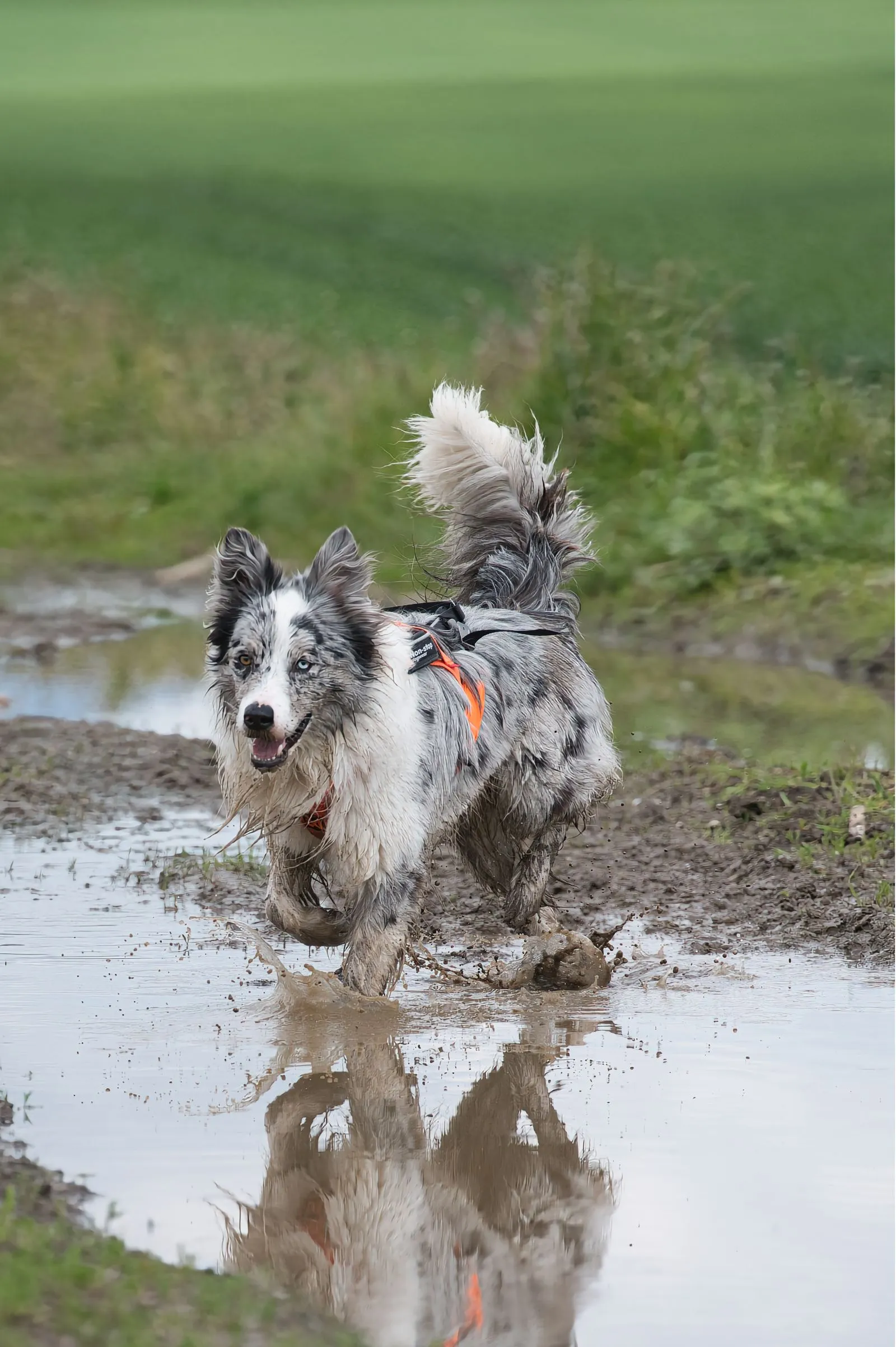
Spring rain and thawing ground turn runs and paddocks into mud, and wet, fouled surfaces are exactly where the parasites that cause diarrhea in puppies survive longest — so the weeks before your spring litters are the time to fix drainage, upgrade surfaces and tighten daily cleaning, rather than fighting an outbreak in a whelping room full of puppies.
The most important first
- Remove feces every day. Giardia cysts are infective as soon as they are passed, and coccidia become infective quickly in warm, moist conditions.
- Hard, sealed, well-drained surfaces are far easier to keep clean than soil, grass or gravel.
- Get rid of standing water. Puddles and slow-moving water are linked to leptospirosis, especially after heavy rain.
- Diarrhea in a litter is a reason to call your veterinarian, not to wait and see.
Last updated: November 8, 2026
Why spring is a risk
Intestinal parasites are common wherever dogs live in groups. In a study of 266 puppies aged 5 to 14 weeks in 29 French breeding kennels, Grellet and colleagues found at least one gut pathogen in 77% of puppies, and abnormal feces in about a quarter; canine parvovirus was the strongest risk factor for diarrhea around weaning. Wet weather can add to the load: at a Labrador breeding facility in Spain, Barrera and colleagues found that Cystoisospora (coccidia) shedding by dams and puppies was highest in autumn, when rainfall was at its peak. Spring brings the same combination of mud, warmth and moisture in many regions.
Giardia
The Companion Animal Parasite Council (CAPC) explains that dogs are infected by swallowing Giardia cysts, which are infective as soon as they are passed in feces and spread through contaminated water, food, surfaces and self-grooming. Infection is common, often without signs, and is more frequent in kennels, breeding facilities and shelters. CAPC advises removing feces daily, steam-cleaning hard surfaces or using a disinfectant and then letting them dry fully, and notes that soil, grass and standing water are hard to decontaminate. Bathing dogs at the end of treatment removes cysts from the coat.
Coccidia
According to CAPC, Cystoisospora mainly affects young animals and can cause diarrhea, weight loss and dehydration, sometimes severe. Oocysts become infective quickly at warm temperatures, can survive up to a year in moist, sheltered places, and resist most common disinfectants. CAPC recommends daily removal of feces, steam or pressure washing to dislodge debris, painted or sealed floors that are easier to clean, and, in outbreaks, treating all in-contact animals, including breeding females, on veterinary advice. Rodents can carry infection too, which is one more reason to keep feed secure.
Leptospirosis and standing water
The American Veterinary Medical Association notes that leptospirosis bacteria live in soil and water, spread mainly through the urine of infected animals, especially wild rodents, and can survive for weeks to months in urine-soaked soil. Risk rises with stagnant or slow-moving water, and outbreaks are more likely after heavy rain or flooding. Infected dams can pass it to their puppies, and people can be infected, so wear gloves when cleaning urine spots and wash your hands. Ask your veterinarian whether leptospirosis vaccination is advised for your dogs.
Your spring checklist
- Walk the runs after rain. Note where water pools and where mud forms at gates, doors and feeding spots.
- Fix drainage first: slope runs away from buildings, clear drains, and raise feeding and resting areas.
- Upgrade the worst areas to sealed concrete or another surface you can scrub and dry. Gravel and soil hold cysts and oocysts.
- Daily feces removal, everywhere, including exercise paddocks.
- Clean, then disinfect, then dry. Most disinfectants work poorly on dirty surfaces. Read the product label for contact time.
- Boot and hand hygiene between adult areas and the whelping room.
- Secure feed and fill holes to keep rodents out.
- Check external parasites too. Ticks and fleas return with warmer weather; the CDC notes that brown dog ticks can infest kennels.
In practice
A breeder notices that two runs stay wet for days after rain and that her last spring litter had soft stools at weaning. Her veterinarian finds coccidia and advises treatment for the dam and litter. Before the next spring litter she regrades and seals the two runs, moves the water buckets onto a raised platform, and adds a boot tray at the whelping room door. The next litter’s fecal checks are clear.
(Illustrative, composite scenario.)
When to call your veterinarian
- Diarrhea, blood or mucus in the feces, or weight loss in puppies.
- Vomiting, lethargy, jaundice or reduced appetite in an adult after wet weather or contact with rodents or standing water.
- Several dogs with diarrhea at once.
- If in doubt, call — your vet would rather hear from you early.
Work on it
A few minutes here will teach you more than re-reading the article.
Ask yourself
- Which runs stay wet after rain?
- Do I remove feces from every area every day?
- Can rodents reach my feed?
Find out & check
- Ask your veterinarian to run fecal tests on your breeding dogs before spring litters.
Do one thing
- After the next heavy rain, walk your kennel and mark every place water stands for more than a day.
Was this article helpful?
Anonymous. We do not store your name, email or IP address.
Sources & further reading
- Companion Animal Parasite Council — Giardia (guidelines). capcvet.org
- Companion Animal Parasite Council — Coccidia (guidelines). capcvet.org
- American Veterinary Medical Association — Leptospirosis. avma.org
- Grellet A, Chastant-Maillard S, Robin C, Feugier A, Boogaerts C, Boucraut-Baralon C, Grandjean D, Polack B (2014) — Risk factors of weaning diarrhea in puppies housed in breeding kennels. Preventive Veterinary Medicine 117:260–265. doi.org
- Barrera JP, Montoya A, Marino V, Sarquis J, Checa R, Miró G (2024) — Cystoisospora spp. infection at a dog breeding facility in the Madrid region: infection rate and clinical management based on toltrazuril metaphylaxis. Veterinary Parasitology: Regional Studies and Reports 48:100971. doi.org
- Centers for Disease Control and Prevention — Preventing Ticks on Pets. cdc.gov
Where evidence is limited, recommendations rest on established practice and expert judgment, and may be updated as knowledge develops. Treatment decisions belong to your veterinarian. This is general information and does not replace advice from your veterinarian.
Next steps
- Read next: Infection control and biosecurity for the litter.
- Related: Parasites and worming schedules · Common illnesses in puppies.
- Return to the guide: Kennel operations: the complete guide.