Around three weeks old, puppies climb out of the whelping box and the box stops being an adequate world — what replaces it shapes hygiene, house-training and confidence, and it is worth designing rather than assembling.
The most important first
- The environment needs to expand as mobility does, from roughly three weeks, when puppies start leaving the nest on their own.
- Separate zones for sleeping, eating, playing and eliminating work with the puppies’ instinct to keep their nest clean.
- Surfaces should be non-slip, easy to clean and non-porous — slippery flooring raises the risk of injury and joint strain.
- Paper or wood pellets make a better elimination substrate than clay cat litter, and the tray must be low enough for a small puppy to climb into.
- A barren space is a stressful space: varied surfaces, objects and retreat options are part of the setup, not an extra.
Growing the space with the litter
Until around three weeks, the whelping box does everything: it keeps puppies warm, contained and close to the dam. From that point, puppies climb out, walk, and start eliminating independently, and a box that once meant safety becomes a restriction. The usual progression is from box to a pen that includes the box, then to a larger pen with clearly distinct areas, and eventually to a space with access to the outdoors and to normal household life.
The dam needs something the puppies do not: a way out. A raised area, an adjoining space, or simply a pen wall she can step over lets her leave and return at will, which matters more and more through weaning. She needs more than a way out: give her a resting place the puppies cannot reach, especially once teeth arrive and weaning begins. A dam who cannot get away is more likely to snap at puppies.
Zones and the elimination area
Puppies instinctively move away from their sleeping and eating areas to eliminate, and a setup that gives them somewhere to go turns that instinct into a habit the new owner will benefit from for years. The practical arrangement is a bed area at one end and a designated toilet area at the other — roughly half and half at first, shrinking as the pen grows and the puppies get better at holding on.
For the toilet area, pellets made from recycled paper or wood are a better substrate than clay cat litter, which is dusty and readily eaten. The tray needs a low enough lip for a three-week-old puppy to climb into unaided, and it needs to be close — a young puppy that has to travel far will not make it. A large litter usually needs more than one.
Surfaces and flooring
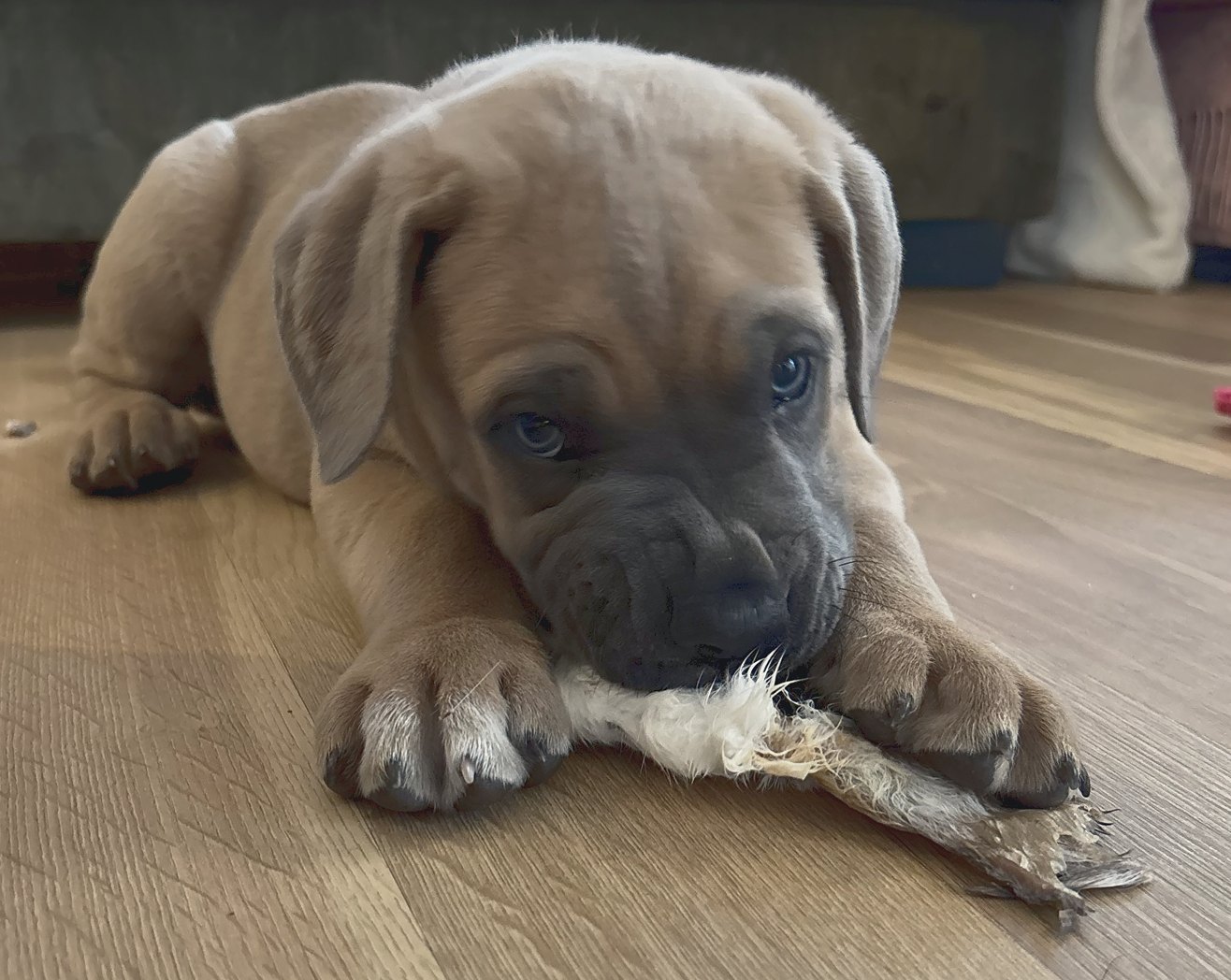
Flooring should be non-slip, easy to clean and disinfect, and non-porous enough that it does not absorb urine. Slippery surfaces are difficult for puppies to move on, increase the risk of injury, and place strain on developing joints; hard smooth surfaces also reflect sound, making the space noisier than it needs to be. Damp bedding left in place causes skin and paw problems, so wet or soiled material should be removed as it happens rather than at the end of the day.
Beyond hygiene, surfaces are a developmental tool. Deliberately offering different textures — a rubber mat, a fleece bed, a piece of vinyl, grass once it is safe to go out — builds sure-footedness and adaptability, and feeds directly into the habituation work covered in behavior, development and enrichment.
In practice
A breeder sets up a pen on a smooth laminate floor because it wipes clean in seconds. The puppies skid, splay, and avoid crossing the open middle of the pen. Laying non-slip mats over most of the floor, keeping a small wipe-clean section by the food and toilet areas, costs almost nothing and changes how the litter moves within a day.
(Illustrative, composite scenario.)
Space, complexity and stress
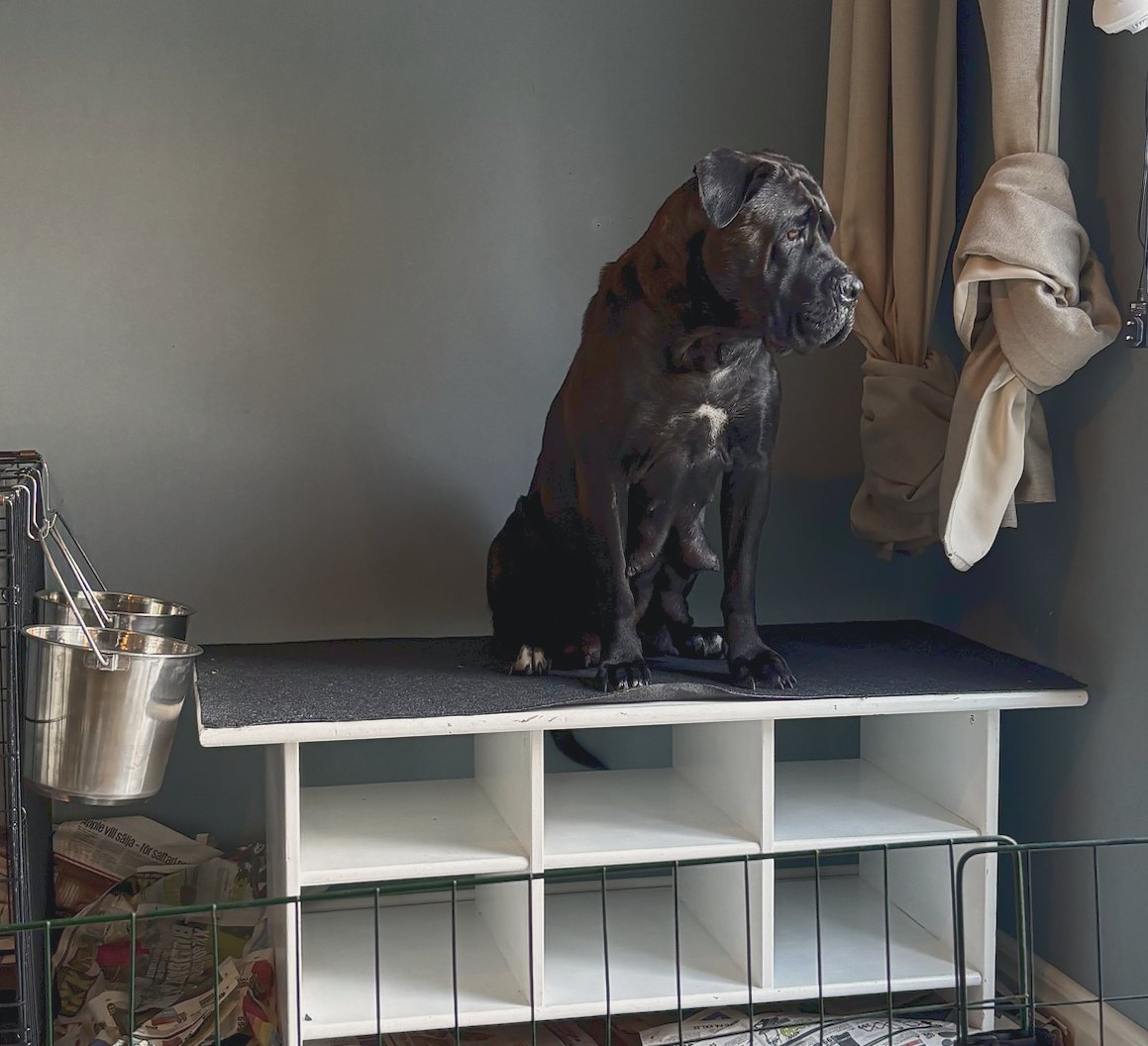
There are legal minimum space requirements in many jurisdictions, and it is worth knowing yours — but they are minimums, and there is little research establishing them as sufficient. In the US, for example, the Animal Welfare Act sets a floor-space formula based on body length and requires floors that protect feet; in England, licensed breeders must give a bitch with a litter double the standard space and a divider so she can get away from the puppies. Use these as a floor, not a target. The more useful standard is functional: enough room to sit, stand, lie stretched out and move freely, with genuinely separate areas for the things puppies do.
Equally important is what is in the space. Barren environments are stressful; environmental complexity reduces stress. Low obstacles, tunnels, different levels, safe novel objects rotated regularly, and somewhere to retreat when the household gets loud all belong in a puppy pen. A puppy that can choose to withdraw and then re-approach on its own terms is learning recovery, which is a more useful outcome than exposure alone.
Temperature, and where the pen lives
Puppies cannot regulate their own temperature reliably until around four weeks, so the pen’s warmth is their thermostat and supplementary heat remains relevant early on, tapering as they mature — the requirements of the earliest weeks are covered in the neonatal period. As a guide, the Merck Veterinary Manual suggests about 84–89 °F (29–32 °C) at puppy level in week one, around 80 °F (27 °C) in weeks two and three, and about 69–75 °F (21–24 °C) by week four, with moderate humidity.
Always leave a cooler area so puppies — and the dam, who will often be too warm — can move away from the heat. Heating pads should have a low setting or automatic shut-off, and heat lamps must be secured well out of reach because of burn and fire risk. Keep the pen out of drafts and check the temperature at floor level, where the puppies actually are. Puppies spread out and sleeping quietly are comfortable; piled up and crying, they are cold; restless and panting, they are too hot.
As the litter grows, the argument for where the pen sits shifts from warmth toward exposure: a pen in a normally busy part of the house gives puppies household sounds, movement and smells as ordinary background rather than as events. That has to be balanced against hygiene and visitor control, covered in infection control and biosecurity for the litter. Before the pen moves into a busy part of the house, decide your hygiene rules: hands washed before touching puppies, outdoor shoes off, and no visitors who have just been around other dogs.
When to call your vet
- A puppy feels cold, will not settle, or will not suckle even after the pen is warmed — rewarm slowly and call.
- A puppy has a burn, red patch or blister after contact with a heat source.
- Puppies are panting, restless and spread to the edges — overheating — and do not settle once cooled.
- A puppy slips or splays repeatedly and seems unable to bear weight normally on a non-slip surface.
- The dam is restless, will not stay with the litter, or snaps at puppies despite having her own space.
- If in doubt, call — your vet would rather hear from you early.
Work on it
A few minutes here will teach you more than re-reading the article.
Ask yourself
- Does my setup let puppies sleep, eat, play and eliminate in genuinely different places?
- Would a three-week-old puppy be able to climb into the toilet tray unaided?
- Is there anything in the pen to investigate, climb over or retreat behind — or is it an empty rectangle?
Find out & check
- Find out what the minimum space and housing requirements are where you live, and treat them as a floor rather than a target.
Do one thing
- Walk the pen at puppy height and check for slippery patches, then cover them with non-slip matting before the litter starts moving properly.
Was this article helpful?
Anonymous. We do not store your name, email or IP address.
Sources & further reading
- Purdue University Center for Animal Welfare Science, Croney Research Group — Environmental Sources of Stress for Kenneled Dogs: Space and Flooring Needs. caninewelfare.centers.purdue.edu
- American Kennel Club — Set Your Puppies Up for Success: Housetraining Foundation. akc.org
- Purdue University Center for Animal Welfare Science — Setting Up a Welfare-Friendly Whelping Area. caninewelfare.centers.purdue.edu
- Merck Veterinary Manual — Management of the Neonate in Dogs and Cats. merckvetmanual.com
- Purdue University Center for Animal Welfare Science — Puppy Socialization. caninewelfare.centers.purdue.edu
- US Code of Federal Regulations — 9 CFR Part 3, Subpart A (Animal Welfare Act standards for dogs and cats). ecfr.gov
- UK Government (Defra) — Dog breeding licensing: statutory guidance for local authorities. gov.uk
Where evidence is limited, recommendations rest on established practice and expert judgment, and may be updated as knowledge develops.
Next steps
- Read next: Daily care and hygiene routines.
- Related: Physical development of the growing litter.
- Related: Puppies and swallowed objects: choking, blockages and bag suffocation.
- Return to the area hub: Raising a healthy litter.