For most puppies the first night alone, the first crate and the first car journey all arrive on the same day — the day they leave for a new home — and the weeks before that are the only chance anyone has to make those three things ordinary rather than frightening.
The most important first
- A puppy that has never been alone, crated or driven anywhere meets all three at once, on the day it also loses its litter and every familiar smell.
- The crate is a resting place, not a container: introduced open, with food and naps inside it, long before the door is ever closed.
- Crate time is limited by the bladder before it is limited by tolerance: as an absolute maximum after the puppy has just been to the toilet, about three hours at two months, four at three and five at four. Puppies still in the litter need much shorter sessions.
- Two or three short, calm journeys at the breeder’s turn the drive home from a first car experience into a fourth one.
- Evidence specific to breeder-stage separation training is limited; much of this rests on established practice and on what is known about the developmental periods it sits inside.
Why being alone is a skill
Litter life contains almost no solitude. From birth a puppy has been in near-continuous contact with the dam or with littermates, and company is simply a background condition of its existence. Unless you arrange otherwise, being alone arrives all at once — in a strange house, on the evening of the largest upheaval of its life.
The work is to make solitude unremarkable by making it brief and frequent. One puppy carried to another room for two minutes and brought back. One fed on its own while the others eat together. One handled away from the group, as part of the routine in handling and body-handling exercises. What counts is the number of repetitions, and the fact that each one ends with the puppy going back to the litter. You are teaching that separation is temporary — exactly what a puppy in a new home has no reason to believe.
Be straightforward about how well founded this is. The first weeks with dam and littermates are known to shape later social behavior, but that deliberate two-minute separations at six weeks reduce separation-related problems in the adult dog is much less well evidenced. The practice is cheap, plausible and widely recommended; it is not a proven intervention, and should not be sold to a buyer as one.
The crate as a resting place
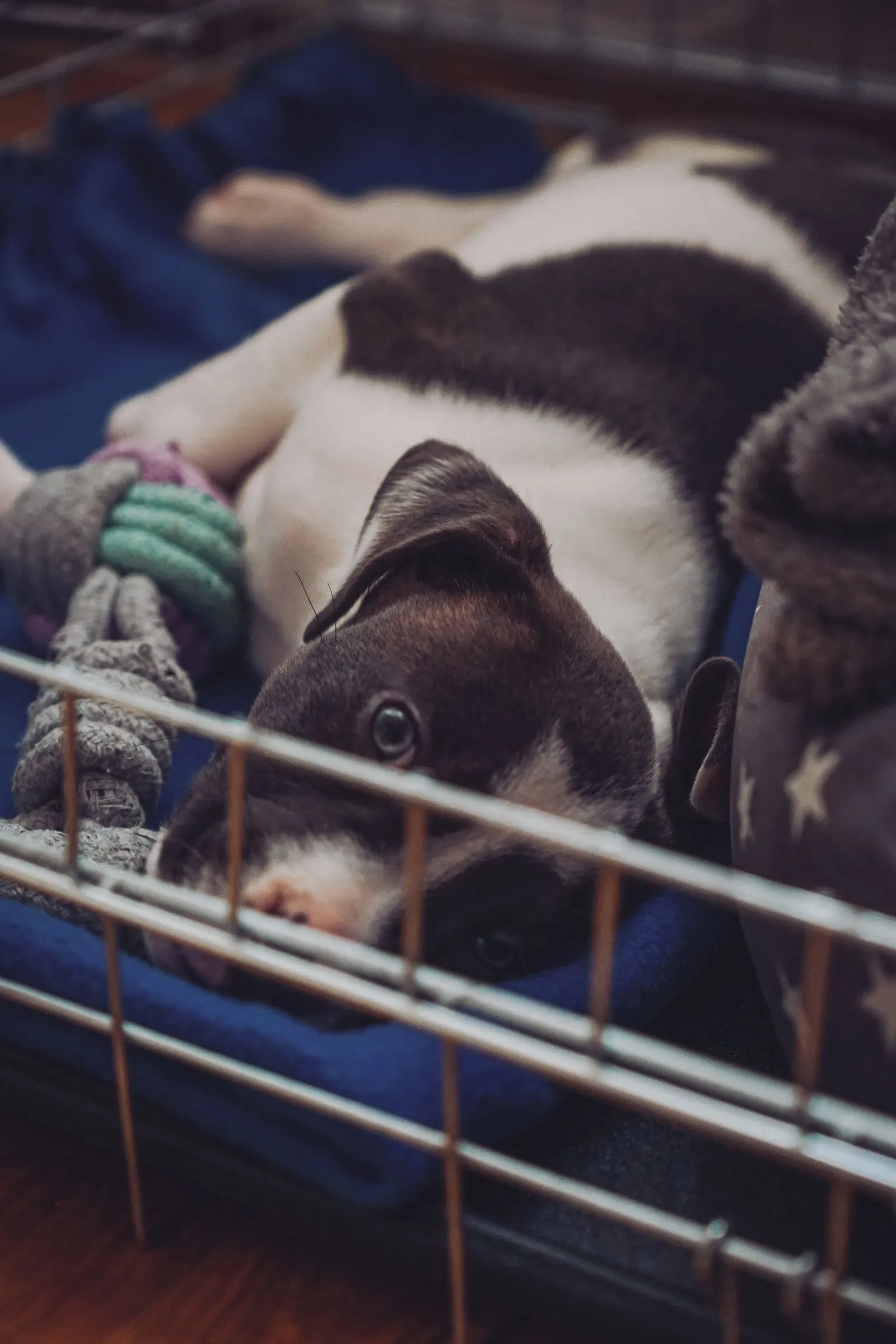
Almost everything that goes wrong with crates comes from introducing the crate and the closed door on the same day. Put an open crate into the puppy area early, with bedding and toys, and leave it there as furniture. Scatter food in it so going in is always the puppy’s own idea, feed meals in it, and make part of every morning and afternoon a nap taken inside it. The association you want is crate equals sleep, not crate equals exclusion.
The crate wants to be large enough for the puppy to stand up, turn around and stretch out, and no larger — one big enough to divide into a bed and a lavatory undoes the work in house-training and daily routines. A wire crate covered on three sides feels more like a den, and it belongs where the household is: a crated puppy still needs attention. A small litter can begin sleeping in crates from around six weeks; with a large one, short crate periods inside the pen do the same job without the space.
The door closes last, for very short periods, after exercise and elimination, and opens again before the puppy becomes distressed rather than after. Breeder-facing guidance is clear that puppies should not be left to cry it out — what they learn is that the crate is where nobody comes. Consistent crying means the sessions are too long, not the puppy too soft.
The crate is never a punishment, and the puppy is never pushed in. Most puppies protest briefly at first. A puppy that panics — frantic scratching or chewing at the door, heavy drooling, injuring its mouth or nails, or repeatedly soiling the crate — is not learning to settle. Stop closing the door, go back to the open-door stage, and talk to your veterinarian or a veterinary behaviorist.
The first car journeys
Consider what the standard first journey consists of. The puppy is taken from its litter, put in a crate it may not know, in a vehicle it has never been in, with a person it met once, for between twenty minutes and four hours, often shortly after eating. Many such journeys end in vomiting, and a puppy sick on its first three trips can take a long time to stop expecting to. There is a physiological reason the young travel badly: the parts of the inner ear involved in balance are not yet fully developed, and many dogs outgrow motion sickness by around a year old. Short is the variable that matters most.
A sensible progression costs very little. Carry the puppy to the car, sit in it with the engine off, feed it something, come back in. Next time, engine running, still stationary. Then to the end of the road and back, then five minutes. Travel on an empty stomach, in a secured crate rather than loose or on a lap. As a practical suggestion, two or three of these in the final two weeks change the category of experience the drive home falls into — and the trip for the pre-sale check and microchipping can double as one, provided the journey stays calm.
Every journey, however short, should have the puppy secured in a ventilated crate or carrier that is fastened in place. A loose puppy can be thrown forward under braking or injured by an airbag. Never leave a puppy alone in a parked car: the inside of a car can warm by nearly 20 °F (about 11 °C) in ten minutes, even on a mild day, and opening the windows a little makes little difference.
Signs of motion sickness include whining, pacing, drooling, lip licking, yawning, dullness and vomiting. If a puppy is sick on practice trips, go back a step and keep trips shorter. If it continues, talk to your veterinarian before the puppy leaves — some travel medications need to be started in advance, and none should be given without veterinary advice.
In practice
A breeder introduces crates from six weeks and the puppies nap in them happily, but the crates have never left the puppy room. On collection day two of the litter are sick within ten minutes and one screams most of the way. The next litter gets four two-minute drives in the final two weeks, in the crates they already sleep in — and the crate becomes the one thing that stays constant while everything else changes.
(Illustrative, composite scenario.)
What you hand over, and what you do not
None of this is finished when the puppy leaves. You can honestly say that it has slept in a crate, been briefly alone many times without anything bad happening, and traveled by car three or four times without incident. You cannot say it will be relaxed about being left: that depends on the next few months in the buyer’s house rather than the last few weeks in yours.
So make the handover specific. Name the crate the puppy knows and suggest the same kind. Give them the bladder arithmetic, so the first week’s crate times are set by physiology rather than by the working day. Suggest the crate goes in the bedroom for the first nights, and say plainly that separations at home should start at minutes rather than hours — the same exercise, continued. That continuity is the real product of this work, and it belongs in the guidance that goes home alongside early learning and a puppy’s first training.
Talk to your vet when planning: ask before giving any travel or calming medication or supplement, and ask about motion sickness if a puppy still vomits on car trips after short practice.
Work on it
A few minutes here will teach you more than re-reading the article.
Ask yourself
- Has every puppy in this litter been genuinely alone, away from littermates, on more than a handful of occasions?
- Is my crate introduction open-door and food-based, or does it begin with a closed door?
- Will the drive to the new home be each puppy’s first car journey, or its fourth?
Find out & check
- Ask your veterinary practice whether the pre-sale visit can be scheduled so the journey is short and the wait in a busy room is not.
Do one thing
- Take one puppy to another room for two minutes today, and note how it behaves when it comes back.
Was this article helpful?
Anonymous. We do not store your name, email or IP address.
Sources & further reading
- American Kennel Club — Setting Puppies up for Success: Beginning Crate Training. akc.org
- VCA Animal Hospitals — How to Crate Train Your Dog. vcahospitals.com
- VCA Animal Hospitals — Motion Sickness in Dogs. vcahospitals.com
- UC Davis School of Veterinary Medicine — Crate Training Your Puppy. vetmed.ucdavis.edu
- American Veterinary Medical Association — Pets in vehicles. avma.org
- American Veterinary Society of Animal Behavior — Position Statement on Puppy Socialization. avsab.org
- University of Bristol Veterinary School, Behaviour Clinic — Separation related behaviours. bristol.ac.uk
- Royal Veterinary College — Dale FC, Casey RA, Burn CC — study on easing puppy separation stress, Journal of Veterinary Behavior, 2026. rvc.ac.uk
Where evidence is limited, recommendations rest on established practice and expert judgment, and may be updated as knowledge develops.
Next steps
- Read next: Enrichment and environmental design.
- Related: House-training and daily routines.
- Return to the area hub: Behavior and development.
- Also: Flying dogs and puppies: the IATA crate rules (CR82).