Enrichment is usually sold as a box of objects, when what actually shapes a litter is the design of the environment around them — what is in it, how often that changes, how much of it the puppies get to solve, and how much of the day is left completely undisturbed.
The most important first
- Dogs show intense but short-lived interest in novel objects, so novelty must be rotated rather than accumulated: six toys left out permanently stop being enrichment.
- Varied surfaces and things that move underfoot — turf, metal, matting, mulch, wobble boards — build body awareness in a way a flat floor cannot.
- Food-based problem solving turns a meal into occupation; the target is difficulty the puppy can solve, not difficulty that defeats it.
- Enrichment must never be frightening. An item that scares a puppy has done developmental harm, not good.
- Sleep is part of the design, not an interruption of it: young puppies sleep for a large part of the day, and long, undisturbed rest matters more than any exact number of hours. The physical setup is covered in the puppy environment.
Enrichment is a schedule, not a shelf
The commonest mistake is treating enrichment as a purchase. Buy the toys, put them in the pen, job done — and three days later the puppies ignore them. That is habituation rather than indifference, and it is what the research on kenneled dogs predicts: dogs are strongly neophilic about objects, and the interest is transient. The functional unit of enrichment is therefore not the object but the change.
So build a rotation. Divide what you have into three or four sets, put out one at a time, swap every few days, and add genuinely new items periodically rather than continuously. Rotate social contact and activities on the same principle — different people, rooms and times of day — as part of the wider plan in habituation and environmental exposure. As an example, a litter that meets four new things a week for five weeks has had far more enrichment than one given twenty things at once in week one.
The other half of the discipline is watching. Purdue’s welfare guidance puts it plainly: monitor how behavior changes when you add a type of enrichment, and if the puppies are frightened of it or bored by it, change it. That is a two-minute observation, and it separates enrichment you perform from enrichment you adjust.
Surfaces, levels and things that move
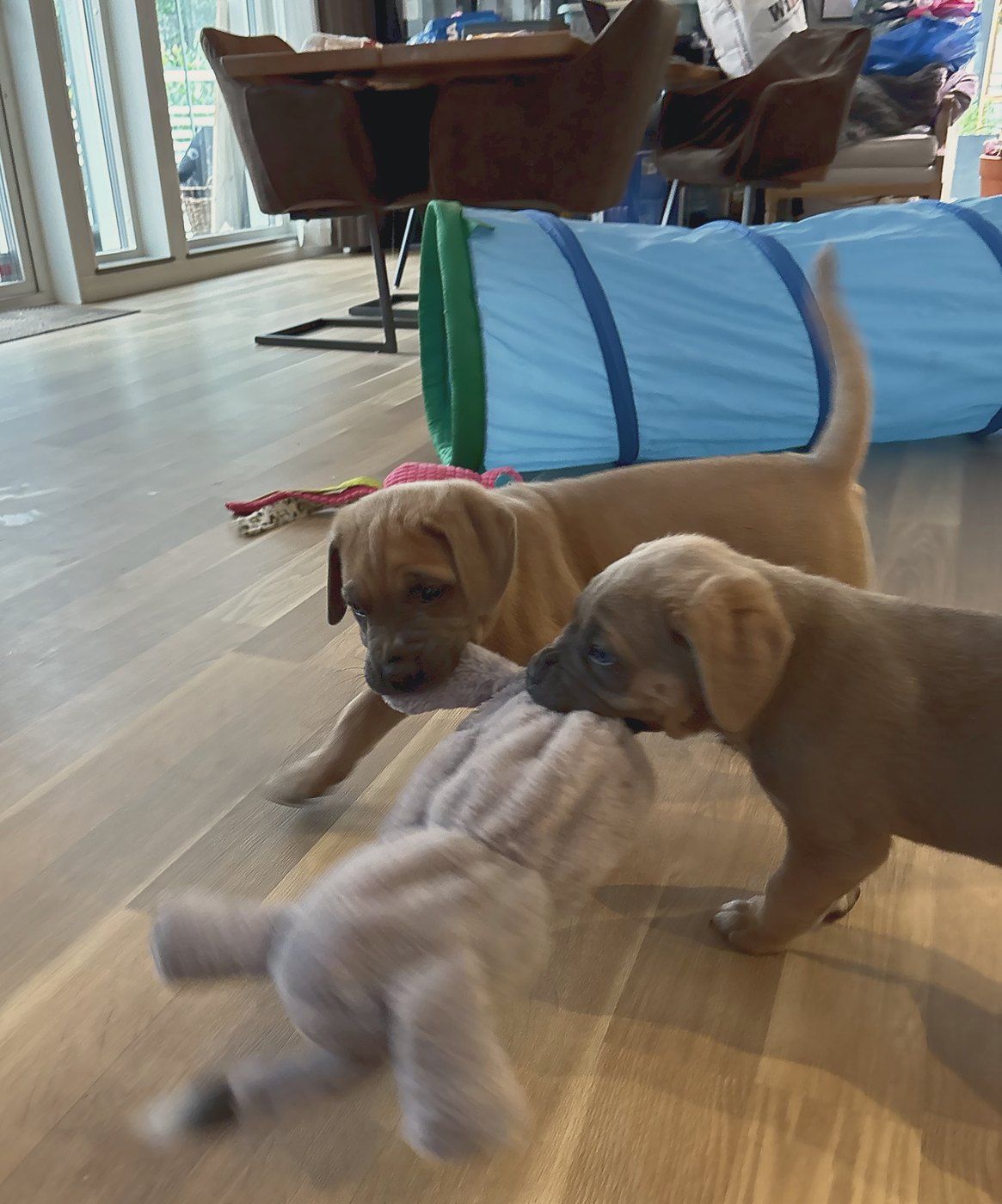
A puppy raised on one flat floor has practiced one thing. Give the pen more than one texture underfoot — artificial turf, metal, rubber matting, bark in a tray, something that crackles — and each becomes a small novel experience and a preparation for a world made of pavements, gratings, vinyl and gravel.
Levels and instability do a different job. A low platform, a ramp, a cushion that gives way, a wobble board: these ask the puppy to work out where its own limbs are. Breeder-facing guidance recommends exactly this kind of moving obstacle for body awareness, and it dovetails with the self-directed play in age-appropriate activity and exercise — the puppy sets the difficulty by choosing whether to get on.
Timing matters more than inventory. Positive experience with new things before wariness of new things typically increases — often cited as around eight to nine weeks, though timing varies by breed and individual — is what builds tolerance for what it meets later — which argues for starting in week four with small, low-stakes novelty rather than introducing everything at once in week seven. What to do when a puppy is frightened anyway belongs to fear, recovery and building resilience.
Safe enough to chew
Assume every object will be chewed and some of it swallowed. Avoid items with string, ribbon, loose fabric, stuffing or small parts; check toys daily and remove anything torn or cracked; and supervise anything you would not want inside a puppy. A puppy that vomits repeatedly, stops eating, has a tender belly or becomes dull after chewing something needs a veterinarian the same day — intestinal blockage is an emergency.
Working for food
Food is the most reliable enrichment there is, because a puppy is motivated by it several times a day whether or not it is in the mood for a toy. Once the litter is eating solids, part of a meal can be delivered through something that has to be solved: scattered in a snuffle mat or a tray of shredded paper, hidden in an egg box, wrapped in a rolled towel, or in a simple puzzle feeder. The shift is from food that appears to food that is found, and it recruits the nose.
Two cautions. The first is calibration: a puzzle a five-week-old puppy cannot solve teaches it that effort does not pay, the opposite of what you want from frustration tolerance and problem-solving. Start below the litter’s ability and make it harder as they succeed. If a puppy walks away from a puzzle, or starts biting and barking at it, it is too hard — make it easier straight away. The second is competition — a whole litter round one feeder is not enrichment, it is a resource dispute. Several stations, or one puppy at a time, keeps the exercise about the problem rather than the littermates. Food used this way comes out of the day’s rations rather than on top of them, for the reasons in feeding the growing litter.
In practice
A breeder builds an elaborate puppy playroom — tunnels, sound recordings, a ball pit, new visitors most days — and is surprised that the litter is jumpy and slow to settle at seven weeks. Cutting back to one new element a day, moving the rest into a rotation and blocking out two undisturbed sleep periods produces puppies who engage with novelty more, not less. The problem was never how much stimulation was available; it was that nothing in the day had been designed to stop.
(Illustrative, composite scenario.)
Stimulation, overstimulation and the right to sleep
More is not better, and this is where well-intentioned breeders most often go wrong. A puppy that is tired, over-aroused or frightened is not learning what you intended; it is learning that this room is unpredictable. The signs are recognizable once you look for them — puppies that cannot settle, that bite harder and less accurately in play, that ignore food, that cannot disengage from whatever is happening.
The correction is structural rather than a judgment made in the moment. Build the day so enrichment happens in short defined blocks with long gaps between them, and so at least two of those gaps are genuinely undisturbed: no visitors, no handling, no vacuum cleaner, lights down. Young puppies sleep for a large part of the day. Published figures vary widely — the often-quoted 18 to 20 hours is not well supported, and measured totals in older puppies are closer to 11 to 14 hours — but the more useful point is quality: puppies that are woken again and again by noise, visitors or handling tend to be more irritable and harder to settle. So a schedule with people in the puppy room from nine in the morning until nine at night is not offering enough opportunity, however gentle each visit is. It also gives you an answer for buyers who want to visit daily: limiting visits is part of the same plan as the visits, alongside the biosecurity case in infection control and biosecurity for the litter.
Sleepiness is normal; dullness is not. A puppy that is suddenly much sleepier than its littermates, will not play, or is eating less should be checked by your vet.
What transfers to the new home is not an outcome but a puppy that has met novelty and found it manageable. Tell the buyer which surfaces and objects it knows, what it can solve for its food, and that the rotation should continue rather than becoming a permanent basket of toys. A puppy that arrives well enriched and then lives in an unchanging room has not been inoculated against anything.
Work on it
A few minutes here will teach you more than re-reading the article.
Ask yourself
- Are my toys and novel objects on a rotation, or have they been in the pen since week three?
- How many textures and levels can a puppy in my setup actually choose between?
- Are there at least two long blocks in my day when nobody goes into the puppy room?
Find out & check
- Look through your records or photographs from the last litter and work out how many genuinely new things the puppies met each week, and in which weeks.
Do one thing
- Divide your enrichment items into three sets today, put one set out, and put the other two away.
Was this article helpful?
Anonymous. We do not store your name, email or IP address.
Sources & further reading
- Purdue University Center for Animal Welfare Science — Enrichment. caninewelfare.centers.purdue.edu
- American Kennel Club — Setting Puppies Up for Success in New Homes: Early Socialization and Training Tips. akc.org
- VCA Animal Hospitals — Is your puppy sleeping too much?. vcahospitals.com
- American Animal Hospital Association (Trends magazine) — How sleep shapes canine behavior. aaha.org
- Vaterlaws-Whiteside H, Hartmann A — Improving puppy behavior using a new standardized socialization program, Applied Animal Behaviour Science, 2017 (Purdue summary). caninewelfare.centers.purdue.edu
- Morrow M et al. — Breed-dependent differences in the onset of fear-related avoidance behavior in puppies, Journal of Veterinary Behavior, 2015. sciencedirect.com
- Cornell University College of Veterinary Medicine, Riney Canine Health Center — Gastrointestinal foreign body obstruction in dogs. vet.cornell.edu
- VCA Animal Hospitals — Using Predictability, Scheduling, and Enrichment to Train Your Dog. vcahospitals.com
Where evidence is limited, recommendations rest on established practice and expert judgment, and may be updated as knowledge develops.
Next steps
- Read next: Age-appropriate activity and exercise.
- Related: The puppy environment: space, surfaces and setup.
- Return to the area hub: Behavior and development.