Socialization is the one part of a puppy’s development that cannot be rescheduled — the weeks in which a dog learns who belongs in its social world fall largely inside the time it spends with you, and what is not built then must be repaired later, by somebody else.
The most important first
- The sensitive period opens at around three weeks and is largely closed by twelve to sixteen weeks, so much of it happens under your roof.
- Socialization is learning about social partners — people, dogs, other species. Getting used to surfaces, sounds and objects is habituation, a separate process.
- Quality decides the outcome, not volume: exposure without attention to the response can sensitize rather than desensitize, leaving a puppy worse off than one that never met the thing.
- The puppy’s own decision to approach is the signal; a puppy that withdraws needs lower intensity, not more repetitions.
- The vaccination series is unfinished while the window is open; the answer is managed exposure, not a choice — see vaccination and immunity in puppies.
Socialization, and what it is not
Socialization is the process by which a puppy learns how to interact with other dogs, with people and with other animals — who counts as a social partner, and what to expect from one. Getting used to a tiled floor or a washing machine is habituation: learning that a non-social feature of the world is not worth reacting to. The EU Platform on Animal Welfare’s breeder guidance keeps the two apart, and so should your planning. A dog can be thoroughly habituated to traffic and still be frightened of men in hats.
So a plan is built around categories of social partner rather than around outings — adults who differ in age, sex, size, gait and voice; children; people in hats, jackets and uniforms; healthy adult dogs other than the dam; cats and whatever else the breed will live alongside. The EU guidance suggests at least ten different people during the breeder’s weeks, ideally twenty to thirty: a target for variety, not a quota to discharge on one busy Sunday.
The window, and how much of it is yours
Sources put the closing edge differently — three to fourteen weeks in the AVMA’s literature review, three to sixteen in some veterinary sources, “the first three months of life” in AVSAB’s position statement — but agree on the shape: it opens at around three weeks as the senses come fully online and closes gradually rather than slamming shut.
Most puppies leave between eight and ten weeks, so well over half the window has passed before the puppy meets its new owner. AAHA’s life-stage guidelines therefore state plainly that behavioral development begins before arrival in the permanent home — and a survey cited there found only about a third of puppies had been exposed to people and dogs outside the home during the critical window. Fear-related avoidance begins to appear somewhere between about five and ten weeks, earlier in some breeds and individuals than others (in one study, Cavalier King Charles spaniels showed it later than German shepherds and Yorkshire terriers). There is no single fixed “fear period”, but the rise overlaps the weeks many puppies travel, which is a reason to keep collection week calm (see fear, recovery and building resilience).
Quality decides the outcome
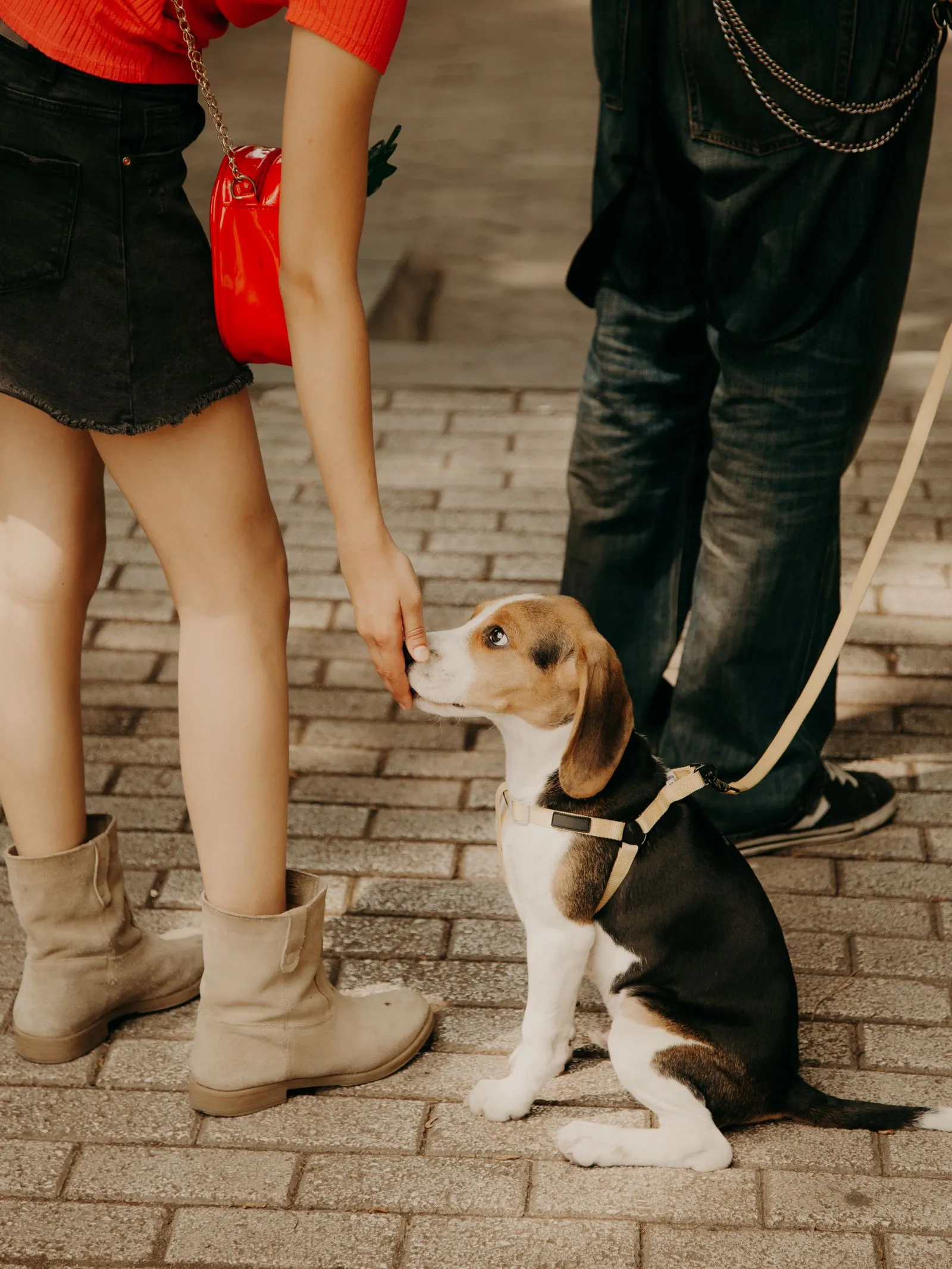
AAHA’s behavior guidance makes the decisive point: exposure without evaluating the puppy’s response may cause sensitization rather than desensitization — the reaction grows with repetition instead of shrinking. Its behavior management guidelines give the rule that follows: a dog beginning to withdraw, or showing outright fear, should not be given more exposure. Counting encounters tells you nothing about which direction a puppy is moving in.
So you work from the puppy’s behavior, not your list. Approach is the signal: let the puppy come forward at its own pace, at an intensity it can recover from within the session. A tucked tail, lip-licking, yawning, trembling or flattened ears are the signs to watch for; the answer to any of them is less distance, duration or company. The cost of getting this wrong is real: a sensitive puppy can be lastingly affected by an unexpected growl or snap from an unfamiliar adult dog, which is why play partners are known, vaccinated adults rather than whoever is available. Record early fear rather than excuse it; AAHA’s 2015 behavior guidelines cite one line of research in which about a tenth of puppies fearful at an eight-week examination were still fearful at eighteen months, and state that animals do not outgrow pathological fear.
In practice
A breeder sets a target of fifty visitors before eight weeks and hits it, logging every one. Two of the puppies do well; a third has started leaving the pen when the doorbell rings and will not take food from strangers, and the log shows it met more people in week seven than either littermate. The breeder moves that puppy to single quiet visitors sitting on the floor with food and no approach, and notes the response each time. The count was never the problem; nobody had been reading it.
(Illustrative, composite scenario.)
Vaccination and socialization are not a choice
The window overlaps the period before the vaccination series is complete, and pretending otherwise helps nobody. AAHA states there is no medical reason to delay puppy classes or social exposure until the series is finished, provided sick animals are avoided and basic hygiene maintained. AVSAB’s position statement (2008) holds that the risk of behavioral problems outweighs the infection risk of well-managed exposure, noting that behavior is the leading cause of relinquishment to shelters and, on its assessment, the number one cause of death in dogs under three years old.
None of that licenses carelessness. Bring the world to the litter rather than the litter to the world: known, healthy visitors who have not been around sick dogs, shelters or shows that day, shoes off and hands washed, as in infection control and biosecurity for the litter. Use vaccinated adult dogs you know, and avoid public grass and parks. AVSAB considers classes reasonable from seven to eight weeks, given one set of vaccines at least seven days beforehand and a first deworming.
The puppy vaccination series is designed to finish at 16 weeks or older, with a further booster at around six months. That means the whole socialization window, with you and in the new home, happens before protection is complete. The evidence that controlled exposure is worth it is reassuring: in one US study, vaccinated puppies attending well-run classes were at no greater risk of parvovirus. The protection comes from the conditions, though: known healthy visitors, clean surfaces and no contact with unknown dogs. If any puppy starts vomiting, has diarrhea, seems lethargic or stops eating, call your veterinarian the same day and stop visitors until you have advice.
Your work, and where it ends
You can influence the starting point: the breadth of experience, its intensity, and whether anyone watched the response. You cannot inoculate a dog against later problems. The AVMA review is explicit that class attendance alone is not sufficient, and AAHA notes that behavioral problems commonly emerge or worsen during social maturity, roughly six months to three years. So the handover must carry the work forward. The EU guidance asks breeders to give new owners the puppy’s socialization plan — what it experienced, how it responded — plus a list of what that individual likes; the socialization checklist is the format.
Reducing exposure is the right first response to a fearful puppy, but it is not always enough. Veterinary guidelines recommend a veterinary behaviorist for aggression toward people or other animals and for profound fears. A puppy that cannot be approached by any stranger, or that snaps when cornered, falls into that group. Raising it with your vet before the puppy leaves gives the new owner a plan instead of a surprise.
Work on it
A few minutes here will teach you more than re-reading the article.
Ask yourself
- Am I recording how each puppy responded, or only that it happened?
- Could I name my most cautious puppy, and say what I changed for it?
- Is my visitor list varied in age, size, voice and appearance?
Find out & check
- Ask your veterinary practice what it advises locally on social exposure before the vaccination series is complete.
Do one thing
- Add a response column to your visitor log and fill it in from memory for the last three visits. Where you cannot, that is the gap.
Was this article helpful?
Anonymous. We do not store your name, email or IP address.
Sources & further reading
- American Veterinary Society of Animal Behavior (AVSAB) — Position Statement on Puppy Socialization (2008). avsab.org
- American Animal Hospital Association (AAHA) — 2019 AAHA Canine Life Stage Guidelines: Behavior. aaha.org
- American Veterinary Medical Association (AVMA) — Literature review: Socialization of puppies and kittens (2024). avma.org
- EU Platform on Animal Welfare — Supplementary guidance for dog breeders on the socialisation of puppies. food.ec.europa.eu
- American Animal Hospital Association (AAHA) — 2015 AAHA Canine and Feline Behavior Management Guidelines. aaha.org
- Stepita, M. E., Bain, M. J. & Kass, P. H., Journal of the American Animal Hospital Association 2013;49(2):95–100 — Frequency of CPV infection in vaccinated puppies that attended puppy socialization classes. jaaha.kglmeridian.com
- World Small Animal Veterinary Association (WSAVA) — 2024 Guidelines for the Vaccination of Dogs and Cats. wsava.org
- Morrow, M. et al., Journal of Veterinary Behavior 2015;10(4):286–294 — Breed-dependent differences in the onset of fear-related avoidance behavior in puppies. pure.psu.edu
Where evidence is limited, recommendations rest on established practice and expert judgment, and may be updated as knowledge develops. Behavioral work with a litter influences a puppy’s starting point; it does not guarantee any individual dog’s adult behavior.
Next steps
- Read next: Socialization checklist.
- Related: Habituation and environmental exposure.
- Return to the area hub: Behavior and development.